22 June 2018

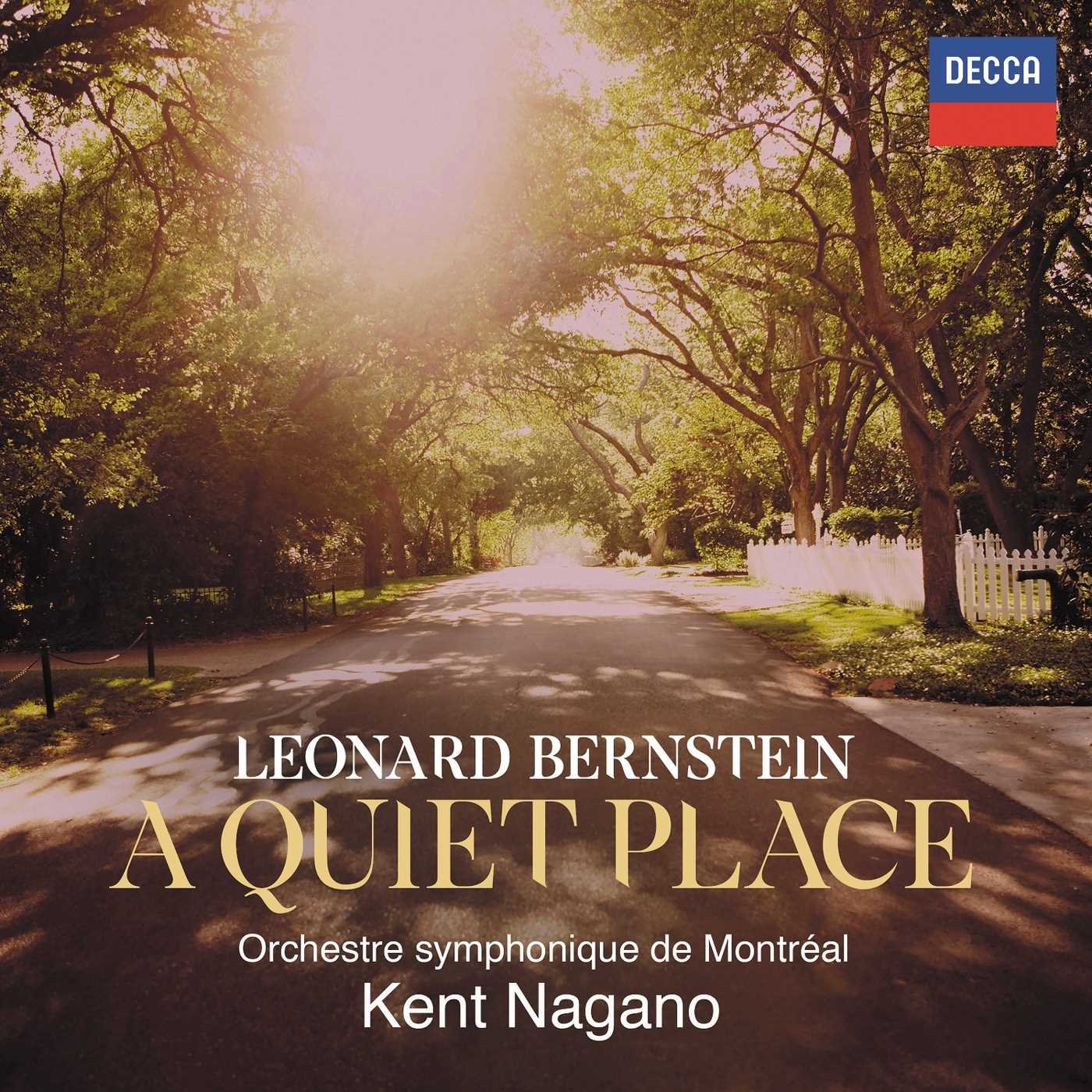
CD REVIEW: Leonard Bernstein — A QUIET PLACE (C. Boyle, J. Kaiser, G. Bintner, L. Meachem, R. Charlesworth, D. Belcher, A. Rosen, S. Humes, M. Skille, J. Tessier; DECCA 483 3895)

IN REVIEW: Leonard Bernstein - A QUIET PLACE (DECCA 483 3895)LEONARD BERNSTEIN (1918 – 1990): A Quiet Place [Edition by Garth Edwin Sunderland]—Claudia Boyle (Dede), Joseph Kaiser (François), Gordon Bintner (Junior), Lucas Meachem (Sam), Rupert Charlesworth (Funeral Director), Daniel Belcher (Bill), Annie Rosen (Susie), Steven Humes (Doc), Maija Skille (Mrs. Doc), and John Tessier (Analyst); Chœur et Orchestre symphonique de Montréal; Kent Nagano, conductor [Recorded in Maison symphonique de Montréal, Montréal, Québec, Canada, 17 – 19 May 2017; DECCA 483 3895; 2 CDs, 93:05; Available from Amazon (USA), iTunes, jpc (Germany), Presto Classical (UK), and major music retailers; WORLD PREMIÈRE RECORDING OF SUNDERLAND’S EDITION]

The roads leading to the world’s important opera houses are strewn with the carcasses of musical vehicles scuttled before they reached their destinations, parts tried and discarded in the process of revising scores, and the abandoned ambitions of works that never realized their potential. Even among pieces that found success, there are plethoras of questions with no definitive answers. Should a mezzo-soprano or a tenor Idamante be preferred in Mozart’s Idomeneo? Should Bizet’s Carmen be performed with spoken dialogue or sung recitatives? Should Verdi’s Don Carlos be sung in four or five acts; and in French or Italian? Is Gershwin’s Porgy and Bess more at home in a Broadway theatre or an opera house? Now, nearly two decades after his death, how is Leonard Bernstein’s legacy as an operatic innovator fairly assessed?

Since its inception, qualms about the work’s theatrical viability have largely banished Leonard Bernstein’s opera A Quiet Place to the pages of academic studies of the composer’s œuvre, the few productions that the score has received in the thirty-five years since the première of its original form having mostly failed to meet the opera’s goals of further examining and refining the themes addressed in Bernstein’s 1952 opera Trouble in Tahiti. In the earlier work, audiences met Dinah and Sam, a couple bound in a complicated marriage that produced a son who was more a possession to be inventoried than a tangible manifestation of love. Integrating Trouble in Tahiti into its second act as a series of reminiscences, the three-act version of A Quiet Place that Bernstein conducted at the Wiener Staatsoper in 1986, pacing performances that were recorded by Deutsche Grammophon, opens with the aftermath of Dinah’s death in a car accident. The tyke in Trouble in Tahiti, Junior, was joined in the time between the operas by a sister, Dede, whose husband François was previously Junior’s lover. Each member of the family loves and is loved but has never learned to express feelings more intimate than frustration. Perhaps this is the crux of the opera’s difficulties: how can a composer who made lines as seemingly banal as ‘Gee, Officer Krupke’ not only integral to a piece’s dramatic continuity but also an indelible episode in American musical history effectively convey the sometime futility of words?

That he returned after an absence of thirty years to the dysfunctional family at the core of Trouble in Tahiti indicates that these people and their mostly self-inflicted struggles clearly captivated Bernstein. First devised by the composer and his chosen librettist, Stephen Wadsworth, in a single, two-hour act, A Quiet Place was a departure from the charm and romance of West Side Story and Candide. Considerably more convoluted than the straightforward love against the odds of West Side Story’s María and Tony, the relationships at the heart of A Quiet Place triggered profound responses from both composer and librettist, described in detail in Wadsworth’s insightful liner notes for the Deutsche Grammophon recording.

...we discovered a coincidence of need - to write about loss, grief, family mourning, and coming through tragedy together. Lenny had lost his wife, Felicia, only two years before, to cancer. I had lost my sister Nina only one year before, in a car crash. These things weighed heavily on our souls.
It is gross exaggeration to assert that the incarnation of A Quiet Place performed in Vienna in 1986 and recorded by DGG attempted to conflate the intimacy of Idomeneo with the grandeur of Götterdämmerung, but there is a certain legitimacy in the gist of the hyperbole: the impact of the stark simplicity of the distinctly American family dynamic that is the lifeblood of A Quiet Place was diminished by the necessity of matching the drama with music of auditorium-filling dimensions.

Recorded with exceptional sonic clarity in Maison symphonique de Montréal, this DECCA recording of A Quiet Place utilizes an arrangement of the score prepared by The Leonard Bernstein Office Vice President for Creative Projects Garth Edwin Sunderland, first performed in Konzerthaus Berlin in 2013 under the direction of Kent Nagano, whose conducting is a vital component of the success of this performance. Engendered by career-long acquaintance with the composer’s work, as well as his mastery of a related piece like Poulenc’s Dialogues des Carmélites, with which A Quiet Place shares an emphasis on the Existential implications of interpersonal relationships, Nagano’s informed handling of Bernstein’s music lends Sunderland’s arrangement of A Quiet Place an aura of authority. Bernstein possessed one of the Twentieth Century’s best-trained ears for reimagining orchestral colors and textures, and Nagano’s management of the intricately-constructed tonal strands, spellbindingly executed by Orchestre symphonique de Montréal, unearths and enlivens the wealths of musical ingenuity and emotional power that the score wielded from the start of Bernstein’s and Wadsworth’s operatic alliance.

Reduced from the 150 minutes heard in Vienna in 1986 to ninety-three minutes, principally by excising flashbacks of Trouble in Tahiti from Act Two, the opera here moves at a fast pace that suits the episodic nature of the drama. Paralleling the work of their orchestral counterparts, the expert singing of Chœur symphonique de Montréal combines close adherence to the score’s pitches and rhythms with convincing conversational immediacy. The communicative effectiveness of Bernstein’s writing for groups of voices is enhanced by Sunderland’s treatment of the intersections among instruments and voices, and Nagano’s conducting spotlights subtleties always present in the opera but less evident in previous performances.

In the orchestral Postlude that ends Act One of A Quiet Place, Bernstein unleashed a torrent of the destructive but liberating familial angst that permeates Mozart’s Idomeneo, Verdi’s Rigoletto, and Wagner’s Die Walküre, and Nagano fully capitalizes on the music’s innate poignancy. Lyrical passages emerge from the manic pages of the score like lulls in storms of grief, given space in which to develop organically. A Quiet Place was unquestionably a masterful work at its 1983 première, and Sunderland’s intelligent restructuring of its words and music make it more accessible. With this performance, Nagano confirms that A Quiet Place is one of the most beautiful, unique, and moving operas of the Twentieth Century.

During his career, Bernstein was fortunate—far more fortunate than many of his contemporaries in musical theatre and opera—to enjoy collaborations with artists who understood, respected, and shared his ideals. Supporting rôles in this performance of A Quiet Place are brought to life by singers who exhibit qualities similar to those that defined the work of vocalists with whom Bernstein worked closely. Tenor John Tessier’s bel canto credentials might seem an over-qualification for the Analyst’s music in A Quiet Place, but his proper placement of vowels, rhythmic precision, and intonational accuracy are as welcome in Bernstein’s vocal lines as in Bellini’s. Similarly, the techniques of bass Steven Humes and mezzo-soprano Maija Skille are deployed with style and sensitivity in their portrayals of Doc and Mrs. Doc. The vocal acting of intrepid mezzo-soprano Annie Rosen amplifies the importance of Susie’s every word and note, lending the character added substance. Baritone Daniel Belcher’s Bill is also a fully-characterized depiction, sung with burnished tone and verbal lucidity. The Funeral Director receives from tenor Rupert Charlesworth a performance that gives the character unexpected dimensions of credibility and empathy. Each of these singers devotes to Bernstein’s music the vocal charisma and emotional honesty that it deserves.

The voice of tenor Joseph Kaiser is an instrument of finer quality than any listener might ever have hoped to hear in Bernstein’s music for François, the unknown variable of sorts in A Quiet Place’s family equation. First Junior’s lover and then Dede’s husband, François is the outsider who, despite his close involvement in their affairs, is able to discern the family’s shortcomings. Casting Kaiser in the rôle astutely intensifies the contrasts among François and both Junior and Sam, his higher, leaner timbre sounding almost fragile in comparison with the voices of his in-laws. In his every utterance in Act One, Kaiser is anything but feeble, however, his agile, attractive voice dominating the angular writing with ease except at the extreme top of the range, where effort is audible. Those hints of effort are put to apt dramatic use: like the family into which he inserted himself, François falls victim to his own insecurities, portrayed by Kaiser with touching verisimilitude. This is implicitly evoked in François’s Act Two aria ‘I’ve been afraid,’ passionately sung by Kaiser as a genuinely self-searching expression of endearment.

The tenderness that often glows in Kaiser’s vocalism calms the tempestuous egos that explode in the opera’s charged atmosphere. There is an alluring Mozartian fluidity in his account of the Act Three aria ‘Dear Loved Ones,’ the reading of Dinah’s suicide note that was originally assigned to Junior and is here the song of a Twentieth-Century Idamante brokering a delicate peace. Fulfilling his destiny as the catalyst for reconciliation and healing, Kaiser’s François launches his aria ‘Stop! You will not take another step!’ with the conviction of exasperation, but the sense that he is at last being heard softens the steel of his delivery. As the shared lover of troubled siblings, François is a character who can seem calculating and opportunistic, but, singing with gleaming tone and sincerity, Kaiser infuses François with nobility that figuratively provides the quiet place in which the drama achieves resolution.

It is not difficult to imagine Kaiser’s thoughtful François having been infatuated with the Junior of bass-baritone Gordon Bintner. Even when careening towards psychiatric cataclysm, this Junior is mesmerizing and, more consequentially, obviously redeemable. There is no denying that the Junior who bursts into Act One with the vehemence of a rabid animal exhibits few signs of reclaimable sanity, but Bintner evokes sympathy for the errant son by voicing his lines with a pervasive suggestion of inevitability, demonstrating that Junior’s rants are symptoms of illness, not true depravity. In the disturbing scene in which Junior disrupts his mother’s funeral with a shocking strip tease, Bintner adopts a garish but pitiable manner that suits the frenzied music and further exposes the fractures in the man’s mental state. By casting a singer with a strong, sinuous voice as Junior, his kinship with Sam is rendered both more believable and more meaningful.

The pathetic state of Junior’s mental health becomes sickeningly apparent in the vaudevillian scene in Act Two in which he invents a harrowing tale of an incestuous youthful relationship with Dede, mercilessly taunting François and goading his family to conflict. Bintner traverses this jazz-tinged music with flamboyance, purring his untoward accusations with something of Chet Baker’s sangfroid. None of the vocal effects that Bintner employs for dramatic variety distorts the singer’s pitch, but his characterization is immeasurably enriched: like Kaiser’s François, Bintner’s Junior, engrossingly sung, is an atypically plausible persona. Spanning the psychological metamorphoses of Act Three with acuity that culminates in a commanding performance of the aria ‘You see, Daddy, that death does bring some relief,’ Bintner persuasively evinces Junior’s ultimate transformation from bitter man mired in childhood inhibitions to better man on the path to recovery.

Building upon her colleagues’ erudite embodiments of their parts, soprano Claudia Boyle uplifts this performance of A Quiet Place with a portrayal of Dede that is capably sung—no small feat—and refreshingly free of cliché. The wide intervals and placement of tones without facile approach demanded by Dede’s music, much of which prefigures very different but equally difficult rôles like Ariel in Thomas Adès’s The Tempest and Pip in Jake Heggie’s Moby-Dick, are unflappably supplied by Boyle. Her voice soars above the stave, but she also negotiates tricky passages in the lower octave with aplomb. Boyle voices Dede’s Act One arietta ‘Fantastic, great!’ with a piercing irony that is unmistakably limned by the slightly acidic edge with which she projects her tones. Dede plays the rôle of the more stable of Sam’s children (and François’s partners), but she is not without idiosyncrasies and indiscretions. Still, Boyle never allows the young woman’s flaws to obscure her basic humanity, her vocalism as reassuringly lovely when the text is thorny as when her words are comforting.

The trio with Junior and François and the scene in Act Two in which Dede at least momentarily connects with her father whilst donning one of Dinah’s dresses are pinnacles in Boyle’s performance, her voice arrayed in primary colors for the confrontational sparring and in pastel hues for intermittent tranquility. Occasional shrillness, dramatically appropriate, illustrates Dede’s awkwardness, especially in exchanges with François. The ambivalence of Sam’s and Dinah’s marriage is echoed in Dede’s relationship with François, and Boyle affectingly articulates her character’s indecision. The soprano sings the Act Three aria ‘Morning’ incisively, the text garnering as much attention as the music. Dede can be portrayed as a petulant shrew, but Boyle tames her, seizing each of the score’s inherent opportunities to chart the progress of her emotional evolution.

The husband and father at the center of the opera’s drama is portrayed in this performance with a myriad of temperamental contradictions by granite-voiced baritone Lucas Meachem. The first impression made by his Sam is one of unstinting strength, the core of iron in his singing introducing an element of stereotypical machismo into his depiction of the stern father. Meachem quickly divulges that Sam’s bravado is a coping mechanism that masks a vulnerability that is exacerbated by the father’s damaged relationships with his children. The character’s gruff exterior crumbles when platitudes are not adequate to express his feelings, and the baritone’s singing is most memorable when Sam’s hopelessness is most exposed. Throughout Act One, Meachem alternates boldly handsome singing with vocalism of unnerving sweetness, his account of the aria ‘You’re late’ a manifestation of Sam’s inability to grant his children access to his innermost emotions.

Grappling with the anger, denial, and uncomfortable truths forced to the surface by Dinah’s death, Sam begins Act Two with the aria ‘I wish I could sleep,’ delivered by Meachem with a wide spectrum of vocal colors ranging from darkest despair to glowing embers of self-recrimination. Here and elsewhere in this performance, the world-weariness of Meachem’s singing unveils a link between the small-scaled situations of A Quiet Place and the macrocosms of Wagner’s Ring. Singing with galvanizing resolve, Meachem reveals in Sam a suburban Wotan, his Fricka gone but still omnipresent and his children, not unlike Sieglinde and Siegmund, embroiled in futile combat against fate. In Meachem’s performance, Sam’s aria in Act Three, ‘Oh, François, please,’ is an outcry of desperation. Freud would likely theorize that, as an amorous partner for Dede and Junior, François is a stand-in for Sam, a father figure with whom they share a long-desired affection. In the wake of François’s rebuke and cathartic destruction of Dinah’s letter, the humility with which Meachem’s Sam welcomes François to the family proposes that he accepts and embraces his son-in-law as an equal. Though not every man can aspire to sing as Meachem does, his Sam is an Everyman, complicated in his simplicity and finally strongest when admitting his weaknesses.

Opera is an art that thrives on second chances. Many are the works that overcame unpromising and in some instances utterly disastrous premières to claim eventual success. Nonetheless, how many neglected honorable failures are there for every Carmen, and how many of those honorable failures might prove to be stage-worthy under the right circumstances? In terms of the consistent quality of Leonard Bernstein’s music, the very busy conducting schedule that undoubtedly deprived the public of works that never came to fruition was perhaps advantageous. It can be truthfully if not charitably said of some composers that their least-inspired music is good and their best work not markedly better, but Bernstein had little time for mediocrity. Artistically, A Quiet Place was never a failure, but, as the opera’s protagonists discover, redemption often requires compromise and cooperation. In this performance of A Quiet Place, all of the circumstances are right, and Bernstein’s final work for the operatic stage makes its second chance a triumph.

12 June 2018

June 2018 RECORDING OF THE MONTH: COME TO ME IN MY DREAMS – 120 Years of Song from the Royal College of Music (Dame Sarah Connolly, mezzo-soprano; Joseph Middleton, piano; Chandos CHAN 10944)

June 2018 RECORDING OF THE MONTH: COME TO ME IN MY DREAMS - 120 Years of Song from the Royal College of Music (Chandos CHAN 10944)FRANK BRIDGE (1879 – 1941), BENJAMIN BRITTEN (1913 – 1976), REBECCA CLARKE (1886 – 1979), THOMAS FREDERICK DUNHILL (1877 – 1946), CECIL ARMSTRONG GIBBS (1889 – 1960), IVOR GURNEY (1890 – 1937), MURIEL HERBERT (1897 – 1984), GUSTAV HOLST (1874 – 1934), HERBERT HOWELLS (1892 – 1983), JOHN IRELAND (1879 – 1962), ERNEST JOHN MOERAN (1894 – 1950), SIR CHARLES HUBERT HASTINGS PARRY (1848 – 1918), SIR ARTHUR SOMERVELL (1863 – 1937), SIR CHARLES VILLIERS STANFORD (1852 – 1924), SIR MICHAEL TIPPETT (1905 – 1998), and MARK-ANTHONY TURANGE (born 1960): Come to Me in My Dreams – 120 Years of Song from the Royal College of Music—Dame Sarah Connolly, mezzo-soprano; Joseph Middleton, piano [Recorded in Potton Hall, Dunwich, Suffolk, UK, on 22, 23, and 25 September 2017, and 7 April 2018; Chandos CHAN 10944; 1 CD, 77:18; Available from Chandos, Naxos Direct, Amazon (USA), jpc (Germany), Presto Classical (UK), and major music retailers]

Eulogizing his brother Robert in 1968, Senator Edward Kennedy spoke of the slain man’s penchant for first perceiving his world’s wrongs and then toiling to right them. A century before an assassin’s bullet ended the life of Robert Kennedy, another man of vision perceived a need and sought to fill it. In many ways a stranger in his adopted country and never allowed to forget it, Queen Victoria’s consort Prince Albert of Saxe-Coburg and Gotha nonetheless observed aspects of British society with rare perceptiveness and clarity. A Continental man exposed in his youth to Europe’s great cultural consortia, he recognized in music-loving Britain a lamentable lack of rigorous, state-supported tuition for aspiring professional musicians. In the months prior to his untimely death in 1861, the Prince Consort advocated the establishment of a national academy dedicated to the training of musicians, an initiative that came to fruition, albeit ineffectually, more than a decade later. Under the guidance of Sir George Grove and the patronage of Albert’s son, the eventual King Edward VII, the school that arose from Albert’s endeavors evolved into the Royal College of Music, which in 1883 admitted its first ninety-two scholars.

The first fourteen decades of RCM’s history have been guided by the leadership of ten directors, amongst whose ranks are esteemed musicians including Grove, Sir Hubert Parry, Sir George Dyson, Sir David Willcocks, and the present director, Colin Lawson. Even more awe-inspiring than surveying the accomplishments of this decury of directors is contemplating the voices that have echoed in RCM’s South Kensington corridors, both literally and figuratively. Reverberating in that storied space, the formative sounds of some of Britain’s greatest compositional talents forever qualify RCM as a shrine to the Art of Song. It is this legacy of nurturing the continuing vitality of English Song that this Chandos release celebrates by presenting works by some of the institution’s most distinguished alumni and faculty.

Spanning 120 years of repertory yielded by RCM’s commitment to educating and encouraging composers, Come to Me in My Dreams partners two of Britain’s most gifted interpreters of Art Songs, mezzo-soprano Dame Sarah Connolly and pianist Joseph Middleton, in performances that are as emotionally engaging as they are stylistically varied. From the lush late Romanticism of the College’s early years to the stark sounds of more recent decades, the music on this disc tunefully appraises RCM’s influence on more than a century of Britain’s musical life. Here singing with exemplary but unpretentious diction and impeccable musicality, Connolly could frankly make a musical history of pickling in the home counties compelling. Performing a programme of Art Songs that might have been composed specially for her, she honors RCM with a recital that rivals the finest Lieder recordings in the discography.

Whether lamenting man’s inconstancy as Purcell’s Dido or communicating the grim forebodings of Wagner’s Brangäne and Fricka, Connolly’s voice is a richly-textured instrument in which subtlety and sublimity meld organically with splendor and majesty. Aspects of her performances evoke memories of the work of some of her most venerable fellow interpreters of repertory in English: Helen Watts’s straightforwardness, Dame Janet Baker’s stylistic versatility, Rosina Raisbeck’s innate theatricality, and Jan DeGaetani’s verbal flair, for example. In the context of the selections on Come to Me in My Dreams, however, Connolly’s singing brings to mind the performances of none of her operatically-inclined colleagues as vividly as it recalls the vocalism of Lancashire-born popular singer Cilla Black. Like Black at her best, Connolly wields a sensitive but stern femininity that is used as neither an excuse nor a weapon. Reinforced by the probing lucidity of Middleton’s pianism, the mezzo-soprano’s singing on this disc is wonderfully robust, prissing and purring altogether banned from her musical demeanor. In Connolly’s and Middleton’s handling, the merits of the music on Come to Me in My Dreams are revealed to be gratifyingly consistent: commendably little disparity in quality separates the most familiar songs from their least-known comrades.

The musical odyssey of Come to Me in My Dreams begins with Muriel Herbert’s ‘The Lost Nightingale,’ here performed by both voice and piano with none of the artifice that can ruin even well-sung performances of this expertly-crafted piece. Interpreted by Connolly and Middleton with disarming simplicity, John Ireland’s ‘Earth’s Call’ is legitimately a ‘sylvan rhapsody,’ the singer’s delivery of the vocal line emerging from the accompaniment with the brilliance of rays of sunlight penetrating a forest canopy. Ireland’s ‘The Three Ravens’ is also given a reading of poetic savvy. ‘The Cloths of Heaven’ from Thomas Frederick Dunhill’s The Wind among the Reeds should be in the repertory of every singer capable of performing it with the sentimental sincerity and glamorous tone with which Connolly limns its eloquent melody. All of Herbert Howells’s music also deserves to be performed more frequently, but Connolly and Middleton make an especially strong case for greater exposure for ‘Goddess of Night.’ The hauntingly perceptive use of text that Howells cultivated in his English-language Requiem, Hymnus Paradisi and the motet Take Him, Earth, For Cherishing is evident throughout the two minutes of ‘Goddess of Night,’ heightened in this performance by the singer’s nuanced but natural enunciation of the vowels that drive the music.

Frank Bridge’s studies at RCM bestrode the turn of the Twentieth Century, and his music linked the past of Beethoven, Brahms, and Tchaikovsky with the future of Rubbra, Britten, and Tippett. Like many of his confederates in what Howells described as the ‘cosy family’ of RCM, song often provided Bridge with respites from the horrors of the Great War and professional frustrations. Bridge’s ‘Where she lies asleep’ and ‘Come to me in my dreams’ offer the listener solace, too, the atmosphere of each song awakened in the hearer’s imagination by Connolly’s and Middleton’s vivid musical colloquy. The composer’s setting of Humbert Wolfe’s ‘Journey’s End’ is a harrowing acceptance of finality made piercingly personal by the effortless candor of the performance on this disc. Gustav Holst’s rendering of ‘Journey’s End,’ the ninth of the twelve songs that constitute his Opus 48 (H 174), is marginally lighter in mood but no less moving than Bridge’s song. Middleton plays Holst’s music adroitly, and Connolly’s phrasing highlights the psychological depth of Holst’s reaction to the text.

Among the composers whose music is performed on Come to Me in My Dreams, Benjamin Britten’s name and songs are likely the most familiar to listeners beyond Britain’s borders. Dating from 1947, Britten’s Opus 41 A Charm of Lullabies is hardly the best-known of his song collections, however, and it is heartening to observe that, nearly forty-two years after the composer’s death, there are still worthwhile products of his creativity awaiting widespread discovery. Virtually all of Britten’s songs are tonally ambiguous, some of them deceptively so, but they share a near-obsessive commitment to textual integrity. The words of ‘A Cradle Song’ are articulated as crisply in Britten’s music as in Connolly’s singing. This composer’s writing for the piano seldom follows predictable harmonic paths, but Middleton’s playing, whilst reveling in the music’s ingenuity, divulges the inner logic that is the foundation of each of these songs. He and Connolly perform ‘The Highland Balou’ and ‘Sephestia’s Lullaby’ with the thoughtfully-conceived interaction of chamber musicians, and their traversal of ‘A Charm’ winningly imparts the wry humor of the brusque text. There is a disconcerting ambivalence that defies easy explanation at the heart of ‘The Nurse’s Song,’ not overtly threatening as in ‘A Charm’ but vaguely disquieting, but vocalist and accompanist avoid imposing an interpretive agenda on the song. Here recorded for the first time, Britten’s ‘A Sweet Lullaby’ and ‘Somnus, the humble god,’ both contemporaneous with A Charm of Lullabies, are beguilingly sung, Connolly’s claret-hued timbre bathing the songs in the crepuscular glow that the music invokes.

Its pervasive melancholy transformed into genuine pathos by the emotional honesty of Connolly’s and Middleton’s performance, Sir Arthur Somervell’s ‘Into my heart an air that kills’ from his 1904 adaptation of verses from A. E. Housman’s A Shropshire Lad is unexpectedly one of the most affecting songs in this recital. Likewise, listeners for whom Sir Charles Hubert Hastings Parry’s name summons notions of stodginess may find this performance of ‘Weep you no more, sad fountains,’ one of the six songs in his fourth set of English Lyrics, revelatory. Voice and piano are deployed with keen comprehension of the relationship between words and music. ‘A soft day’ from Sir Charles Villiers Stanford’s A Sheaf of Songs from Leinster (Opus 140) is also sung with assurance, Connolly voicing the line ‘The hills wear a shroud of silver cloud’ with particular radiance.

Cecil Armstrong Gibbs’s 1934 ‘Sailing Homeward’ is another song in which Connolly’s and Middleton’s cooperation produces an ambience of contemplative resignation that lends an aural dimension to this defining niche of the English psyche. The warmth of the mezzo-soprano’s tone as it caresses the strains of E.J. Moeran’s ‘Twilight’ is stimulating, lifting the words off of the page enchantingly. Like many of the pieces on this disc, the songs of Ivor Gurney are too-little-known gems of the repertory, and the three of his songs offered on Come to Me in My Dreams sparkle dazzlingly in these performances. Superlatives are divisively subjective, but how could opposition to the assertion that Gurney’s ‘Thou didst delight my eyes’ is one of the finest songs in the English language be justified? That anyone who has heard Connolly’s voicing of the song could deny the expressive impact of the music or the artist is unthinkable. She and Middleton are no less effective in disclosing the virtues of ‘The fields are full’ and ‘All night under the moon,’ prominent among which is a directness of feeling reminiscent of the Zwei Gesänge of Brahms’s Opus 91.

Rebecca Clarke dedicated her setting of ‘The Cloths of Heaven’ to Gervase Elwes, the tenor who was also the dedicatee and first performer of Vaughan Williams’s On Wenlock Edge. Differences of Fach notwithstanding, Elwes would undoubtedly delight in recognizing Connolly as an artistic legatee, and her singing of Clarke’s music qualifies her as an heiress of the most exalted traditions of Lieder singing of any country and generation. Composed for a 1962 Old Vic production of William Shakespeare’s The Tempest, Sir Michael Tippett’s Songs for Ariel make use of some of the play’s best-known lines. Connolly’s and Middleton’s approach to ‘Come unto these yellow sands’ is appropriately spritely but unflappably focused. In her singing of the doleful ‘Full fathom five,’ a deluge of heartbreak surges in the line ‘Those are pearls that were his eyes,’ uttered with complete control of rhythm and dynamics. Wings flutter convincingly in Middleton’s playing of the accompaniment to ‘Where the bee sucks,’ and there is an enigmatic whiff of diffidence in Connolly’s voicing of the closing statement of ‘Where the bee sucks, there suck I’—the work of a great actress who also happens to sing splendidly.

Composed for Connolly in 2016, Mark-Anthony Turnage’s ‘Farewell’ constitutes an apt resolution for Come to Me in My Dreams, both as a representative of current trends in British songwriting and as a summation of the musical development that has transpired in the years since the first RCM class occupied their desks. As in all of the selections on this disc, Connolly’s ascents to the top of the stave are projected with a dramatic soprano’s surety, but the inviolable solidity of her tone and the accuracy of her intonation throughout the range are the true hallmarks of her work on this recording. Britain and her music are rarely cited as bastions of spirited expression, but they possess profusions of passion unlike but as earnest and poignant as those of their Continental counterparts. It is perhaps gilding the lily to suggest that Come to Me in My Dreams has been 135 years in the making, but it is no exaggeration to avow that Dame Sarah Connolly’s and Joseph Middleton’s performances of these songs were wholly worth the wait.

09 June 2018

CD REVIEW: Benjamin C.S. Boyle, Jake Heggie, Jennifer Higdon, Lori Laitman, & Glen Roven — REMEMBER (Tobias Greenhalgh, Steven LaBrie, & Jarrett Ott, baritones; Roven Records RR051218)

IN REVIEW: Benjamin C.S. Boyle, Jake Heggie, Jennifer Higdon, Lori Laitman, & Glen Roven - REMEMBER (Roven Records RR051218)BENJAMIN C.S. BOYLE (born 1979), JAKE HEGGIE (born 1961), JENNIFER HIGDON (born 1962), LORI LAITMAN (born 1955), and GLEN ROVEN (born 1962): Remember—Tobias Greenhalgh, Steven LaBrie, & Jarrett Ott, baritones; Michael Brofman, Adam Nielsen, Glen Roven, & Danny Zelibor, piano [Roven Records RR051218; 1 CD, 54:00; Available from Roven Records, Naxos Direct, Amazon (USA), and major music retailers]

Once upon a time, there was a land in which remarkable baritone voices like those of Richard Bonelli, John Charles Thomas, Lawrence Tibbett, Leonard Warren, Robert Merrill, Cornell MacNeil, and Sherrill Milnes seemed to emerge from her ponds, prairies, and peaks like inexhaustible natural resources. That land remains, extending from Atlantic to Pacific in the embrace of Canada and Mexico, but the skepticism of the listener whose experiences belie the richness of that baritonal endowment is a predictable consequence of acquaintance with the recent state of baritone singing in America’s great opera houses and concert halls. Declaring the Great American Baritone an endangered species slipping ever closer to extinction is understandable, but, no matter how convincing the evidence to the contrary may be, Mark Twain’s quip about the rumor of his demise having been greatly exaggerated might also be applied to baritone singing in the United States.

The international standards of baritone singing, particularly in Verdi repertory, have arguably been continually spiraling downward since Leonard Warren’s untimely death during a 1960 Metropolitan Opera performance of Verdi’s La forza del destino, but the totemic American baritone is not a chimera. Physiologically, it is true that the baritone range is the most common territory inhabited by male voices, but voices such as those of young American baritones Tobias Greenhalgh, Steven LaBrie, and Jarrett Ott are anything but common. With Remember, this compelling disc on his own label, lauded composer, conductor, pianist, poet, and producer Glen Roven provides a platform via which these three gifted singers connect with listeners via intelligently-sung, affectionately-accompanied performances of Art Songs by some of America’s most renowned contemporary composers. Intelligence is commendable, not least owing to it being in sadly short supply, but the brightest mind achieves little in the service of mediocre vocal cords. Mediocrity finds no home on this disc.

Possessing a voice of genuine beauty allied with interpretive instincts that have garnered acclaim from savvy critics and audiences in locales including Aix-en-Provence, New York, and Vienna, Tobias Greenhalgh is at the forefront of today’s ranks of memorable baritones. The comfort and vocal elasticity with which he transitions among musical styles recalls the singing of another American baritone, the under-appreciated Brent Ellis. Like Ellis, Greenhalgh can thunder as convincingly as he whispers, his timbre’s attractiveness never compromised. Accompanied with finesse and flexibility by Michael Brofman, Greenhalgh here performs Roven’s Four Surreal Songs—a title aptly reminiscent of that of Brahms’s Opus 121 Vier ernste Gesänge—with a broad range of vocal hues that embolden the subtleties of Paul Éluard’s words. As set by Roven and sung by Greenhalgh, these texts reveal seldom-seen facets of Éluard’s creative personality that are uncannily appropriate for the first husband of the notorious provocateuse who would eventually enter history on the arm of her second husband, Salvador Dalí.

Motivated by Brofman’s firm but fluid rhythm foundation, Greenhalgh delivers ‘Arc of Your Eyes’ with unapologetic sentimentality, the golden patina of the voice suiting the shimmering colors of the text. The unforced immediacy of his singing of ‘Ecstasy’ establishes a core of serenity amidst the song’s surging emotions. To borrow Hemingway’s conceit, baritone and pianist make ‘The Bull’s Ear’ a moveable feast that lures the listener to the table with a tantalizing array of musical flavors. Roven’s compositional idiom is at its most entrancingly efficacious in ‘End of Monster,’ in which the composer’s responses to Éluard’s words create their own unique sonic poetry. Brofman’s playing fashions a foundation upon which Greenhalgh crafts a reading shaped by a precise balance between music and drama. The song’s metaphysical subtleties are manifested with poignant directness, but this is a performance of a song, not a poetry recitation, and the baritone never ignores the composer’s ingenuity. The listener cannot ignore the unaffected beauty of Greenhalgh’s singing.

Utilizing texts by Paul Valéry [a fittingly operatic surname!], composer Benjamin C. S. Boyle created in his Le passage des rêves a song cycle that rivals the finest efforts in similar form by Erik Satie, Henri Sauget, and Francis Poulenc. Boyle’s musical language is often ambiguous, harmonies conveying as much emotional complexity as his exquisitely-crafted melodies, but the poet’s words are not obscured by the composer’s musical imagery. The duality of words and music that is the nucleus of Boyle’s songs is embodied by the interpretive interdependency of Steven LaBrie and Adam Nielsen, their work on this disc bringing to Boyle’s music the spirit of Benjamin Britten’s and Peter Pears’s still-potent recordings of Schubert Lieder.

LaBrie’s gifts of tonal opulence, strength throughout his range, and expressive sincerity qualify him as a markedly effective exponent of recent repertory: how wonderful he could be as the libidinous Steward in Jonathan Dove’s Flight and is sure to be as Charlie Mitchell in San Diego Opera’s March 2019 production of Jake Heggie’s Three Decembers. His bold, burnished singing of Boyle’s songs is ideally partnered by Nielsen’s eloquently electric pianism. From the first bars of their evocative, resoundingly musical traversal of ‘La dormouse,’ the ethos of this performance is evident: identifying and analyzing the intellectual core of each song, LaBrie and Nielsen inspire one another to make emotional transitions audible. Their singing—and Nielsen’s playing sings as palpably as his colleague’s vocalism—of ‘Les pas’ further refines the principals of musical communication that their collaboration epitomizes, the interaction between voice and piano treated as a candid dialogue. Similarly, the pair’s account of ‘Le sylphe’ pulses with poetic intensity, the layers of meaning inherent in both words and music insightfully elucidated. Even amidst the bounty of wonderful music making on Remember, LaBrie’s and Nielsen’s performance of ‘À l’aurore’ is special: there are palpable feelings of personal vindication and addressing a new day with hope that validates the necessity of darkness. The surety of Nielsen’s touch contrasts with the improvisatory malleability of LaBrie’s phrasing, energizing music, text, and emotion with unerring equilibrium.

The interpretive symbiosis with which LaBrie and Nielsen ignite Boyle’s songs proves to be no less incendiary in their performance of Lori Laitman’s The Joy of Uncreating. Not unlike the textual integrity of her operatic setting of Hawthorne’s The Scarlet Letter, the composer’s uses of Joan Joffe Hall’s words in the songs on this disc are strikingly perceptive, her music dissecting the heart of the words with a tonal scalpel that pares away artifice. LaBrie and Nielsen cut into the flesh of ‘Illumination’ with unhesitant strokes, piercing the song’s torso with a gleaming blade sharpened on the backs of the words. Here and in ‘The Joy of Uncreating,’ they navigate the music’s paths through the texts with magnetic expressive dexterity.

Like Greenhalgh and LaBrie, Jarrett Ott is an artist whose performances are events in the best and truest senses of the term. With a voice that is at once sinewy and sonorous, Ott has the ability to disguise biting ferocity with slyly-employed finesse. There is a kind of irresistible danger in his singing; the song of a siren whose hypnotic vocal snares cannot be escaped. Singing as he does on this disc, with a pianist of Danny Zelibor’s caliber supporting his work, resistance is unimaginable. Both in his performances on Remember and in his work in general, Ott cogently bridges the distances that separate listeners from composers and poets, facilitating empathy that transcends the mechanics of singing.

Few American composers of any generation have dedicated their efforts to exploring the expressive capacities of the human voice as consistently or as persuasively as Jake Heggie has done, and his settings of verses by Vachel Lindsay in Of Laughter and Farewell exemplify the wit and discernment that are the hallmarks of his Art Songs. Ott and Zelibor approach ‘Under the Blessing of your Psyche Wings’ with the combination of concentration and spontaneity that the music demands, presenting the song as a delicate but forceful episode. Likewise, baritone and pianist immerse themselves in Heggie’s musical evocation of riparian reverie in ‘By the Spring, at Sunset,’ the interplay of music and words handled with sophistication.

Complementing the literary sensibility of Heggie’s songs, Jennifer Higdon’s treatment of Walt Whitman’s ‘When lilacs last in the dooryard bloom’d’ blossoms with the shifting moods of the poetry, despair and anger melding with quiet resilience and an inextinguishable but almost reluctant optimism. Ott’s singing infuses warmth into Whitman’s elegiac strains, capitalizing on Zelibor’s propulsive realization of Higdon’s writing for the piano. Like their Remember colleagues, Ott and Zelibor foster a musical discourse into which the listener is invited, not as an observer but as a participant.

Greenhalgh, LaBrie, and Ott join their voices above the composer’s sensitive accompaniment to close Remember with a thrilling, touching performance of Roven’s song of that name. As in their individual assignments, the three baritones enunciate the text, in this case a lovely selection by Christina Rossetti, with clarity and comprehension. Roven’s music is a logical destination for the journey traveled in the songs on the disc. With these performances of songs by five of today’s most eminent American acolytes of the muse of Art Song, three masterful singers inaugurate a renaissance of the iconic American baritone. For that alone, this is disc worth remembering, but its most memorable virtue is uniformly, flawlessly superb singing.

20 May 2018

CD REVIEW: Georg Friedrich Händel — HANDEL ARIAS (Franco Fagioli, countertenor; Deutsche Grammophon 479 7541) & Nicola Porpora — OPERA ARIAS (Max Emanuel Cenčić, countertenor; DECCA 483 3235)

IN REVIEW: Georg Friedrich Händel - HANDEL ARIAS (Deutsche Grammophon 479 7541) and Nicola Porpora - OPERA ARIAS (DECCA 483 3235)[1] GEORG FRIEDRICH HÄNDEL (1685 – 1759): Handel Arias—Franco Fagioli, countertenor; Il pomo d’oro; Zefira Valova, concertmaster and director [Recorded in Sala Rossa, Villa San Fermo, Lonigo, Italy, in March 2017; Deutsche Grammophon 479 7541; 1 CD, 79:52; Available from Amazon (USA), fnac (France), iTunes, jpc (Germany), Presto Classical (UK), and major music retailers]

[2] NICOLA ANTONIO PORPORA (1686 – 1768): Opera Arias—Max Emanuel Cenčić, countertenor; Armonia Atenea; George Petrou, conductor [Recorded in the Megaron, The Athens Concert Hall, Athens, Greece, 6 – 9 March and 4 – 12 September 2017; DECCA 483 3235; 1 CD, 75:59; Available from Amazon (USA), fnac (France), iTunes, jpc (Germany), Presto Classical (UK), and major music retailers]

The Russian actor and pedagogue Konstantin Stanislavski famously quipped that ‘there are no small parts, only small actors.’ Virtually every actor engaged to portray Chorus Girl Number Seven in a blockbuster Broadway revue or Silent Roman Centurion in a cinematic epic clings to an optimistic interpretation of Stanislavski’s assertion, trusting that true talent is as apparent in ten seconds of screen time as in ten pages of dialogue. In opera, this could be equated with a singer making as great an impact in undemanding recitative as a colleague manages to create in an intricate aria—a feat achieved on stage and in studio by some of opera’s foremost singing actors. Still, it cannot be denied by even the most unbiased aficionado that there are niches in opera’s four-century repertory that, though in no way of ‘small’ quality, require the advocacy of specially-qualified artists. Anyone who has heard poorly-sung performances of Baroque music can be pardoned for questioning whether the long-ignored operas of the late Seventeenth and early Eighteenth Centuries truly merit rediscovery. In order to reclaim the impact that they exercised on audiences in the Eighteenth Century, the arias of composers like Georg Friedrich Händel and Nicola Porpora need singing of the distinction of Claudia Muzio’s and Rosa Ponselle’s performances of music by Verdi and Puccini. Such singing is ever in short supply, but some of Händel’s and Porpora’s finest opera arias receive on new discs from Deutsche Grammophon and DECCA performances by countertenors Franco Fagioli and Max Emanuel Cenčić that embody the system of bringing characters to life advocated by Stanislavski: feeling the emotions of the individuals they portray, even in the context of studio-recorded recitals of individual arias, Fagioli and Cenčić confirm that they are ingenious artists, here playing large parts in facilitating the modern reassessment of Eighteenth-Century vocal music.

Unlikely as it may seem to Twenty-First-Century observers, there was little difference in the eminence of Händel’s and Porpora’s reputations among their contemporaries. When a rival company was formed with the aim of undermining Händel’s dominance of Italian opera in London, Porpora was imported to serve as its presiding genius, both as composer and organizer of a troupe of singers to compete with Händel’s regular ensemble of foreign and domestic virtuosi. Renowned throughout Europe as a pedagogical paragon of the Neapolitan school of singing that produced the celebrated castrati Farinelli and Caffarelli, Porpora was sufficiently appreciated to have been invited to fill Antonio Vivaldi’s former post at the helm of the lucrative musical activities at Venice’s Ospedale della Pietà.

Paralleling the similar perceptions of Händel’s and Porpora’s artistic merits in the Eighteenth Century, there is little to choose between Il pomo d’oro’s playing in Fagioli’s recital of Händel arias and Armonia Atenea’s backing of Cenčić’s accounts of Porpora arias. Led in this performance by Zefira Valova, the Pomo d’oro musicians transform their instruments into participants in the dramas that play out in arias that Fagioli sings. Armonia Atenea’s artistic director George Petrou leads his colleagues in accompanying Porpora’s arias with dauntless technical and interpretive dexterity. The performances of both ensembles are insightfully molded to complement the styles of the composers and singers, Il pomo d’oro’s emotionally-charged sonorities suiting Händel and Fagioli and the bold colors of Armonia Atenea’s soundscapes mirroring Porpora’s and Cenčić’s sensibilities. Moreover, these performances reflect the tremendous progress in producing ear-pleasing sounds made by period instrument ensembles since the inception of the historically-informed performance practice movement. Perhaps accompaniment of this caliber does not truly enhance the distinction of the singing, but it indisputably increases the listener’s enjoyment of it.

Recorded in celebration of his victory in the 2003 Bertelsmann Neue Stimmen competition, Fagioli’s first commercial recording featured arias by Händel and Mozart, handsomely if slightly anonymously sung. In the subsequent fifteen years, Fagioli has fastidiously honed his artistry, both on stage and in studio. To this release, his first solo recital disc dedicatedly wholly to the music of Händel, he brings an abiding musicality that is only occasionally compromised by over-emphatic delivery. In the performances on this disc, Fagioli is on excellent form, but there are fleeting moments in which he seems to be pushing the voice uncomfortably. His voice is an extraordinary instrument that impresses without manipulation, and his technique largely enables him to meet the demands of the most difficult music without forcing. In his singing of the Händel arias on this disc, he is at his best when he surrenders himself to the music. He needs only to follow where Händel leads in order to find greatness.

Still undeservedly among Händel’s least-known works for the stage, the 1734 pasticcio Oreste (HWV A11) was tailored to the abilities of a fine cast that included the castrato Giovanni Carestini, often cited as Farinelli’s foremost rival for recognition as the greatest singer of the first half of the Eighteenth Century, as the title character. Fagioli here performs Oreste’s aria ‘Agitato da fiere tempeste’ with dazzling agility that sounds frantic only at the top of the range.

The title rôle in Serse (HWV 40), created in the opera’s 1738 première by Caffarelli, is a near-perfect fit for Fagioli, who also recorded the part complete in conjunction with a concert performance at Opéra Royal de Versailles in 2017 and will return to it in an European tour with Il pomo d’oro in October and November 2018. The brief ‘Frondi tenere e belle’ is perhaps the most famous recitative in any of Händel’s operas, and Fagioli mostly evades the trap of over-singing, exercising restraint and resolving cadences without distorting the flow of the text. The recitative is followed by one of Händel’s most familiar arias, albeit one that has suffered in the guise of ‘Händel’s Largo’ almost every conceivable bowdlerization in the 280 years since it was first sung. Thankfully, ‘Ombra mai fu’ is now allowed to cast its spell with more authentic tempi, and Fagioli sings it captivatingly. He voices ‘Crude furie degl’orridi abissi’ with gravitas, evincing the sentiments of the text by exploring Händel’s vivid musical imagery.

Composed in 1711, Rinaldo (HWV 7) was the score with which Händel secured both his own and Italian opera’s fortunes in London. The name part was created by the castrato Nicolini, for whom Händel wrote music of tremendous musical and dramatic variety. The exquisite ‘Cara sposa, amante cara’ is one of its composer’s most affecting contemplative arias, and Fagioli sings it with palpable, nuanced emotion, magnifying the pathos of the words without imposing anachronistic Freudian subtexts. The bravura brilliance of his performance of the electrifying ‘Venti, turbini, prestate’ is arresting but almost too aggressive. The voice rockets through the tessitura thrillingly, but the undeniable impact of the highest notes comes at the expense of lessened focus and beauty in the middle of the voice.

After an uncharacteristically long gestation, Imeneo (HWV 41) reached the stage in 1740, with Giovanni Battista Andreoni, who also created the rôle of Ulisse in Händel’s Deidamia the following year, taking the rôle of Tirinto. The castrato must have been delighted by the opportunity for exhibiting his histrionic abilities afforded by the aria ‘Se potessero i sospir miei,’ and Fagioli honors his memory with a performance of edge-of-the-seat immediacy. Nearly three decades earlier, the part of Mirtillo was created in the 1712 première of Il pastor fido (HWV 8) by Valeriano Pellegrini, who had sung Nerone in the Venetian première of Händel’s Agrippina in 1709. Fagioli brings to Mirtillo’s ‘Sento brillar nel sen’ the easy command of the fiorature that the music demands, but he also traces the vocal line with imaginative phrasing. Singing the aria competently is a feat, but Fagioli convincingly recreates Mirtillo’s predicament with sounds that stoke the listener’s empathy.

Perhaps none of Händel’s operas merits the attention that it has received in recent years as completely as his 1725 masterpiece Rodelinda, regina de’ Longobardi (HWV 19), a musical tangle of amorous intrigue and presumed death of the type frequently encountered in Baroque opera. Senesino’s rôle was Bertarido, the rightful ruler of Lombardy who is believed to have been slain, and his Twenty-First-Century counterpart fully expresses the horror, shock, and anger of a man confronting the sight of his own tomb in ‘Pompe vane di morte.’ The aria that follows, ‘Dove sei, amato bene,’ is one of those miraculous passages in which the affectation of opera is stripped away, enabling a deluge of genuine, timeless emotions to flow from the music. Producing a commendably well-integrated stream of tones and tastefully ornamenting the da capo repeat, Fagioli exercises welcome restraint, imparting Bertarido’s inherent dignity as meaningfully as his desperation.

First performed in 1724, Giulio Cesare in Egitto (HWV 17) was the score by which Händel’s standing as a composer of opera was maintained for generations, and it remains his most widely-known—and likely still his most frequently-performed—opera. The title rôle is perhaps the most overtly heroic of the parts that Händel wrote for Senesino, but the aria ‘Se in fiorito, ameno prato’ reveal’s the hero’s latent romanticism. Historical accounts of his stage presence suggest that Senesino was not altogether convincing as a lover. In this realm, Fagioli has a decided advantage, his virile voicing possessing a core of magnetic attractiveness that he puts to good use in his voicing of ‘Se in fiorito, ameno prato.’ There is no doubt that this is a Cesare with tyrannical inclinations, but sensuality is one of his most potent weapons.

The first of two operas that Händel composed for the Covent Garden Theatre in 1735, Ariodante (HWV 33) has proved to be one of the composer’s most enduring scores, its name part, created by Carestini, having been sung in recent seasons by renowned and diverse singers including Cecilia Bartoli, Dame Sarah Connolly, and Joyce DiDonato. Fagioli joins their company with performances of Ariodante’s two most familiar arias. To the animated ‘Scherza, infida, in grembo al drudo’ he devotes an exhibition of bravura singing of the highest order. Still, it is his intense but tranquil singing of the serenely beautiful ‘Dopo notte atra e funesta’ that impresses most. Baroque vocal music is equated by some listeners with the difficult passagework that consigned it to generations of neglect, but there are moments, a number of which are found in Händel’s operas, in which Baroque music rivals the emotional sophistication of Mozart, Verdi, and Wagner. Fagioli’s singing of ‘Dopo notte atra e funesta’ on this disc assumes a place among Elisabeth Grümmer’s, Maria Callas’s, and Kirsten Flagstad’s unforgettable performances of Pamina’s ‘Ach, ich fühl’s,’ Violetta’s ‘Addio, del passato bei sogni ridenti,’ and Isolde’s Liebestod.

In the 1730 Season that included the first production of Partenope (HWV 27), the Bolognese castrato Antonio Bernacchi replaced Senesino as Händel’s primo uomo, interpreting the rôle of Arsace in Partenope. To the extent that the music that he wrote for Arsace can be assessed as a benchmark, Händel seems to have harbored great esteem for Bernacchi’s abilities. Could they hear his performance of ‘Ch’io parta?’ on this disc, both Händel and Bernacchi would undoubtedly regard Fagioli with the respect due to an exemplary interpreter and an equal. From the first casts to Dame Janet Baker, Helen Watts, and Marilyn Horne, Händel’s operatic rôles in mezzo-soprano range have been sung by an array of engaging artists, each of whom brought unique qualities to the music. Foremost among Fagioli’s Händelian virtues is the absolute confidence in the importance of this music that is audible in every bar that he sings on this disc. This is a disc that should be heard by those listeners who continue to doubt the effectiveness of Händel’s music for today’s singers, theatres, and audiences.

Leading men of Baroque opera: composers NICOLA ANTONIO PORPORA (left) and GEORG FRIEDRICH HÄNDEL (right) in Eighteenth-Century engravingsNicola Antonio Porpora (left) and Georg Friedrich Händel (right)
[Source: Eighteenth-Century engravings in the public domain]

The espousal of Porpora’s music that engendered a fantastic DECCA studio recording of the composer’s opera Germanico in Germania [reviewed here] led the ever-inquisitive Cenčić to seek in the composer’s still-under-appreciated body of work arias awaiting rediscovery via which his passion for Porpora’s singular idiom could be translated into performances of stylistic authority. As an artistic laboratory in which experiments utilizing elements of past, present, and future trends were conducted in musical form, Porpora’s career was not unlike Mahler’s, in whose music the past of Bach, Beethoven, and Brahms met the future of Bax, Britten, and Berio. Porpora was perhaps more of a synthesizer than an innovator, but the adroitness with which he absorbed, modified, and individualized aspects of his contemporaries’ compositions is evidence of the depth of his inventiveness. Throughout his career, Cenčić has been a musical catalyst, not only reviving forgotten Baroque repertory but also broadening the reach of the countertenor voice with projects including his creation of the rôle of the Herold in Aribert Reimann’s Medea. Critical to the success of Cenčić’s initiatives is his understanding of the fact that even the most exalted aspirations are betrayed by haphazard musicianship. When he commits to a project, it is with undeviating focus and diligence. This has rarely been more discernible than in his performances of the arias on this disc. By lending his percipient artistry to reintroducing these pieces, Cenčić expands his significance as a pivotal, persuasive champion of Porpora’s music.

The cast of the 1728 Venetian première of Porpora’s Ezio was graced by a pair of acclaimed castrati: Domenico Gizzi, who portrayed Valentiniano, and the famed Nicolino, who sang Ezio. Familiar to modern listeners owing to their appearances in operas by Händel and Gluck, Valentiniano and Ezio are two of Eighteenth-Century opera’s most widely-traveled characters. In his performance on this disc, Cenčić matches the virtuosity of the blazing trumpets in Valentiniano’s aria ‘Se tu la reggi al volo’ with remarkably assured handling of the cyclonic coloratura. His singing of Ezio’s ‘Lieto sarò di questa vita’ is equally exciting, his vocal colorations mirroring the subtle, shifting hues of the text. Cenčić’s naturalness on stage tellingly permeates these performances. Whereas Fagioli looked inward in his singing of Händel arias, seeking the motivations within the characters’ hearts, Cenčić projects the emotions of Porpora’s characters across the unseen footlights, acting even when before studio microphones.

The structure of Ericlea’s aria ‘Torbido intorno al core’ from Meride e Selinante, written for the 1727 Venetian Carnevale season, reveals kinship with the tuneful slow movements of Vivaldi concerti. Cenčić crowns his nobly-phrased account of the aria with a truly superb final trill. Porpora’s most celebrated pupil Farinelli was the first Agamennone in Ifigenia in Aulide, premièred in 1735 in London, and the volleys of fiorature with which Porpora shaped the aria ‘Tu, spietato, non farai’ are reminiscent of similar music by Johann Adolf Hasse. Cenčić despatches the divisions with indefatigable technical acumen, but, as must have been true of Farinelli, it is the perceptiveness with which Cenčić integrates the coloratura into his portrayal of the aria’s drama that mesmerizes.

Porpora’s Filandro was first heard in 1747 in Dresden, a center for operatic progress in which cultural cross-pollination yielded strikingly original musical blossoms. The Arcadian finesse of ‘Ove l’erbetta tenera, e molle’ is sustained by delicate writing for recorders that comment on a dulcet vocal line, gracefully delivered by Cenčić. The countertenor’s vocalism in ‘D’esser già parmi quell’arboscello’ is a model of Italianate bel canto technique appropriately returned to the repertory from which the fundamentals of bel canto emerged. Providing another vehicle for Farinelli, Poro was first performed during Torino’s 1731 Carnevale. Bolstered by raucous horns and timpani, the great castrato surely made a dashing impression with the martial aria ‘Destrier, che all’armi usato.’ Cenčić here sings the number with electrifying bravado, the contrast between his upper and lower registers heightening the effect of his take-no-prisoners machismo.

Premièred in 1734, Enea nel Lazio was one of the operas that Porpora wrote for London during his tenure as composer-in-residence for the opera company founded by aristocrats organized by the Prince of Wales as a rival to Händel’s second Royal Academy, which enjoyed the patronage of the prince’s parents, King George II and Queen Caroline. Italian opera’s prominence in London was then already being supplanted by entertainments in the vernacular, including Händel’s own oratorios, but Porpora’s music for the English capital, typified by the aria ‘Chi vuol salva la patria e l’onore,’ enjoyed popularity among the cognoscenti. The listener need not be a scholar or a nobleman in order to appreciate Cenčić’s singing of ‘Chi vuol salva la patria e l’onore,’ his voice ably limning the gallantry of the text. Having abandoned Händel and joined Porpora and the Opera of the Nobility, Senesino remained loyal to the Italian composer, ultimately making his farewell to staged opera as Turno in the 1740 Naples production of Porpora’s Il trionfo di Camilla. The arias ‘Va per le vene il sangue’ and ‘Torcere il corso all’onde’ indicate that Senesino remained a very capable singer until the end of his career—or else that Porpora expected him to be. Cenčić voices ‘Va’ per le vene il sangue’ with intensity that builds to a stirring climax. His traversal of ‘Torcere il corso all’onde’ is among his most memorable recorded performances: in the agility, accuracy, and artfulness of these four minutes of his singing beats the heart of Cenčić’s artistry.

Three of Lottario’s arias from Porpora’s opera Carlo il Calvo, premièred in Rome in 1738, are here heard for the first time on disc. ‘Se rea ti vuole il cielo’ receives from Cenčić a performance of particular urgency, the voice surging with enhanced pointing of the words’ meaning. The lyricism of ‘Quando s’oscura il cielo’ draws from the singer vocalism of mellifluous expressivity. The full panoply of his faculties is deployed in ‘So che tiranno io sono,’ the voice flickering with the character’s remorse and self-recrimination.

Seven years before his retirement from the stage, Senesino sang the rôle of the mythological hero Teseo in the 1733 première of Porpora’s Arianna in Nasso, and the musical and dramatic requirements of the aria ‘Nume che reggi ’l mare’ were unquestionably customized to the castrato’s gifts, which were documented by Eighteenth-Century Londoners to have included the declamatory power of a musical orator. Today’s listeners can only conjecture about how Senesino sounded in his performances of Porpora’s music, but, if he sang ‘Nume che reggi ’l mare’ as eloquently as Cenčić sings it on this disc, his place in musical history is justified by this alone.

Whether the repertory is Baroque, bel canto, or verismo, the viability of opera largely depends, now as much as when Senesino first sang in London in 1720, upon the continual presence on the world’s stages of singers for whom opera is not artifice but a way of life—singers, as these discs reaffirm, like Franco Fagioli and Max Emanuel Cenčić. In recent months, both Fagioli and Cenčić have added fully-staged interpretations of Rossini rôles to their repertoires, the former singing Arsace in Semiramide and the latter portraying Malcolm in La donna del lago in a new production that he also directed. The horizons of countertenor singing now rightly extend well beyond the boundaries of repertoire written for castrati. With singers of Fagioli’s and Cenčić’s stature leading the way, the continued viability of both countertenor singing and opera in general is guaranteed.

14 May 2018

ARTS IN ACTION: The Operatic Wizards of Oz — Eminent conductor Brian Castles-Onion and Désirée Records preserve the legacies of Australia's foremost vocal artists

ARTS IN ACTION: Desirée Records releases devoted to the careers of Australian artists NANCE GRANT, ROBERT ALLMAN, and JUNE BRONHILL (GAV 001, GAV 002, & GAV 003)
ARTS IN ACTION: Desirée Records releases devoted to the careers of Australian soprano DAME JOAN SUTHERLAND (GAV 004 & GAV 005)[1] Great Australian Voices – Nance Grant, soprano [Désirée Records GAV 001; 3 CDs; Available from Fish Fine Music]

[2] Great Australian Voices – Robert Allman, baritone [Désirée Records GAV 002; 3 CDs; Available from Fish Fine Music]

[3] Great Australian Voices – June Bronhill, soprano [Désirée Records GAV 003; 3 CDs; Available from Fish Fine Music]

[4] Great Australian Voices – Dame Joan Sutherland, soprano [Performances recorded in Melbourne and Sydney during the Sutherland-Williamson Grand Opera Season, July – October 1965; Désirée Records GAV 004; 4 CDs; Available from Fish Fine Music]

[5] Great Australian Voices – The Australia House Recital 1959—Dame Joan Sutherland, soprano; Richard Bonynge, piano [Recorded in performance at Australia House, London, UK, 18 June 1959; Désirée Records GAV 005; 1 CD; Available from Fish Fine Music]

If one establishes as the objective of one’s artistic endeavors a summarization of the ethos of a time, a place, or a people, how does one pursue the fulfillment of that goal? In which medium can the collective ideals of a culture be best expressed? Walt Whitman made a persuasive argument for poetry with Leaves of Grass, in which he created one of the most complete and compelling portraits of Nineteenth-Century America available to modern observers. The Zeitgeist of Victorian England haunts the novels of Charles Dickens, and every cry for equality and plea for peace of the 1960s resounds in the songs of Bob Dylan. These are the works of artists whose creative impulses and intellects were shaped by the eras that they immortalized, and in this distinction is the crux of what makes Désirée Records both unique and invaluable. Dedicated to the preservation and celebration of the legacies of Australia’s foremost vocal artists, many of whom were never adequately appreciated or are now too little-remembered beyond Oceania, Désirée Records and the label’s founder, conductor and voice connoisseur Brian Castles-Onion, are affectionately restoring to these singers the reputations they earned with performances that deserve worldwide adulation.

Though hardly the first Classically-trained singer of Australian birth to win fame in her native land, Dame Nellie Melba was the first Australian opera singer to enjoy widespread recognition throughout the world. That Melba studied in Melbourne with a teacher who was herself a pupil of the celebrated pedagogue Manuel García, the brother of Maria Malibran and Pauline Viardot and son of the tenor who was Rossini’s first Norfolk in Elisabetta, regina d’Inghilterra and Conte Almaviva in Il barbiere di Siviglia, reveals a tradition of vocal training in Australia that places the emergence of the great Australian voices of the Twentieth Century in a well-established tradition that many Eurocentric histories of singing have overlooked. Like many American singers of her time, Melba conquered opera in Europe, and details of the crucial context of her formative experiences in her homeland were outnumbered in musical annals by tales of her European successes, as well as by memories of her rapturously-received appearances at New York’s Metropolitan Opera. In addition to support of Australian art and artists, Melba bequeathed to her countrymen an example of translating appreciation in Australia into global stardom with a fluency that perhaps only Dame Joan Sutherland (1926 – 2010) can truthfully be said to have matched in subsequent generations.

Melba was unquestionably a phenomenon, but she was not an operatic Uluṟu, a musical monolith rising out of an uncultured desert. Still, mimicking modern expressions of time, opera in Australia can be categorized into AM and PM periods: ante-Melba and post-Melba. With the indefatigable concertizing in support of Australia’s armed forces in World War One that secured her appointment as a Dame Commander of the British Empire and the seemingly interminable cycles of farewell appearances that ushered her into a jocund colloquialism, Melba honed the persona of the quintessentially Australian prima donna, as temperamental as that distinction implies but singularly practical and hard-working. Her legacy continued on the world’s stages first by Florence Austal and later by Marjorie Lawrence, Melba imparted to aspiring Australian singers both the drive to succeed and the necessity of developing an ironclad technique akin to the mastery of bel canto that she learned from Mathilde Marchesi.

Melba’s extant recordings are mostly sonically paleolithic, but they furnish dim glimpses of the magic that the voice could wield. Owing to their various provenances, there are selections on Désirée Records discs that suffer from poor sound. Unlike some ill-advised attempts at remastering Melba’s recordings, however, Castles-Onion’s work is focused on faithfully recreating voices’ individual timbres, avoiding the distortion and false overtones that can result from aggressive processing of archival recordings. In the context of material of the vintage heard on these Désirée Records releases, some of which was recorded non-professionally and under less-than-ideal conditions, only varying sound quality is wholly faithful to the source recordings. These discs are the aural equivalents of the weathered family Bibles so beloved by many Americans: the pages are crinkled, discolored, and torn, but the potency of the message is not lessened by the dilapidated state of the vessel.

Among these discs, the recording of Sutherland’s 1959 Australia House recital is the most challenging for the listener in terms of its soundscape, but the ears that cannot adjust to the difficult sound for the sake of hearing the youthful, exuberant, dauntlessly virtuosic singing that Sutherland shared with the London audience—and it can be heard to thrilling effect—are listening for the wrong reasons. Four months after the Covent Garden performances of Lucia di Lammermoor that catapulted her to international recognition, Sutherland remained on pristine form, offering a programme that at least temporarily quashes contentions that she was an unimaginative singer. Alongside selections typical of her recital repertoire in the first decade of her career—arias from Händel’s Alcina and Rodelinda, Elvira’s mad scene from Bellini’s I puritani, and music for another Elvira, the heroine of Verdi’s Ernani—Sutherland sang numbers from Dalayrac’s Nina, Paisiello’s La molinara, Arne’s Love in a Village, Lehár’s Merry Widow, and Shield’s Rosina, all of them voiced with astonishing freedom and immediacy. The surprises come in her performances of songs by Arditi, Arne, Dvořák, Grieg, Leoncavallo, and Rachmaninoff. Seldom admired for her handling of text even before the much-discussed sinus surgery that she underwent in the same year as the first Covent Garden Lucia and this Australia House recital, La Stupenda is unlikely to be proclaimed a peer of Dietrich Fischer-Dieskau on the merit of these song performances, but this is not the Sutherland of the mid-career studio recordings, in the contexts of which diction can be problematic. The words in this recital were surprisingly crisp and genuinely felt. Detrimental though it is to the overall experience of this disc, the imperfect sound focuses the attention on listening closely to every note and syllable that Sutherland produces. It is a visceral journey that every Twenty-First-Century listener who wonders why Sutherland was adored by many operaphiles should make.

Like Melba before her, Sutherland was a phenomenon whose work was applauded in almost every locale in which she appeared, and Désirée Records’ release devoted to Melbourne and Sydney performances from the 1965 Sutherland-Williamson Grand Opera Season allows today’s listeners to hear her singing as it sounded to the audiences who applauded her. Even amidst a plethora of widely-circulated in-house, broadcast, and studio recordings, connoisseurs and her countrymen know that, whether at the outset or in the twilight of her career, Sutherland was never on better form than when singing before an Australian audience. Her DECCA account of Puccini’s music for the heroine of Suor Angelica is beautifully sung, but, when performing the rôle on stage in Sydney opposite the draconian Zia Principessa of Rosina Raisbeck, she sang the character, not merely the music. Likewise, time’s effects on the voice, an immense instrument that challenged recording technology, were often magnified by studio microphones but seemed less apparent and sometimes inconsequential in Australian performances. When Sutherland returned to Australia after triumphs in London, Milan, New York, and Chicago to revitalize the touring company inaugurated decades earlier by American-born J. C. Williamson, whose entrepreneurial ambition contributed indelibly to Melba’s popularity in Australia, her performances combined the vigor and vocal health of youth with the discipline and experience of a seasoned artist.

In excerpts from the 1965 Sutherland-Williamson Grand Opera Season Melbourne staging of Lucia di Lammermoor, Sutherland is joined by John Alexander as Edgardo, Cornelis Opthof as Enrico, Dorothy Cole as Alisa, Clifford Grant as Raimondo and Sergei Baigildin as Arturo, the last two of whom reprised their parts with Opera Australia when Sutherland sang Lucia in Sydney in 1986. In addition to having sung Pollione in the first of Sutherland’s studio recordings of Norma and partnering her in MET performances in New York and on tour, including in Lucia di Lammermoor, Alexander respectively portrayed Pollione and Gennaro in Sutherland’s début performances in Vancouver of the title rôles in Norma and Lucrezia Borgia. Edgardo was a part to which he was well suited, and he was in strong voice in Melbourne, giving Edgardo’s music beauty and brawn. Still, the spotlight is naturally on Sutherland, and she does not disappoint. The significance of any loss of verbal clarity suffered since the 1959 Covent Garden outing is lessened by the increased confidence of the singing: an affecting Lucia in 1959, she was an engrossing one in 1965.

Also sampled are Sydney performances of Lucia di Lammermoor from later in the same year, represented by Elizabeth Harwood’s traversal of Lucia’s ‘Ardon gl’incensi,’ more fragile than the madness of Sutherland’s Lucia but no less spellbinding, and an unexpected but stirring account of Edgardo’s ‘Tu che a Dio spiegasti l’ali’ by Alberto Remedios, whose lauded Siegfried for Sadler’s Wells and superb Melbourne Tristan, both opposite Rita Hunter, would eventually overshadow the tenor’s strong showings in Italian repertory.

In addition to Lucia di Lammermoor, Donizetti appeared in the 1965 season via performances of L’elisir d’amore with Harwood as Adina, Luciano Pavarotti as Nemorino, Spiro Malas as Dulcamara, Robert Allman as Belcore, and Doris Yanick as Giannetta. No opera company in the world could engage a cast of this quality for L’elisir d’amore in 2018. Pavarotti brought unforced charm to Nemorino, not least in this production, staged when he inhabited the part with physicality that matched his vocal suitability for the music. Malas and Allman are sonorously effective in their parts, but Harwood’s Adina is a pure delight. The voice glistens throughout the range, and the character springs to life with humor and good-natured feminine cunning. What a pity that Harwood never had an opportunity to record Adina under studio conditions!

The 1965 Melbourne production of Gounod’s Faust united Sutherland’s Marguerite with the native Mississippian Alexander’s Faust, a portrayal also heard at the Metropolitan Opera, including on the auspicious occasion of the joint house débuts of Montserrat Caballé and Sherrill Milnes, later in 1965; Richard Cross’s saturnine Méphistophélès; Opthof’s Valentin; the underrated Margreta Elkins’s Siébel; and Raymond Collier’s Wagner. Alexander lacked the easy resonance in the upper register that Corelli had in spades in Sutherland’s studio recording of Faust but otherwise sang with greater stylistic fluency and vocal pliancy than his Italian counterpart. The technical demands of Marguerite’s music—trills, long phrasing, and security on high—were easy going for Sutherland, and she here soars in passages in which some sopranos sink. In these selections, Sutherland’s characterization of Marguerite is generic, but the music is sung with supreme assurance.

Soprano DAME JOAN SUTHERLAND in a 2001 portrait by Richard Stone [Image © by the artist; used with permission]The essence of La Stupenda: soprano Dame Joan Sutherland in a 2001 portrait by Richard Stone
[Image © by Richard Stone; used with permission]

The Sutherland-Williamson Grand Opera Season’s 1965 Sydney production of Bellini’s La sonnambula was the setting for one of Sutherland’s early collaborations with Luciano Pavarotti, then not yet thirty years old. Discovered by Sutherland and her husband and frequent conductor Richard Bonynge two years earlier, the young tenor from Modena was the rare colleague who could match Sutherland in height, stage presence, and tonal opulence. His Elvino complemented an awe-inducing cast that also included Harwood as Lisa, Lauris Elms as Teresa, Malas as Rodolfo, and Tom McDonnell as Alessio. That singers of Harwood’s and Elms’s caliber assayed rôles like Lisa and Teresa is indicative of the prestige of the company assembled for the 1965 season. As heard on this disc, Malas is a grumbling, uncomplicated Count, Pavarotti’s Elvino a golden-voiced swain with a quick temper. Sutherland’s Amina is a sweet-souled, abidingly rustic creature. The marvel of Maria Callas’s depiction of Amina was the sophistication that she found in the part, allying coloratura display with emotional complexity. There is little depth beyond basic sincerity to Sutherland’s Amina, but the music is sung with unrivaled brilliance.

Pavarotti and Opthof also appeared as Germonts fils and père opposite Sutherland’s Violetta in the 1965 Melbourne La traviata, with a supporting cast that included Malas, Clifford Grant, Morag Beaton, Joseph Ward, Monica Sinclair, and Ronald Maconaghie. Like Amina and Elvino in La sonnambula, Violetta and Alfredo in La traviata are rôles that Sutherland and Pavarotti recorded together in studio, but the excerpts from this Melbourne production preserve their partnership at its freshest, their voices produced with almost giddy effortlessness. Sutherland was subjected to much negative criticism of her diction, but Pavarotti rarely received the praise that he deserved for his crystalline enunciation. In his singing on this disc, Alfredo’s love for Violetta is potently conveyed by both words and music, handled with equal aplomb. Sharing the stage with an artistic equal galvanizes Sutherland: audiences could rely upon her Violetta being impeccably sung, but Melburnians were treated to a characterization as satisfying dramatically as vocally.

Still staged infrequently at the time of the Melbourne performances memorialized by this Désirée release, Rossini’s Semiramide is perhaps the opera that benefited most from Sutherland’s espousal. The daunting music for the eponymous queen, composed to emphasize the still-strong elements of the deteriorating voice of Isabella Colbran, who married Rossini less than a year before Semiramide’s première, held few terrors for La Stupenda, who returned to the score in Sydney as late as 1983. Sutherland sang the title rôle in all of the Melbourne performances in 1965, backed by Joseph Rouleau’s Assur, Maconaghie’s Oroe, and Grant’s Ombra di Nino. Sinclair and Elms alternated as Arsace, and André Montal and Joseph Ward shared duties as Idreno. [Elms and Grant also reprised their Melbourne rôles in the 1983 Australian Opera production.] The age of Rossini tenors of the ilk of Juan Diego Flórez, Lawrence Brownlee, and Michele Angelini had not yet dawned, but it seems as though there were no embarrassments in Melbourne. Rouleau’s Assur is familiar from Sutherland’s studio recording of Semiramide and a recording of a Boston performance, and the vocal solidity heard in those performances was also at his command in Melbourne. Marilyn Horne may always be many listeners’ paragon for the performance of Arsace’s music, but Elms was an artist of comparable gifts and a worthy partner for Sutherland’s regal Semiramide. Whereas recent performances of Semiramide have inspired barrages of squabbling about the quality of the singing, it is difficult to imagine the singing in these selections provoking any reaction but universal acclamation.

The Sutherland-Williamson Grand Opera Season also gave audiences down under then-rare opportunities to hear Tchaikovsky’s Yevgeny Onegin, staged with Allman as Onegin, Joy Mammen as Tatyana, Alexander as Lensky, and Elms as Olga—a cast comparable to the best ensembles heard at the Bolshoi, Covent Garden, or the MET. In addition to singing Tatyana in Yevgeny Onegin, the Melbourne-born Mammen alternated with Sutherland and Harwood as Violetta and Adina. Her portrayal of Tatyana exhibits the technical stability that she continues to share with today’s singers. Heard both at Lincoln Center and in a MET tour performance in Boston, Alexander’s Lensky was an aptly poetic depiction, delivered in Australia with boyish vitality. Any Tchaikovsky aficionado might dream of hearing a singer of Elms’s calibre as Olga, and the same can be said of Allman, who brandished a voice that recalled Giuseppe Taddei’s instrument. In the character’s music on this disc, Allman’s Onegin is a virile but diffident man, evinced with powerful vocalism.

A beloved component of Dame Nellie Melba’s carefully-cultivated farewell performances was her singing of ‘Home, Sweet Home,’ the song by composer Sir Henry Bishop and librettist John Howard Payne that Donizetti famously—criminally, according to Bishop—used in the Anna Bolena mad scene. Sutherland often paid tribute to her predecessor by singing ‘Home, Sweet Home’ in her own recitals and concerts. A Melbourne performance of the song, recorded on 14 August 1965, makes a fitting finale to Désirée’s memento of the Sutherland-Williamson Grand Opera Season of 1965. In a sense, it is a memorial to a bygone era, as much an exercise in nostalgia as an example of the singer’s artistry. Perhaps there will always be operas and singers who perform them, but Dame Joan Sutherland was a gift to the art form that can never be replicated.

Soprano NANCE GRANT as Ortrud in Victoria State Opera's 1985 - 1986 production of Richard Wagner's LOHENGRIN [Photograph © by Victoria State Opera]Bringing Bayreuth to Melbourne: soprano Nance Grant as Ortrud in Victoria State Opera’s 1985 production of Richard Wagner’s Lohengrin
[Photograph © by Victoria State Opera]

Anyone who has not heard the 1981 Melbourne Symphony Orchestra concert performance of Die Walküre in which Nance Grant’s Sieglinde was rescued first from Donald Shanks’s Hunding by Robert Gard’s Siegmund and then from the political wrangling of Raymond Myers’s Wotan and Lauris Elms’s Fricka by Rita Hunter’s Brünnhilde is sadly ignorant of a performance that could teach many fellow Wagnerians much about the elusive art of singing Wagner’s music beautifully and characterfully. An exceptionally versatile singer whose repertoire extended from Elettra in Mozart’s Idomeneo, rè di Creta to rôles in contemporary works, Grant possessed a voice worthy of being heard in the world’s most exalted opera houses and concert halls. Rightly lauded in the land of her birth, Grant inexplicably does not share Sutherland’s familiarity abroad. Castles-Onion’s meticulous curation of Désirée’s wide-ranging survey of this marvelous soprano’s career is therefore particularly valuable.

At first glance, the most striking facet of Grant’s bejeweled artistry as this release celebrates it is the incredibly broad array of musical styles that populated her repertoire. From the Eighteenth Century, there are pieces from Gluck’s La corona and Orfeo ed Euridice and Mozart’s Die Entführung aus dem Serail, Le nozze di Figaro, Don Giovanni, and Die Zauberflöte, all capably if not always authoritatively sung. Moving into the Nineteenth Century, Leonore in Beethoven’s Fidelio is a rôle in which Grant excelled: the tempestuous ‘Abscheulicher! Wo eilst du hin?’ might have been composed to suit her abilities, and the nobility of the character was ably served by the singer’s balance of gusto and grace. Finding music from Donizetti’s Lucia di Lammermoor among these treasures of Grant’s career is surprising, but the determination with which the soprano sings is customary.

A sample of Grant’s Marguerite in Berlioz’s La damnation de Faust returns to more predictable repertory. In the Verdi canon, excursions into the dramatic worlds of Simon Boccanegra and Aida disclose Grant’s affinity for interpreting the Italian composer’s heroines, but the excerpt from La traviata is revelatory. Similarly enlightening are numbers from Puccini’s Suor Angelica and Ermanno Wolf-Ferrari’s I quattro rusteghi, vastly different pieces that Grant sings with unwavering commitment to stylistic verisimilitude. Similarly unique is the selection from Rossini’s devout but overtly operatic Stabat Mater, sung with utter conviction and gleaming tone. Assessed in the context of these performances, Grant clearly was an artist for whom partial efforts were unacceptable. When she approached new music, her commitment was absolute, the results of which are audible in every selection on these discs.

Grant had a natural affinity for the operas of Richard Wagner, in which she encountered characters with whom she sympathized, musically and temperamentally. This Désirée release introduces the listener to her resigned but resilient Senta in Der fliegende Holländer, her radiant Elisabeth in Tannhäuser, and her resolute, resplendently maternal Sieglinde in Die Walküre, music from all three rôles voiced with assurance and spot-on dramatic instincts. Her portrayal of Ortrud in Lohengrin was one of the greatest successes of her career, and hearing her ethereally intone Elsa’s name suggests how entrancing she must have been in the rôle in the theatre. The Marschallin in Richard Strauss’s Der Rosenkavalier could hardly be more different, but Grant lends her pathos without ever being pathetic, achieving precisely the balance between heartbreak and self-awareness that enables the listener to feel the struggle between the character’s dignity and desperation.

Alongside such cerebral scenes, the once-popular number ‘My Hero’ from Oscar Straus’s Chocolate Soldier is unusual fare for this musical feast, but Grant’s singing makes it a delectable interlude. Desirable, too, is the music from Debussy’s L’enfant prodigue, sung with impressive comprehension of the composer’s singular musical language. The three minutes in which Grant is heard as Madame Lidoine in Poulenc’s Dialogues des Carmélites constitute a captivating character portrait in miniature. The unexaggerated expressivity of her operatic portrayals is convincingly adapted to the smaller dimensions of the Art Songs included here. The singer’s intelligence and interpretive insightfulness are ever apparent, but it is the voice that ultimately prompts contemplation of how knowledge of the work of such an artist can for so long have been confined to privileged connoisseurs. With this release, Grant débuts anew on the international stage, and how fantastic she sounds!

Baritone ROBERT ALLMAN as Iago in The Australian Opera's 1984 production of Giuseppe Verdi's OTELLO [Photograph © by Opera Australia]The complexities of malice: baritone Robert Allman as Iago in The Australian Opera’s 1984 production of Giuseppe Verdi’s Otello
[Photograph © by Opera Australia]

The paucity of voices endowed by nature with the qualities necessary for success in singing Verdi repertory has been one of the most lamentable realities in opera in the first eighteen years of the Twenty-First Century. It has become clichéd to state that this or that singer of a previous generation, perhaps under-appreciated during his career or largely forgotten since his retirement, would be widely celebrated were he singing now, alongside today’s lackluster colleagues, but earnest Verdians long to hear baritones like Cesare Bardelli, Franco Bordoni, and Lorenzo Saccomani, singers whose fine performances of Verdi rôles were overshadowed by the work of better-known singers. The Désirée Records released devoted to the singing of Melbourne-born baritone Robert Allman (1927 – 2013) documents the enviable career of a true gentleman who was arguably Australia’s foremost Twentieth-Century Verdi baritone.

Allman sang the small rôle of Monsieur Javelinot in the 1958 British première of Poulenc’s Dialogues of the Carmelites, opposite fellow Australians Sutherland and Sylvia Fisher. By that time, his Covent Garden credentials included performances as Donner in Das Rheingold with Sutherland and Rosina Raisbeck, Monterone in Rigoletto with Tito Gobbi as the jester, the herald in Verdi’s Otello, and Escamillo in Carmen. Another of Allman’s London rôles was the Greek captain in Berlioz’s Les Troyens. More than a quarter-century later, he returned to Les Troyens in Melbourne, singing Chorèbe to the Cassandre of Margreta Elkins. Though sung in English, the excerpt from Allman’s performance included by Désirée imparts the distinctive Gallic ethos of the music. Further evincing the baritone’s incredible stylistic flexibility, very early recordings of music from Mozart’s Le nozze di Figaro and Don Giovanni, complemented by endearing mementos from Allman’s 1997 farewell gala and disarmingly sincere performances of Katie Moss’s ‘The Floral Dance’ and Sir Arthur Sullivan’s ‘The Lost Chord,’ deepen awareness of the subtleties of the singer’s artistry.

Selections from Der fliegende Holländer, Lohengrin, Tannhäuser, Götterdämmerung, and Parsifal divulge that Allman was no less enthralling in Wagner rôles than in Verdi parts. His Holländer and Amfortas are tormented by weariness of body and psyche, his Gunther exudes the uncertainty of a powerful man whose control of his empire is crumbling, and his enigmatic Telramund and reverent Wolfram reaffirm that, when sung with uncompromising musicality and proper technique, there is considerably more beauty in Wagner’s music than many performances suggest. Allman’s preeminence in German repertory also encompassed Richard Strauss’s Salome and Elektra, and, as heard in the excerpts tendered by Désirée, his Jochanaan and Orest would be boons to any production of these operas, in any language. In all of the music on these discs, Allman phrases with a poet’s attention to the sounds and meanings of words. Nothing is over-accentuated, but nothing is ignored.

Schaunard in Puccini’s La bohème was another rôle for which Allman was applauded at Covent Garden, where his Musetta was fellow Victorian Marie Collier. Via this release, his interpretations of Scarpia in Tosca, Michele in Il tabarro, and Gianni Schicchi can be appraised. The menace that a successful Scarpia must exert is unmistakable in Allman’s depiction, but there are also indications of a gnawing vulnerability: this is a Scarpia whose cruelty emerges from an unfillable void. Similarly, a vein of humanity enriches the blood of Allman’s Michele, who proves that the most dangerous hatred is born only of the most intense love. Allman was perhaps not the most natural comedian, and his is an uncaricatured Gianni Schicchi—and is all the better for it. Prospective interpreters of the part could learn from Allman’s example that comedy and stupidity are neither identical nor interchangeable commodities. A related lesson can be gleaned from the baritone’s singing in Leoncavallo’s Pagliacci. His Tonio commits monstrosities but is not the snarling, grunting monster portrayed by many singers. His villainy is no less triggered by unrequited love than is Canio’s violence. Not even legendary recordings by Carlo Galeffi, Gino Bechi, and Giuseppe Taddei are superior to Allman’s account of ‘Nemico della patria’ from Giordano’s Andrea Chénier, for which his emulsion of passion, patrician sensibilities, and resonant, beautiful tone was ideal.

As an exponent of Verdi’s baritone rôles, Allman’s only Australian rivals were Raymond Myers and John Shaw, both gifted singers who shared their countryman’s suitability for this repertory. Myers and Shaw often portrayed these characters as tough, irascible scions of their social strata, but Allman projected greater individuality, emphasizing personal rather than universal emotions. The drama that he brings to the excerpt from I masnadieri is siphoned from the score, the structure of the music used as a template for creating vocal imagery. There is venom in Allman’s Macbeth, but his fangs, sharpened by his wife’s deadly ambition, are bared with reluctance. His Rigoletto is akin to Giuseppe de Luca’s admired portrayal, defined as much by finesse as by raw force: the man’s shame, boundless love, and fury burst from only a few minutes of music. The decorum of both the Conte di Luna in Il trovatore and Giorgio Germont in La traviata is communicated in singing of consummate musicality and dramatic integrity. In Allman’s performances, the fathers in Simon Boccanegra and Aida, the former conciliatory and the latter vengeful, share a core of bronzed vocalism that makes Simone’s probity profoundly moving and Amonasro’s rage chilling. Allman’s Iago in Otello is grippingly mercurial: his nefarious plans come to fruition with the added peril of being handsomely sung.

As deserving of praise as the breadth of Allman’s repertory is the fact that the consistency of his singing throughout the four decades explored by this Désirée release is inviolable. The voice aged, of course, and the technique metamorphosed accordingly, but the essence of his artistry was unchanging. Perhaps Allman’s most important legacy to subsequent generations of singers is his embodiment, of which this Désirée release is a testament, of the premise that the health of a voice is maintained by singing only what and how it is meant to sing.

Soprano JUNE BRONHILL (center) in the title rôle of Victoria State Opera's 1976 production of Gaetano Donizetti's MARIA STUARDA [Photograph © by Victoria State Opera]Queen of the stage: soprano June Bronhill (center) in the title rôle of Victoria State Opera’s 1976 production of Gaetano Donizetti’s Maria Stuarda
[Photograph © by Victoria State Opera]

To the company of a trio of Joans—Hammond, Sutherland, and Carden—in the ranks of Australia’s foremost interpreters of bel canto repertory must be added a single June: the charismatic soprano June Bronhill (1929 – 2005). Now remembered by many music lovers principally for her sparkling portrayals of operetta heroines, not least in productions and recordings by London’s Sadler’s Wells, her deft characterizations of leading ladies of serious opera, epitomized by her singing of the title rôle in Victoria State Opera’s 1976 production of Donizetti’s Maria Stuarda, in which she was antagonized by Nance Grant’s Elizabeth I, are not recalled with the respect that they deserve. For this sin of omission, Désirée’s release endeavors to make amends by spotlighting performances of music important to Bronhill’s artistic development but overlooked in most remembrances of her work.

Like many Australian artists of her generation, some of Bronhill’s earliest experiences in the often harrowingly combative world of professional Classical Music—and some of listeners’ earliest experiences of her singing—resulted from her participation in Mobil Quest, one of the world’s first widely-disseminated competitions for Classical singers. Bronhill was a finalist in the 1951 edition of Mobil Quest, in which the top prize was won by another coloratura soprano, Margaret Nisbett. This and other competition successes put her on the path to stardom in and beyond Australia, facilitating her studies and early appearances in the UK.

The variety of music chosen by Castles-Onion to retrace the progress of her career is mesmerizing. From early Mobil Quest appearances to comic parts and triumphs in rôles from the standard repertory, the musical odyssey on these discs leads to destinations as relatively remote as Pergolesi’s La serva padrona, for the heroine in which Bronhill’s voice might have been specially tailored. Considering her comfort with Eighteenth-Century vocal writing, it is regrettable that, subject to the availability of archival recordings, Mozart figures in this study of Bronhill solely in music from Die Entführung aus dem Serail, in which she notably sang Blonde to Joan Carden’s Konstanze in 1977. Almost any of the pre-da Ponte operas might have been revived for her, and she could have been a near-perfect Ilia when Sutherland sang Elettra in Idomeneo in Sydney in 1979. [Further evidence of her Mozartean credentials is the warm reception her singing in Le nozze di Figaro at Sadler’s Wells garnered from the British press.]

Norina in Donizetti’s Don Pasquale was another part for which Bronhill’s gifts qualified her, and the music presented by Désirée is sung with the timing of a conscientious comic actress. Her timbre and vocal amplitude reminiscent of Mercedes Capsir, Bronhill is a light, bright-toned Lucia di Lammermoor, a rare exemplar of the girlish guilelessness that Miss Lucy should manifest. The Melbourne Maria Stuarda was a pinnacle in Bronhill’s singing of serious rôles, and the excerpts on this release permit the listener to make the acquaintance of the soprano’s delicate but spirited Mary Stuart, little like contemporaneous portrayals by Sutherland and Montserrat Caballé but a riveting realization of Donizetti’s—and, in its verbal boldness, Schiller’s—heroine.

Though very different musically and dramatically, Marguerite in Gounod’s Faust, Lady Harriet in Flotow’s Martha, and Massenet’s Manon were parts in which Bronhill’s vocal splendor shone, and the music from these scores that she sings on this release opens a portal into a niche in her repertory that few of her admirers outside of England and Australia witnessed. The luminosity of the soprano’s singing of pieces for Rosina in Rossini’s Il barbiere di Siviglia and Verdi’s Gilda, Violetta, and Oscar in Un ballo in maschera is expected, but the adroitness with which she made music from Puccini’s La bohème and La rondine work on her own terms dazzles. Equally astounding are her performances of selections from Menotti’s The Telephone and The Saint of Bleecker Street: here, too, she stakes her own unique claim to the music. Poaching ‘Bess, you is my woman now’ from Porgy and Bess is a trick that she brought off with aplomb, sounding wholly in her element in Gershwin’s jazz-influenced idiom. Another musical theatre piece, Ron Grainer’s and Ronald Millar’s Robert and Elizabeth, occupied a prominent place in Bronhill’s repertory, and gratitude is owed to Désirée Records for championing music from Robert and Elizabeth and numbers from Romberg’s The New Moon and Ivor Novello’s King’s Rhapsody, all sung with unflappable glamour.

Eurydice and Gabrielle in Offenbach’s Orphée aux enfers and La vie parisienne were rôles in which Bronhill was particularly admired, and her performances of music from these scores are the foundation of Désirée Records’ audit of her career. There is abundant humor in her singing of Offenbach’s frothy melodies, but what lingers in the memory is the generosity of spirit that permeates her characterizations. This is also true of her traversals of music from the Gilbert and Sullivan gems Iolanthe, HMS Pinafore, and The Mikado. Few singers of any nationality have brought greater enchantment to Iolanthe’s Phyllis than Bronhill conjures on this disc. Likewise, her singing of pieces from Lehár’s Merry Widow and Das Land des Lächelns is bewitching, proving that these scores are as divertingly picturesque when staged by the Georges and the Thames as when played along the banks of the Danube. This serves as a germane metaphor for the careers of all of the Australian artists heard on Désirée Records’ releases, subsequent titles having given more singers the attention they deserve: products of one of earth’s most dynamic nations, the allure of these voices is universal.

Widely known on other continents only in the contexts of a handful of world-famous exports, the musical heritage of Australia is as rich and varied as the country’s geography. Also like the continent’s sparsely-populated interior, where hidden wonders await adventurous visitors like the mammoth crocodiles that lurk in the nation’s waterways, Australia’s musical history contains many delicacies perhaps tasted but never fully savored by international audiences. Désirée Records’ ongoing dedication to fondly and analytically honoring and sharing these extraordinary singers’ lives and careers indeed advances Australia fair.