15 November 2019

PERFORMANCE REVIEW: Ruggero Leoncavallo — PAGLIACCI (B. S. Russell, S. Kantorski, R. Zeller, D. Pershall, J. Sorensen, C. Blackburn, S. Toso; Greensboro Opera, November 2019)

IN REVIEW: soprano SUZANNE KANTORSKI as Nedda (center left), tenor BRANDON SCOTT RUSSELL as Canio (center right), and the cast of Greensboro Opera's November 2019 production of Ruggero Leoncavallo's PAGLIACCI [Photograph by Becky VanderVeen, © by VanderVeen Photography & Greensboro Opera]RUGGERO LEONCAVALLO (1857 – 1919): Pagliacci — Brandon Scott Russell (Canio), Suzanne Kantorski (Nedda), Richard Zeller (Tonio), David Pershall (Silvio), Joel Sorensen (Beppe), Christian J. Blackburn (Un contadino), Sean Toso (Un contadino); Members of Burlington Boys Choir, Greensboro Opera Chorus and Orchestra; Steven White, conductor [David Holley, producer and stage director; James Bumgardner, chorus master; Bill Allred, children’s chorus master; Jeff Neubauer, lighting designer and technical director; Greensboro Opera, UNCG Auditorium, Greensboro, North Carolina, USA; 15 and 17 November 2019]

No year in the four centuries since the first performances of Jacopo Peri’s and Claudio Monteverdi’s pioneering favole in musica has been wholly uneventful, but 1892 was an especially momentous year in the history of opera. In addition to the world premières of Alfredo Catalani’s La Wally and Umberto Giordano’s Mala vita, Jules Massenet’s Werther belatedly received its first performance. The year witnessed the births of conductors Artur Rodziński and Victor de Sabata and singers Dame Eva Turner, Renato Zanelli, and Ezio Pinza. Amidst this sequence of musically-significant occurrences, the work upon which Ruggero Leoncavallo’s reputation as a composer of opera would ultimately depend, Pagliacci, premièred at Milan’s Teatro dal Verme on 21 May 1892. In this operatic ‘slice of life,’ Leoncavallo altered the course of opera’s evolution, reacting to the waning of one style by instituting a new one. Less than a year after Pagliacci’s première, the first performance of Giuseppe Verdi’s final opera, Falstaff, signaled the end of one of the most productive eras in Italian opera. With works like Pagliacci, the idealized passions of Romanticism gave way to the grittier vigor and violence of verismo.

Scenically, Pagliacci is a piece that can be—and in several infamously unconventional stagings has been—wholly effective despite directorial misadventure. Set by Leoncavallo, whose libretto for the opera was inspired by his father’s recollection of a criminal investigation over which he presided as a judge, in Calabria in the latter half of the 1860s, Pagliacci’s betrayal, marital infidelity, unrequited love, and class strife are, when approached with intelligence and respect, easily relocated to virtually any combination of place and time. In Greensboro Opera’s production, the company’s General and Artistic Director David Holley sagaciously looked to Leoncavallo for guidance in staging Pagliacci. Originally devised for Sarasota Opera, the sets evoked a rural Italian village, in which the AT Jones-designed costumes and Trent Pcenicni’s wig and makeup wizardry believably arrayed the choristers as hardworking folk gathered in their town’s piazza to celebrate the Feast of Assumption and enjoy an evening of revelry.

Aided by Jeff Neubauer’s logical lighting designs and technical direction and attentive work from stage manager John Lipe and assistant stage managers Alexandra Scott and Eliya Watson, Holley presented Pagliacci as an exceptionally intimate drama. More so than in many productions, the townspeople on stage—and, by extension, the audience—were intruders in a very private realm. The dichotomy of personal strife playing out in a public setting has broad implications in Italian culture, and Holley’s direction exploited this ambivalence by focusing on blocking that simultaneously drew the observer into the drama and heighened the sense of encroachment. This is what verismo should achieve: as in this Pagliacci, the audience’s experience should be as visceral as the events that transpire on stage.

IN REVIEW: tenor JOEL SORENSEN as Beppe (left), baritone RICHARD ZELLER as Tonio (center), and soprano SUZANNE KANTORSKI as Nedda (right) in Greensboro Opera's November 2019 production of Ruggero Leoncavallo's PAGLIACCI [Photograph by Becky VanderVeen, © by VanderBeen Photography & Greensboro Opera]La commedia futile: tenor Joel Sorensen as Beppe (left), baritone Richard Zeller as Tonio (center), and soprano Suzanne Kantorski as Nedda (right) in Greensboro Opera’s November 2019 production of Ruggero Leoncavallo’s Pagliacci
[Photograph by Becky VanderVeen, © by VanderVeen Photography & Greensboro Opera]

Like their counterparts who created the bel canto works of the first half of the Nineteenth Century, the masters of verismo are rarely praised for the inventiveness of their orchestrations, which are frequently dismissed as inferior to the scoring of Germanic composers influenced by Richard Wagner. In artfully adapting the full symphonic panoply of the late-Romantic orchestra to the opera house, Engelbert Humperdinck, Richard Strauss, and lesser-known exponents of Teutonic scoring had few peers originating south of the Alps, but Leoncavallo’s writing for the orchestra in Pagliacci exhibits deftness and imagination that sometimes eluded even Puccini.

Conductor Steven White led the Greensboro Opera Orchestra, here on excellent form, in a performance in which the composer’s creativity and ingenuity were fully apparent. In the orchestral introduction to the Prologo and the stirring Intermezzo, both beautifully played, Leoncavallo’s stimulating use of instrumental timbres and cleverly-wrought counterpoint were highlighted by White’s insightful reading of the score. Similarly, the choral writing was fantastically executed by the Greensboro Opera Chorus, trained by James Bumgardner and joined in this performance by members of the Burlington Boys Choir under the direction of Bill Allred. Brilliant throughout the performance, the choral singing in the tricky Chorus of the Bells was particularly laudable. White paced a taut, fast-moving account of the score but was also alert to the singers’ needs. Ensembles possessed clarity and energy, and the emotional impact of the opera’s conclusion was substantially increased by the subtlety with which White navigated the paths that lead to it.

Greensboro Opera productions typically feature talented singers in supporting rôles, and this  Pagliacci was enlivened by a cast without weakness. As the pair of villagers who interacted with Canio upon his troupe’s arrival, baritone Christian J. Blackburn and tenor Sean Toso sang handsomely, Blackburn voicing ‘Di’, con noi vuoi bevere un buon bicchiere sulla crocevia?’ with conviviality and Toso delivering ‘Bada, Pagliaccio, ci solo vuol restare per far la corte a Nedda!’ suggestively.

Having appeared in acclaimed productions in many prestigious opera houses throughout the world, tenor Joel Sorensen brought extensive experience to his portrayal of Beppe. In the opera’s opening scene, his acting was a masterclass in the art of vibrant but understated characterization. As Canio’s ire and suspicion threatened to upend his troupe’s rapport with the villagers, Sorensen’s Beppe sang ‘Padron! che fate! Per l’amor di Dio!’ incisively, as though only he was truly aware of the impending danger. In the Act Two play, the tenor sang  Arlecchino’s serenata delightfully, maintaining an ideal balance of comedy and musicality. He was a wonderfully wily Beppe, always present but never outstaying his welcome.

IN REVIEW: soprano SUZANNE KANTORSKI as Nedda (left), baritone DAVID PERSHALL as Silvio (right), and tenor BRANDON SCOTT RUSSELL as Canio (right rear) in Greensboro Opera's November 2019 production of Ruggero Leoncavallo's PAGLIACCI [Photograph by Becky VanderVeen, © by VanderVeen Photography & Greensboro Opera]Gli amanti illeciti e la spia: soprano Suzanne Kantorski as Nedda (left), baritone David Pershall as Silvio (right), and tenor Brandon Scott Russell as Canio (right rear) in Greensboro Opera’s November 2019 production of Ruggero Leoncavallo’s Pagliacci
[Photograph by Becky VanderVeen, © by VanderVeen Photography & Greensboro Opera]

In recent Greensboro Opera seasons, baritone David Pershall has earned the adulation of Triad audiences with expertly-sung portrayals of Figaro in Rossini’s Il barbiere di Siviglia (the rôle in which he débuted at the Metropolitan Opera on 29 December 2015), Escamillo in Bizet’s Carmen, and Sharpless in Puccini’s Madama Butterfly. Silvio in Pagliacci is one of the rôles in which Pershall has found acclaim at San Francisco Opera, and his performance of the part in Greensboro Opera’s production of Leoncavallo’s opera was the work of a bonafide leading man in the tradition of the young Robert Merrill. In Silvio’s amorous rendezvous with Nedda, Pershall voiced ‘Sapea ch’io non rischiavo nulla’ with bravado, introducing his Silvio as an intrepid lover who wielded soaring high notes like sultry embraces.

Incensed by Nedda’s reluctance to surrender to his ardor, Pershall sang ‘Nedda, Nedda, rispondimi’ with wrenching immediacy, palpably evincing the young man’s yearning for his beloved. The erotic frenzy of his singing of ‘E allor perchè, di’, tu m’hai stregato’ was epitomized by a stunning top G. Watching Nedda’s performance in the Act Two play from the crowd, prepared to escape with her at the play’s conclusion, Pershall’s Silvio uttered ‘Io mi ritengo appena!’ and ‘Santo diavolo! Fa davvero’ with horror as he realized that Canio’s rage was no longer feigned. Rather than fleeing, this Silvio’s primary instinct was to protect Nedda—an act of chivalry that cost him his life. All of Pershall’s Greensboro Opera performances have been enjoyable, but his portrayal of Silvio, a rôle for which his vocal and dramatic gifts are ideal, reached a new height of artistic excellence.

In April 2019, renowned baritone Richard Zeller’s ingeniously comedic and touchingly human portrayal of Shakespeare’s mercurial Sir John was the heart of UNCG Opera Theatre’s production of Verdi’s Falstaff. The rôle of Falstaff was created in that opera’s 1893 première by Victor Maurel, who had also sung Tonio in the first performance of Pagliacci. Honoring Maurel’s legacy, Zeller followed his witty Falstaff with a menacing, melancholy Tonio. The baritone’s traversal of Pagliacci’s famous Prologo was majestic and multifaceted, his tonal colors metamorphosing with the changing moods of the text. The legato of his phrasing of ‘Un nido di memorie’ and ‘E voi, piuttosto che le nostre povere gabbane d’istrioni’ was a testament to Zeller’s Verdian credentials, as was his resonant top G. His transformation into the bitter, bating Tonio was an example of operatic acting of the highest order.

The loathing exuded by his breathless growl of ‘La pagherai! brigante!’ was terrifying, but it was in Tonio’s pivotal scene with Nedda that Zeller most compellingly demonstrated his consummate mastery of his rôle. His statement of ‘È colpa del tuo canto’ was touchingly sincere, and the pathos of his ‘Non rider, Nedda!’ affirmed that, for all his faults, this Tonio was a man, not a monster. The poignant beauty of tone with which Zeller voiced ‘So ben che diforme, contorto son io’ made the fury of ‘Per la Vergin pia di mezz’agosto, Nedda, io giuro’ and the venomous spite of ‘Cammina adagio e li sorprenderai!’ all the more shocking. Summoning the villagers to the play in Act Two, Zeller declaimed ‘Avanti, avanti, avanti!’ excitingly. In this performance, Taddeo lurked in the shadows, spying on Colombina’s assignation with Arlecchino like a panther ready to pounce. The opera’s ominous final line, ‘La commedia è finita,’ was here uttered by Tonio rather than Canio, and Zeller spoke the words unaffectedly, his Tonio pleased by his own treachery but also shattered by the brutality of Canio’s vengeance. In Zeller’s nuanced, strongly-sung performance, Tonio was unmistakably a descendent of Rigoletto, a decent man twisted by disability and rejection into a depraved but still pitiable figure who hates what he cannot love.

IN REVIEW: soprano SUZANNE KANTORSKI as Nedda (left) and baritone RICHARD ZELLER as Tonio (right) in Greensboro Opera's November 2019 production of Ruggero Leoncavallo's PAGLIACCI [Photograph by Becky VanderVeen, © by VanderVeen Photography & Greensboro Opera]La moglie ed il mostro: soprano Suzanne Kantorski as Nedda (left) and baritone Richard Zeller as Tonio (right) in Greensboro Opera’s November 2019 production of Ruggero Leoncavallo’s Pagliacci
[Photograph by Becky VanderVeen, © by VanderVeen Photography & Greensboro Opera]

A prototypical verismo leading lady, Leoncavallo’s Nedda is, from a dramatic perspective, one of the most difficult rôles in the soprano repertoire. The prevalence of poorly-sung performances of the part divulges that the music is also far from easy, but a number of singers who conquered the rôle’s musical demands failed to create a plausible, sympathetic character. Greensboro Opera’s Nedda, soprano Suzanne Kantorski, crafted an engaging portrait of this complicated, sometimes confounding character. With her straightforward singing of ‘Confusa io son!’ after Canio’s outburst about the mercilessness with which he would punish infidelity, Kantorski displayed a trait that many characterizations of Nedda lack: though she does not truly love Canio, she has no desire to deliberately hurt him. [The question of whether Canio is physically abusive to Nedda, which seems likely, was unanswered in this production, as it is in the score.] Recalling her mother’s stories of nature’s freedom, this Nedda voiced ‘Qual fiamma avea nel guardo!’ and ‘O che bel sole di mezz’agosto!’ rhapsodically. The trills that launch the Ballatella, ‘Stridono lassù, liberamente lanciati a vol,’ were honorably attempted, and the soprano vaulted notes above the stave with pinging precision.

The scorn with which Kantorski infused Nedda’s response to Tonio’s wooing erupted in her singing of ‘Ah! ah! Quanta poesia!’ and ‘Hai tempo a ridirmelo stasera, se brami,’ the latter marked ‘con elegenza’ and ironically rendered accordingly in this performance. It was an altogether different woman who subsequently sought refuge in Silvio’s arms. Kantorski voiced ‘Non mi tentar!’ delicately, her top B♭ gleaming, and the churning emotions of ‘Nulla scordai sconvolta e turbata’ received from her a surge of expressivity. The soprano joined Pershall in a gorgeous account of ‘Tutto scordiam!’ in which their voices intertwined with obvious carnal symbolism. Their lovemaking interrupted by Canio’s approach, Kantorski sought divine protection for her paramour with a meaningful ‘Aitalo Signor!’ From the start of the play in Act Two, Kantorski’s Colombina was the personification of barely-concealed defiance, her desperate attempt to lure Canio back into their scripted farce seeming coy and half-hearted. Her febrile top B, more slashing than the whip that she turned on Tonio, was the exclamation of a woman who demanded immediate liberty or death. Perhaps representing Nedda’s shame and unhappiness, Kantorski’s back was often to the house, lessening her connection with the audience, but she proposed viable solutions to a number of Nedda’s dramatic riddles and sang the rôle exceptionally well.

IN REVIEW: soprano SUZANNE KANTORSKI as Nedda (center left) and tenor BRANDON SCOTT RUSSELL as Canio (center right) in Greensboro Opera's November 2019 production of Ruggero Leoncavallo's PAGLIACCI [Photograph by Becky VanderVeen, © by VanderVeen Photography & Greensboro Opera]I coniugi condanatti: soprano Suzanne Kantorski as Nedda (center left) and tenor Brandon Scott Russell as Canio (center right) in Greensboro Opera’s November 2019 production of Ruggero Leoncavallo’s Paglacci
[Photograph by Becky VanderVeen, © by VanderVeen Photography & Greensboro Opera]

Owing to his widely-known, often-parodied aria ‘Vesti la giubba,’ Canio is arguably verismo’s most recognizable protagonist. Perhaps only Wagner’s valkyries are as familiar beyond the ranks of opera aficionados as Leoncavallo’s weeping clown. [The commedia dell’arte figures in Pagliacci are of course not clowns in the strictest modern sense, but when has popular culture worried about distorting historical distinctions?] From Enrico Caruso and Beniamino Gigli to Mario del Monaco and Franco Corelli, the legacies of past interpreters of Canio still haunt the opera, but Greensboro Opera’s Canio, tenor Brandon Scott Russell, never emulated another singer’s performance. Every tenor naturally wants to replicate Caruso’s diction, Gigli’s emotional candor, del Monaco’s vocal brawn, and Corelli’s peerless upper register, but Russell brought his own qualities to the rôle, one of the most admirable of which was evenness of tonal production that granted his lower register atypical force. The top G♯ that he dispatched in his delivery of ‘Itene al diavolo!’ was equally impressive, and his voicing of ‘Un grande spettacolo a ventitrè ore’ was a proclamation of vocal grandeur that suited the text. Russell sang ‘Un tal gioco, credetemi’ sensitively, the top A emotive rather than ostentatiously demonstrative, and his unassuming enunciation of ‘Adoro la mia sposa!’ was movingly frank.

Canio is changed by Tonio’s report of having seen Nedda with another man, and Russell’s portrayal became more volatile as Canio pursued Silvio, the tenor singing ‘Derisione e scherno!’ with scorching intensity. Doubt clouded Canio’s mind in ‘E se in questo momento,’ plaintively sung by Russell. His was a performance of ‘Recitar! Mentre presso dal delirio’ that was despondent but not overwrought. The sorrow that pervades ‘Vesti la giubba e la faccia infarina’ did not tempt the singer to break or distort the melodic line, and, in this performance, there was no need to project ‘Ridi, Pagliaccio’ to the theater’s last row: Russell had drawn the audience into Canio’s innermost thoughts. In Act Two, the conflicting anger and sadness with which Russell voiced ‘Nome di Dio! quelle stesse parole!’ indicated the deterioration of Canio’s mental state. His singing of the cutting ‘No! Pagliaccio non son’ and the exquisite ‘Sperai, tanto il delirio accecato m’aveva’ recalled Richard Tucker’s unforgettable performances of this scene, Russell’s top B♭ effortlessly filling the auditorium with anguished but beautiful sound. There were isolated moments in which the tenor’s upper register was not projected as effectively as the voice’s lower reaches, but tonal quality was splendidly consistent. Russell’s was a young man’s Canio, sung with technical assurance that has become all too uncommon among singers of any age.

In opera, the term ‘warhorses’ is often used pejoratively, describing works that are performed so often as to have become disinteresting. Popularity can be damning, especially with would-be cognoscenti eager to prove their superiority by condemning scores that are loved by the masses. Pagliacci is undeniably a warhorse, and there are productions of it that merit disdain. Nevertheless, there are almost always legitimate reasons that explain a work’s popularity with the public and productions that remind audiences of why they love it. Performances of Pagliacci are plentiful, but performances of Pagliacci of the caliber exhibited by Greensboro Opera are exceedingly rare.

14 November 2019

PERFORMANCE REVIEW: Richard Wagner — SIEGFRIED Act Three (R. Cox, A. LoBianco, M. Ngqungwana, N. Piccolomini; North Carolina Opera, 10 November 2019)

IN REVIEW: Richard Wagner - SIEGFRIED Act Three (North Carolina Opera, 10 November 2019; Graphic © by North Carolina Opera)RICHARD WAGNER (1813 – 1883): Siegfried, WWV 86C – Act Three — Richard Cox (Siegfried), Alexandra LoBianco (Brünnhilde), Musa Ngqungwana (Der Wanderer), Nicole Piccolomini (Erda); North Carolina Opera Orchestra; Timothy Myers, conductor [North Carolina Opera, Meymandi Concert Hall, Duke Energy Center for the Performing Arts, Raleigh, North Carolina, USA; Sunday, 10 November 2019]

As Americans’ celebrations of the centennial of their declaration of independence helped to heal the still-fresh wounds of the Civil War during the summer of 1876, a new revolution was coming to fruition on the opposite side of the Atlantic. Artists from a plethora of nations and traditions, dignitaries, disciples, and naysayers gathered in the idyllic Bavarian town of Bayreuth, where Richard Wagner, by that time widely acknowledged as an artist with uncommon vision but still a divisive, controversial figure, brought to the stage of a purpose-built theater the first complete performance of his genre-transforming tetralogy Der Ring des Nibelungen. With this epic work, an extended parable imparted by a Teutonic view of Norse mythology, Wagner immortalized his singular concept of Gesamtkunstwerk, an idea borrowed from the German thinker Karl Friedrich Eusebius Trahndorff. The first Bayreuth Ring was arguably less consequential than the American colonists’ struggle for independence, but, with the inauguration of Der Ring des Nibelungen and the Bayreuther Festspiele, Wagner unquestionably celebrated truths that he held to be self-evident.

Premièred on 16 August 1876, the third of the Ring operas advances the cycle’s narrative from Wotan’s abandonment of his spirited daughter Brünnhilde, the eponymous valkyrie who in Act Three of Die Walküre is banished from Valhalla and left to slumber, protected by fire, until she is awakened by a hero who knows no fear, to the maturation of the man destined to be Brünnhilde’s champion. Following its title character’s journey from his untamed youth under the nefarious guidance of Mime to his discovery of Brünnhilde, Siegfried is unique among its companions in Wagner’s ‘Bühnenfestspiel’ in having a third act that is longer in duration than the acts that precede it. [Das Rheingold, Der Ring’s ‘Vorabend,’ is of course structured in a single act, without interval.] Moreover, there is in Siegfried an extraordinary wealth of thematic development, Wagner’s Leitmotivs weaving the dramatic threads of Das Rheingold and Die Walküre into a fabric that unfurls to reveal the cycle’s dénouement in Götterdämmerung. In North Carolina Opera’s concert performance of Act Three of Siegfried, Raleigh’s Meymandi Concert Hall resounded with an overwhelming account of one of opera’s most emotionally tumultuous sequences, as the old order represented by Erda and Wotan is supplanted by the purifying passion of Brünnhilde and Siegfried.

Productions of Wagner’s operas by the world’s best-funded opera companies are sometimes financially ruinous. The monetary benefits of performing a work like Siegfried in concert are obvious, but there can also be considerable artistic advantages not only to concert performances but also to performing single acts of Wagner’s operas. [It was by performing successive acts of the four operas in a period spanning October and November 1953 that Wilhelm Furtwängler recorded his much-discussed complete Ring for Italian radio.] Having already offered Triangle audiences memorable performances of Act One of Die Walküre (2013), Act Two of Tristan und Isolde (2014), and Das Rheingold (2016), North Carolina Opera assembled a group of artists who capitalized on every virtue of performing Act Three of Siegfried in concert. Without visual imagery to animate the opera’s drama, singers, instrumentalists, and conductor relied upon the music to exert its enchantment, aided by musicianship that brought the soul of Bayreuth to life in the heart of Raleigh.

Under the baton of the company’s former Artistic Director Timothy Myers, the playing of the North Carolina Opera Orchestra, expanded for this performance to fulfill the requirements of Wagner’s scoring, was superlative. Siegfried’s vocal demands are so formidable that, especially in the context of staged productions, the difficulties of the orchestral writing do not always receive the attention that they deserve. Wagner’s taxing music for horns is heard throughout Der Ring des Nibelungen, but Act Three of Siegfried also contains some of the composer’s most intimidating but incredibly beautiful music for woodwinds and strings. In North Carolina Opera’s Siegfried, the woodwinds rose to every challenge of their parts, Kevin Streich’s, Brian French’s, and Tony Granados’s respective playing of the bass clarinet, bass trumpet, and contrabass tuba garnering particular admiration. In the passage depicting Siegfried’s ascent to the summit of Brünnhilde’s rock, the violins traverse virtually the entire compass of their instrument, from the open G3 of the lowest string to harmonics at the tip of the fingerboard. The efforts of North Carolina Opera Orchestra’s violinists were laudably accurate in pitch and ensemble. Also noteworthy was the work of harpists Jacquelyn Bartlett and Grace Ludtke, their playing heightening the eroticism of Brünnhilde’s awakening and interaction with Siegfried.

Though his work on the score commenced two decades before the opera reached the stage, Wagner’s final revisions to Siegfried’s orchestrations were completed in 1871, when plans for the Festspielhaus’s recessed orchestra pit were also nearing completion. The positioning of the pit surely influenced the extremes of dynamics that provide much of the score’s momentum—and that make performing any of Siegfried’s three acts in concert, with the orchestra on stage with the singers, troublesome. In North Carolina Opera’s performance, Myers observed Wagner’s dynamic instructions with tremendous care, evading none of the score’s cacophonous climaxes, but silence was as significant as sound in the conductor’s reading. Myers’s emphasis on pauses magnified the emotional impact of the waning of Wotan’s power and Siegfried’s first pangs of fear. His pacing of orchestral passages, support for the singers, and intuitive handling of Leitmotivs revealed that Myers is a master of both the big moments that some conductors belabor and small details that are sometimes forsaken. In Myers’s handling, Wagner’s music was equally radical and accessible, the singularity of Wagner’s artistic vision omnipresent but never impeding enjoyment of what is, despite its countless subtexts, an uncomplicated story of social decay and renewal.

First heard in Das Rheingold, Erda returns in Act Three of Siegfried, her manifestation in response to the Wanderer’s summons anticipating Siegfried awakening her daughter Brünnhilde. The failure of her prescience also prefigures the opening scene of Götterdämmerung’s Prologue, in which the oracular faculties of the Norns of whom she sings are extinguished. In Raleigh, Erda’s sparring with the Wanderer was voiced with gravitas by mezzo-soprano Nicole Piccolomini. Her singing of ‘Stark ruft das Lied’ was a stern rebuke of the Wanderer’s intrusion into her repose, but there was also a seductive aloofness in her tones that persuasively portrayed Erda as a figure who once inflamed proud Wotan’s libidinous desire.

As sung by Piccolomini, Erda’s statement of ‘Mein Schlaf ist Träumen, mein Träumen Sinnen, mein Sinnen Walten des Wissens’ was not merely a metaphysical conceit: divining the fates of gods and men was for this Erda a profoundly personal burden. The mezzo-soprano voiced ‘Männerthaten umdämmern mir den Muth’ with bracing intensity, and her declamation of ‘Wirr wird mir, seit ich erwacht’ crested on a striking top A♭. The disdain with which this Erda hurled ‘Du bist nicht, was du dich nenn’st!’ at the Wanderer was crushing. The natural resonance of Piccolomini’s lower register lent Erda’s words seismic fortitude, and the unmistakable finality of the measured exit of Piccolomini’s beautifully statuesque Erda intimated that the twilight of the gods was imminent.

It is as the Wanderer in Act Three of Siegfried that Wotan is last seen in Der Ring des Nibelungen, though Leitmotivs associated with his actions recur in Götterdämmerung. In the guise of a nomadic Wanderer, he comes to rouse and question Erda, the earth spirit who bore him Brünnhilde, and South African bass-baritone Musa Ngqungwana assumed the tormented god’s mien with a powerful voicing of ‘Wache, Wala!’ From this entrance until the Wanderer’s ambivalent exit, the weary god both wounded by the demise of his authority and relieved to cede control over the fate of the world to a noble youth, Ngqungwana rose with galvanizing security to the top E♭s and Fs in the rôle’s music.

Asked by Erda why he disturbed her rather than posing his queries to their daughter Brünnhilde, Ngqungwana’s Wanderer replied with a voicing of ‘Die Walküre mein’st du, Brünnhild’, die Maid?’ in which the father’s pain was still raw. The bass-baritone sang ‘Dich Mutter lass’ ich nicht zieh’n, da des Zaubers mächtig ich bin’ with vehemence, the Wanderer’s frustration with Erda clearly a reflection of his own inner turmoil. Heralding the approach of Siegfried with a tense but good-humored ‘Dort seh’ ich Siegfried nah’n,’ this Wanderer interrogated his grandson with genuine interest, seeking in the young man’s words hallmarks of the heroism upon which the redemption of the world depended. Ngqungwana sang ‘Ich seh’, mein Sohn, wo du nichts weißt’ and ‘Kenntest du mich, kühner Sproß’ with dramatic potency that belied the fact that this was his first public performance of the Wanderer’s music. Neither ‘Es floh dir zu seinem Heil!’ nor ‘Fürchte des Felsens Hüter!’ over-extended the bass-baritone’s prodigious resources, and the zeal with which he delivered ‘Fürchtest das Feuer du nicht’ was tinged with resignation. There were moments in which Ngqungwana lost the Wanderer’s battle with the orchestra, a virtual inevitability in a concert performance with the orchestra at his back, but the superb quality of the voice was never eclipsed.

In the 143 years since Siegfried was first performed, there have been Brünnhildes who did not bring the character to life as vividly in fully-staged performances as soprano Alexandra LoBianco portrayed her in this concert presentation. As in her performance of the title rôle in North Carolina Opera’s April 2019 production of Puccini’s Tosca, none of her gestures was superfluous: even the simple action of the singer donning her glasses was dramatically involved, symbolically paralleling her surroundings gradually coming into focus as Brünnhilde viewed the world through a woman’s rather than a valkyrie’s eyes. When the soprano inhaled deeply in preparation for her first line, her smile shone as brightly as the sun she greeted with a luminous ‘Heil dir, Sonne! Heil dir, Licht!’ Unlike some Brünnhildes, LoBianco neglected none of the rôle’s trills, her innate musicality faithfully serving the composer and the character.

Extolling her liberator with an exclamation of ‘O Siegfried! Siegfried! seliger Held!’ that conveyed adoration and apprehension, this Brünnhilde was unusually communicative of the uncertainty that grips her as she, like Siegfried, experiences womanhood for the first time. Though her vocalism was aptly valiant, LoBianco did not eschew lyricism, voicing ‘O wüßtest du, Lust der Welt’ and ‘Dort seh’ ich Grane, mein selig Roß,’ Brünnhilde’s greeting to her beloved horse, with affecting restraint. This contrasted markedly with the stark wariness that emerged from her singing of ‘Kein Gott nahte mir je!’ and ‘Sonnenhell leuchtet der Tag meiner Schmach!’ In a concert performance, LoBianco might have trusted her voice to evince Brünnhilde’s evolving emotions, but, not least in her expansively-phrased ‘Ewig war ich, ewig bin ich,’ her singing was supplemented by unflagging concentration on the subtleties of the character’s feelings. The exultant top C on ‘Leuchtender Sproß!’ and the progression of top Bs that followed were exhilarating without being over-asserted. That the final pages of Siegfried build to the euphoric top C with which Brünnhilde ends the opera is undeniable, but the resulting expectation is often disappointed. LoBianco projected the note into the hall with exuberant ease, achieving the sort of concupiscent catharsis that Wagner surely wanted. Musically, LoBianco was a Brünnhilde who impressed by singing the part accurately and alluringly, but the greatest joy of her performance was the expressive sincerity with which she depicted this iconic character’s bittersweet embrace of femininity.

There are Wagner aficionados who might argue that, by performing only Act Three of Siegfried, the tenor to whom the title rôle was assigned avoided the part’s most punishing music, notably the forging song in Act One. It is true that Siegfried is a mammoth rôle: solely in Act Three, he sings nearly as much as several of Puccini’s tenor protagonists sing in their complete operas. It was no easy task that tenor Richard Cox faced in North Carolina Opera’s performance of Siegfried’s third act, but this gifted artist acquitted himself ably and often splendidly. Ignorant of the fact that the mysterious impediment on his path to locating Brünnhilde is his own grandfather, Siegfried replies to the Wanderer’s quizzing impetuously, and Cox sang ‘Mein Vöglein schwebte mir fort!’ and ‘Was lach’st du mich aus? Alter Frager!’ with the arrogance and annoyance of a scolded adolescent. There was as much satin as steel in his articulations of ‘Bleibst du mir stumm, störrischer Wicht?’ and ‘Zurück, du Prahler, mit dir,’ but the tenor’s bright top A emboldened his singing of ‘Meines Vaters Feind, find’ ich dich hier?’ Cox’s utterance of ‘Hoho! Hahei! Jetzt lock' ich ein liebes Gesell!’ disclosed no unkindness, instead focusing on the playfulness and insouciance of Siegfried’s banter.

Surveying the landscape from the vantage point of Brünnhilde’s rock, this Siegfried exclaimed ‘Selige Öde auf sonniger Höh’!’ with an aura of wonder, and his surprise upon perceiving Grane coursed through a dulcetly-phrased account of ‘Was ruht dort schlummernd im schattigen Tann?’ Siegfried’s transformative realization that the sleeping Brünnhilde is not a fatigued warrior but a spellbound maiden prompted an awestruck voicing of ‘Das ist kein Mann!’ that predictably received ill-timed laughter from the audience. The shyness in Cox’s voicing of ‘O Mutter! Mutter! Dein muthiges Kind!’ was endearingly boyish, and the tenor’s sensitivity to the emotional nuances of Siegfried’s music was apparent in his singing of ‘Süß erbebt mir ihr blühender Mund’ and ‘O Heil der Mutter, die mich gebar!’ Like his Brünnhilde, this Siegfried made an honorable attempt at executing their unison trill. The growing ardor of ‘Wie Wunder tönt, was wonnig du sing’st’ and ‘Durch brennendes Feuer fuhr ich zu dir’ smoldered in Cox’s vocalism, but it was in his singing of ‘Nacht umfängt gebund’ne Augen’ and ‘Dich lieb’ ich: o liebtest mich du!’ that he was at his best, his top As fired into the auditorium thrillingly. Cox was an atypically thoughtful Siegfried, the young man’s lack of fear here not equated with brutishness. There was ample force in Cox’s singing, but volume was but one of his Siegfried’s attributes. Most rewardingly, his was an appealingly-sung rather than a shouted Siegfried.

Sadly, earnest Twenty-First-Century Wagnerians learn quickly that enjoyment of many of today’s performances of Wagner’s operas necessitates tolerance of loud, wobbly singing, indifferent conducting, and bizarre stagings. It is easily forgotten that one of Wagner’s musical idols was Vincenzo Bellini, for whose bel canto masterpiece Norma he composed an alternate aria. North Carolina Opera’s concert performance of Act Three of Siegfried was not merely a rare performance of music from Der Ring des Nibelungen by a regional company: it was a still rarer event in which none of the defects of modern Wagner performances inhibited appreciation of the score’s staggering beauty.

09 November 2019

PERFORMANCE REVIEW: Giuseppe Verdi — MACBETH (M. Rucker, O. Graham, S. Zaikuan, G. Sciarpelletti, J. Kaufman, N. Unser, R. Harrelson; Opera Carolina, 7 November 2019)

IN REVIEW: the cast of Opera Carolina's November 2019 production of Giuseppe Verdi's MACBETH [Photograph © by Bob Grand Lubell & Opera Carolina]GIUSEPPE VERDI (1813 – 1901): Macbeth — Mark Rucker (Macbeth), Othalie Graham (Lady Macbeth), Song Zaikuan (Banco), Gianluca Sciarpelletti (Macduff), Jonathan Kaufman (Malcolm), Nancy Unser (Una dama di Lady Macbeth), Robert Harrelson (Un domestico di Macbeth, Un sicario, Un medico), David Clark (Prima apparizione), Ashley West-David (Seconda apparizione), Margaret Tyler (Terza apparizione), Bryson Woodey (Fleance); Opera Carolina Chorus and Orchestra; James Meena, conductor [Ivan Stefanutti, Director and Designer; Atelier Nicolao, Costumes; Michael Baumgarten, Lighting Designer; Opera Carolina, Belk Theater, Blumenthal Performing Arts, Charlotte, North Carolina, USA; 7 November 2019]

It is not solely four centuries’ accumulation of thespians’ superstitions that haunts the pages of ‘the Scottish play,’ William Shakespeare’s The Tragedy of Macbeth. Published for the first time in the 1623 folio of Shakespeare’s works and based upon the fanciful account of Scottish history contained in the 1587 edition of Holinshed’s Chronicles of England, Scotland, and Ireland, Macbeth dramatizes events from the reign of Eleventh-Century King of Alba Mac Bethad mac Findlaích and his wife Gruoch ingen Boite, virtually all accounts of whose lives cannot be corroborated. What can be verified is that, despite its relative brevity in comparison with its Shakespearean brethren, Macbeth has long been problematic for theatrical troupes. Inexplicable staging mishaps, physical injuries, fires, and financial calamities are all part of Macbeth’s lore, but the play’s foremost danger to actors is perhaps a deceptive sense that performing one of the Western canon’s most iconic dramas guarantees success. Plentiful amongst Macbeth’s victims are acclaimed actors whose skills proved to be inferior to the play’s demands.

Apart from a spectator’s startling suicide during an interval in a 1988 performance at the Metropolitan Opera, mayhem is less prominent in the performance history of Giuseppe Verdi’s operatic setting of Macbeth than in that of the play that inspired it, but neither the opera’s creation nor its subsequent revision was without complications. After receiving a carte-blanche commission from Florence’s Teatro della Pergola, Verdi was reminded by the availability of eminent baritone Felice Varesi, who would later create the title rôle in Rigoletto and Giorgio Germont in La traviata, of poet Andrea Maffei’s suggestion of Macbeth as a suitable operatic subject. Maffei was already adapting Friedrich von Schiller’s play Die Räuber for Verdi as I masnadieri, the first performance of which was given in London four months after Macbeth premièred in Florence. The libretto of Macbeth, modeled on Carlo Rusconi’s 1838 Italian translation of the play, was ultimately written by Francesco Maria Piave, who authored texts for ten of Verdi’s operas. The composer fell ill in the summer of 1846, delaying his work on Macbeth, but the extended gestation engendered a score in which aspects of Verdi’s genius that were only glimpsed in his nine previous operas sprang into view.

IN REVIEW: the cast of Opera Carolina's November 2019 production of Giuseppe Verdi's MACBETH [Photograph © by Bob Grand Lubell & Opera Carolina]Disordini in Scozia: the cast of Opera Carolina’s November 2019 production of Giuseppe Verdi’s Macbeth
[Photograph © by Bob Grand Lubell & Opera Carolina]

Eighteen years after its première at Teatro della Pergola, Verdi extensively revised Macbeth for a Paris production, making significant modifications to the music for Macbeth and Lady Macbeth and tailoring the piece to better suit the Parisian tastes influenced by Auber, Halévy, and Meyerbeer. Macbeth was not as successful in Paris in 1865 as it had been in Florence in 1847, but Verdi’s reworkings for the French production introduced new music that tightened the opera’s dramatic structure, bringing its narrative nearer to Shakespeare’s play. Though it was only after Maria Callas sang Lady Macbeth at Teatro alla Scala in December 1952 that the opera reclaimed a place in the international repertoire, a hybridization of components of the 1847 and 1865 versions of the enabled audiences to appreciate both the radical inventiveness of Macbeth’s earlier incarnation and the heightened psychological probity of Verdi’s maturity. Utilizing an edition that, aside from omitting the ballet music and including Macbeth’s ‘Mal per me’ in the final scene, largely adhered to the composite score published by Ricordi in the 1880s [a critical edition of Macbeth was not available until 2005, when David Lawton’s complete editions of the 1847 and 1865 versions were published], Opera Carolina recreated Macbeth’s Scotland in Charlotte with a decidedly modern approach to tradition.

In recent seasons, Opera Carolina productions have demonstrated how effectively projections can be used to minimize the costs of set construction and rentals without imperiling performances’ theatrical potential. The company’s 2011 and 2014 productions of Il trovatore and Nabucco affirmed the viability of scenic projections in Verdi repertoire, and Michael Baumgarten’s lighting designs combined with the projections, devised by Baumgarten and director Ivan Stefanutti, to create visual effects that evolved in tandem with the drama. Not all of the imagery was wholly successful: in particular, the gargantuan specters that appeared on the screen drew the viewer’s attention away from the apparitions who sang on the stage. Scotland’s stunning landscapes clearly inspired many of the tableaux, but, like their paranormal counterparts, depictions of tempest-tossed seas and an undulating forest sometimes overwhelmed the stage action. The opera’s penultimate and closing scenes transpired before an evocative solar eclipse that gave way to a blazing sun, limning Scotland’s delivery from Macbeth’s tyranny. Avoiding blatant anachronisms [there are sometimes objections to use of Scotland’s emblematic rampant lion in productions of Macbeth, but the Royal Banner is known to have been a symbol of the Kingdom of Alba as early as 1222 and may already have been familiar during the historical Macbeth’s life], the production provided a dazzlingly atmospheric backdrop for the opera’s engrossing drama.

Scenically, Stefanutti’s opulent costume designs, masterfully realized by Stefano Nicolao and Atelier Nicolao, were this production’s foremost triumph. Singers of all body types were flatteringly attired in garments that, though indubitably more cumbersome than street clothes, impeded neither movement nor singing. The earth tones donned by Macbeth and his courtiers contrasted tellingly with the gleaming white worn by Lady Macbeth, intimating that the queen was unmistakably a woman at odds with her subjects. Trailing beards and illuminated, antennae-like appendages gave the witches’ bizarre appearance a subtle hint of humor that was inappropriate to neither Shakespeare nor Verdi, Stefanutti’s concept having much in common with the sketches of the inaugural 1847 Florence production of Macbeth now found in the Ricordi archives. So unobtrusive was Martha Ruskai’s typically thoughtful management of wigs and makeup that a pair of patrons were overheard at the interval discussing how artfully the principals’ natural hair was arranged. The absence of reliable primary sources inhibits scholars’ efforts to determine precisely how the denizens of Macbeth’s Scotland adorned and carried themselves, but Opera Carolina’s Macbeth proposed plausible solutions for the opera’s scenic enigmas.

IN REVIEW: baritone MARK RUCKER as Macbeth (left) and soprano OTHALIE GRAHAM as Lady Macbeth (right) in Opera Carolina's November 2019 production of Giuseppe Verdi's MACBETH [Photograph by Mitchell Kearney, © by Opera Carolina]Il caudore e la sua regina: baritone Mark Rucker as Macbeth (left) and soprano Othalie Graham as Lady Macbeth (right) in Opera Carolina’s November 2019 production of Giuseppe Verdi’s Macbeth
[Photograph by Mitchell Kearney, © by Opera Carolina]

The visual appeal of this Macbeth complemented an unfailingly musical and unapologetically Italianate reading of the score by Opera Carolina’s Artistic Director, James Meena. An accomplished interpreter of an extensive repertoire, Meena has often displayed exceptional affinity for conducting Verdi’s operas, and his pacing of Macbeth was febrile but never frantic. The statement in the Preludio of the theme later heard in Lady Macbeth’s sleepwalking scene was phrased with cognizance of its bel canto origins, and tempi were chosen with care throughout the performance. Meena followed Verdi’s lead in progressing organically to rousing climaxes. The tension kindled by the sextet in Act One was palpable, as was the discharge of the accumulated electricity in the act’s finale. There were more mistakes in the Opera Carolina Orchestra’s playing of Macbeth than in previous Verdi performances by the company, the most noticeable of which was the unsettled resolution of the cor anglais’s final trill in the introduction to the sleepwalking scene, but the musicians’ concentration and preparedness yielded many passages of first-rate playing. Most importantly, Meena and the orchestra supported the singers with flexibility and finesse, fostering the creation of an environment in which the principals, certain that their endeavors were bolstered by the work of their colleagues in the pit, could immerse themselves in their rôles.

As has often been true of Opera Carolina productions, the singing of the company’s chorus in this Macbeth was a testament to the wealth of talent in the Charlotte metropolitan opera. As the coven of witches in the opening scene of Act One, the ladies of the chorus intoned ‘Che faceste? Dite su!’ eerily but without resorting to the silly, ‘witchy’ sounds sometimes deployed—often embarrassingly—in this music. Portraying Macbeth’s band of hired assassins in Act Two, the male choristers sang ‘Chi v’impose unirvi a noi?’ sinisterly. Called upon to continue their prophesying in Act Three, Opera Carolina’s ‘weird sisters’ chillingly imparted auguries of Scotland’s future and conjured spirit messengers with unexaggerated singing of ‘Ondine e silfidi, dall’ali candide.’ The sublime andante sostenuto chorus that launches Act Four, ‘Patria oppressa,’ equals the patriotic fervor and pathos of the famous ‘Va, pensiero’ in Nabucco and is perhaps even finer musically. The affecting performance that the piece received from Opera Carolina’s chorus was an ideal foil for the exuberant proclamation of victory with which the opera ended. It was indeed a victorious evening for the choristers.

IN REVIEW: baritone MARK RUCKER as Macbeth (left) and soprano OTHALIE GRAHAM as Lady Macbeth (right) in Opera Carolina's November 2019 production of Giuseppe Verdi's MACBETH [Photograph by Mitchell Kearney, © by Opera Carolina]Il trionfo di male: baritone Mark Rucker as Macbeth (left) and soprano Othalie Graham as Lady Macbeth (right) in Opera Carolina’s November 2019 production of Giuseppe Verdi’s Macbeth
[Photograph by Mitchell Kearney, © by Opera Carolina]

Without exception, Opera Carolina’s cast upheld and enhanced the production’s high musical and dramatic values. The mute rôle of Banco’s young son Fleance was expertly acted by Bryson Woodey, whose beyond-his-years stagecraft shone in his execution of Dale Girard’s choreography of his desperate, violent flight after Banco’s offstage murder. The ominous tidings of the three apparitions who confront Macbeth in Act Three were unnervingly but attractively delivered by David Clark, Ashley West-Davis, and Margaret Tyler. In many performances of Macbeth, it is easy to overlook the fact that Verdi asks Lady Macbeth’s lady-in-waiting to double her mistress’s fearsome top notes in ensembles, but, despite serving a powerhouse Lady, soprano Nancy Unser was an uncommonly vivid, always audible ‘dama,’ the character’s alarm and bewilderment in the sleepwalking scene insightfully communicated. She was partnered in that scene by the firm-voiced doctor of bass-baritone Robert Harrelson, whose confidently-projected tones and intrepid stage presence were equally advantageous in his portrayals of Macbeth’s servant and the assassin who slayed Banco.

In the proverbial operatic Utopia that today’s productions rarely visit, the rôle of Malcolm, the rightful heir to Duncan’s throne, should be assigned to a singer whose performance of his character’s music leaves the impression that he might also have proved to be an effective, capably-sung Macduff. Twenty-First-Century audiences are likely to encounter barely-adequate Malcolms sung by character tenors, but, continuing the trend of the Metropolitan Opera’s current revival, in which Macduff is sung by the renowned tenor Giuseppe Filianoti, Opera Carolina had in Jonathan Kaufman a Malcolm who was anything but a conventional secondo uomo. Kaufman’s lustrous timbre gave Malcolm’s lines in the Act One sextet and finale welcome muscle, and his vocalism in the scene with Macduff in Act Four was fittingly heroic. Ascents above the stave were handled with assurance that echoed the character’s rightful authority. Regaining the power usurped by Macbeth, Kaufman was a Malcolm whose singing was worthy of the crown won by his valor.

IN REVIEW: tenor JONATHAN KAUFMAN as Malcolm (center) in Opera Carolina's November 2019 production of Giuseppe Verdi's MACBETH [Photograph © by Bob Grand Lubell & Opera Carolina]L’erede legittimo: tenor Jonathan Kaufman as Malcolm (center) in Opera Carolina’s November 2019 production of Giuseppe Verdi’s Macbeth
[Photograph © by Bob Grand Lubell & Opera Carolina]

Italian tenor Gianluca Sciarpelletti portrayed Macduff, the Thane of Fife, first as a flinty, fecund warrior and later as a man broken by Macbeth’s merciless slaughter of his family. Discovering the corpse of the slain Duncan in Act One, Macduff’s shock, horror, and grief resounded in Sciarpelletti’s singing in the sextet and finale, in which his navigation of the difficult tessitura of his music betrayed few signs of effort. Lamenting both the deaths of his children and his own feelings of helplessness and failure in his moving scene in Act Four, this Macduff declaimed the recitative ‘O figli, o figli miei!’ with wrenching emotion. The aria ‘Ah, la paterna mano’ is one of Verdi’s loveliest pieces for the tenor voice and the impetus for several famous singers who never sang Macduff on stage having recorded the rôle in studio. Sciarpelletti’s performance of the aria lacked bel canto eloquence, but his emphatic top A♭s and B♭♭ forcefully conveyed the despondent father’s anguish. In the battle scene, the tenor’s impassioned voicing of ‘Via le fronde, e mano all’armi!’ propelled Macduff’s quest for vengeance to its inexorable conclusion. Sciarpelletti’s singing was often reminiscent of that of Carlo Cossutta, who retained Macduff in his repertoire for four decades.

Historians conjecture that the character Banquo, Macbeth’s lieutenant and fellow recipient of fateful prognostications from the witches, is either a conflation of historical figures or an invention of Holinshed’s Chronicles who was reimagined by Shakespeare as a moral counterbalance for Macbeth. In duration, the music for Verdi’s Banco is not substantial, but the rôle is musically and dramatically substantive, a distinction that was accentuated by Chinese bass Song Zaikuan’s thunderous singing in Opera Carolina’s Macbeth. In the Act One duet with Macbeth that follows the witches’ declaration that his own sons will succeed Macbeth on Scotland’s throne, Song articulated Banco’s words with acuity, enabling the listener to differentiate Banco’s and Macbeth’s sentiments with unusual clarity. Like Kaufman and Sciarpelletti, Song ensured that his character’s lines in the sextet and Act One finale were not obscured. The bass sang his aria in Act Two, ‘Come dal ciel precipita,’ with evenly-produced, superbly-projected, and truly beautiful tone. In Shakespeare’s time, it was erroneously believed that the Scottish king James VI, who ascended to the English throne upon the death of Elizabeth I as James I, was descended from Banquo. History notwithstanding, Song’s innately noble Banco was a thoroughly convincing ancestor of kings.

IN REVIEW: tenor JONATHAN KAUFMAN as Malcolm (left), baritone MARK RUCKER as Macbeth (center), and tenor GIANLUCA SCIAPELLETTI as Macduff (right) in Opera Carolina's November 2019 production of Giuseppe Verdi's MACBETH [Photograph by Mitchell Kearney, © by Opera Carolina]Vittoria dei giusti: tenor Jonathan Kaufman as Malcolm (left), baritone Mark Rucker as Macbeth (center), and tenor Gianluca Sciapelletti as Macduff (right) in Opera Carolina’s November 2019 production of Giuseppe Verdi’s Macbeth
[Photograph by Mitchell Kearney, © by Opera Carolina]

Returning to Charlotte, where she has previously sung the demanding title rôles in Verdi’s Aida and Puccini’s Turandot, to portray Lady Macbeth, soprano Othalie Graham first assayed the part in the present production’s October 2019 première at Toledo Opera. This auspicious rôle début inducted her into the very exclusive sorority of singers who have sung Lady Macbeth, Aida, and Turandot. Arguably, the most renowned members of this illustrious society are Maria Callas, Birgit Nilsson, and Leonie Rysanek, but other gifted ladies including Amy Shuard, Pauline Tinsley, Dame Gwyneth Jones, Rita Hunter, Martina Arroyo, Marisa Galvany, and Ghena Dimitrova contributed to the legacy that Graham continued. The vehemence of Graham’s calculating Lady recalled Callas’s standard-setting interpretation, and the incredible might of her singing rivaled Jones’s legendary vocal amplitude. Graham relied upon her own theatrical instincts and vocal resources in forming her characterization, however, thereby restoring to the rôle the Shakespearean grandeur that has been missing from too many recent performances of Macbeth.

IN REVIEW: soprano OTHALIE GRAHAM as Lady Macbeth in Opera Carolina's November 2019 production of Giuseppe Verdi's MACBETH [Photograph © by Opera Carolina & Toledo Opera]Bella regina: soprano Othalie Graham as Lady Macbeth in Opera Carolina’s November 2019 production of Giuseppe Verdi’s Macbeth
[Photograph © by Opera Carolina & Toledo Opera]

Lady Macbeth makes her initial entrance in Act One whilst reading a momentous letter from her husband, a spoken introduction that a number of Ladies have uttered with overwrought enunciation—and, in some cases, wretched Italian. In Graham’s performance, Lady seemed to actually be pondering a private communiqué rather than broadcasting a proclamation to the masses and did so with commendable diction. When she launched the recitative ‘Ambizioso spirto tu sei, Macbetto,’ the soprano began a journey that led the proud Lady from domestic discontent to treachery and destruction. The recitative’s top C was unruly, but the singer’s vocal control prevailed. The trills and bravura passages in the andantino cavatina ‘Vieni! t’affretta!’ and cabaletta ‘Or tutti sorgete’ are rarely comfortable for voices of the size of Graham’s, the former often ignored altogether by dramatic sopranos, but here, too, Graham’s dedication to fidelity to the score conquered the music’s difficulties. Her vocalism in the duet with Macbeth seethed with deadly cunning, her singing of ‘Regna il sonno su tutti’ at once cajoling and contemptuous. Feigning surprise, she credibly played the part of the unsuspecting beneficiary of misfortunate in the sextet and finale, though perceptive onlookers might have recognized her fortissimo top C♭ as an exultant celebration of the success of her scheming. Graham ended Act One with a magnificent D♭6 that might have leveled Birnam Wood.

In Lady Macbeth’s scene at the start of Act Two, Graham traversed the two-octave range of the allegro moderato aria ‘La luce langue’ with abandon, unafraid of roaring as the leonine aspects of Lady Macbeth’s character pounced into action. The false jollity of the Brindisi, ‘Si coimi il calice di vino eletto,’ drew from Graham singing in which Lady’s unrelenting resolve was audible, and, as in her aria and cabaletta in Act One, no trill was neglected. The Act Three duet with Macbeth found Graham at the height of her powers as a singing actress, her depiction of Lady’s ferocity exemplified by her Herculean top C. Not surprisingly, there was no shortage of vocal strength in Graham’s traversal of the sleepwalking scene in Act Four, but the expressivity of her singing was no less prodigious. The scene’s kinship with Bellini’s and Donizetti’s mad scenes was apparent, but the disintegration of this Lady’s faculties was evinced not by manic actions but by an engrossing singularity of purpose devoted to ridding her hands of the ‘damnèd spot’ that only she could see. That such a large voice reached the written top D♭ quietly, as Verdi intended, was astonishing, but the ethereal beauty of Graham’s tone was captivating. Though undeniably unscrupulous and motivated by an unquenchable lust for power, Graham’s Lady Macbeth was no one-dimensional termagant: beyond the venom and vitriol, a vulnerable woman fighting to find lasting security in a hostile world could be discerned.

IN REVIEW: baritone MARK RUCKER as Macbeth (left) and soprano OTHALIE GRAHAM as Lady Macbeth (right) in Opera Carolina's November 2019 production of Giuseppe Verdi's MACBETH [Photograph © by Opera Carolina & Toledo Opera]Teste incoronate: baritone Mark Rucker as Macbeth (left) and soprano Othalie Graham as Lady Macbeth (right) in Opera Carolina’s November 2019 production of Giuseppe Verdi’s Macbeth
[Photograph © by Opera Carolina & Toledo Opera]

In an acclaimed career that includes memorable performances of Rigoletto, Amonasro in Aida, and Don Carlo in La forza del destino at the Metropolitan Opera, Mark Rucker has garnered a position of honor among the preeminent Verdi baritones of his generation. With his performance in the title rôle in Opera Carolina’s Macbeth, he was a peer of Tito Gobbi and Giuseppe Taddei as an interpreter of Verdi’s music for the Thane of Cawdor. In his first scene, this Macbeth was noticeably amazed by the witches’ foretelling of his regal destiny, and the elation of his anticipated elevation in rank was tinged by uncertainty in his duet with Banco. It was a man who needed only a mild prodding to definitive action who sang ‘A me precorri’ in the duet with Lady Macbeth. Nevertheless, Rucker touchingly divulged the doubt and guilt that plagued Macbeth after Duncan’s assassination.

Some Macbeths make little of the brief scene with Lady Macbeth that opens Act Two, but Rucker deepened his psychological portrait of the tormented thane by singing with attention to Macbeth’s words and how they interact with those of his consort. There are many parallels between Macbeth’s agonized responses to the materialization of Banco’s spirit in the banquet scene and the ravings of the eponymous monarch in the latter half of Nabucco. Rucker voiced ‘Prenda ciascun l’orrevole’ with burgeoning dread, and he projected ‘Tu di sangue hai brutto il volto’ with terrifying vocal steel. His ‘Va! Spirto d’abisso’ was a command that not even the most audacious phantom could disobey. The baritone’s stalwart but unquestionably sincere voicing of ‘Oh! lieto augurio!’ in the gran scena delle apparizioni in Act Three effectuated an element of frailty in his portrayal. In the duet with Lady Macbeth, Rucker further refined his characterization, revealing the passivity at the core of Macbeth’s constitution that feeds his wife’s appetite for dominance.

Sensing the increasing feebleness of his grasp on the crown in Act Four, Macbeth contemplates his mortality in one of Verdi’s great baritone arias, ‘Pietà, rispetto, amore,’ sung by Rucker in this performance with the secure tone, aristocratic phrasing, and expressive elegance that are the hallmarks of important Verdi singing. Rightly rewarded with an enthusiastic ovation, this account of the aria bared Macbeth’s tortured heart to the audience. Including the final choral paean to Macbeth’s defeat and death after Rucker’s profoundly plaintive voicing of ‘Mal per me’ seemed cruel, Macbeth having earned pity with an acceptance of death that he had come to regard as retribution for his crimes. Every note of the rôle in the voice and a myriad of the complicated man’s emotions present in his introspective character study, Rucker offered the Charlotte audience a Macbeth of a caliber widely believed to no longer exist in opera. This is the essence of what Opera Carolina productions assert: opera endures in many of America’s great cities, but, with performances like this Macbeth, it thrives in Charlotte.

29 October 2019

BEST CONCERTO RECORDING of 2019: Antonín Dvořák & Aram Khachaturian — VIOLIN CONCERTI (Rachel Barton Pine, violin; Royal Scottish National Orchestra; Teddy Abrams, conductor; Avie Records AV2411)

BEST CONCERTO RECORDING of 2019: Rachel Barton Pine plays Violin Concerti by Antonín Dvořák & Aram Khachaturian (Avie Records AV2411)ANTONÍN DVOŘÁK (1841 – 1904): Violin Concerto in A minor, Opus 53 and ARAM KHACHATURIAN (1903 – 1978): Violin Concerto in D minor – Rachel Barton Pine, violin; Royal Scottish National Orchestra; Teddy Abrams, conductor [Recorded at RSNO Centre, Glasgow, Scotland, UK, 21 – 22 August 2018; Avie Records AV2411; 1 CD, 73:11; Available from Avie Records, Naxos Direct, Amazon (USA), jpc (Germany), Presto Classical (UK), and major music retailers]

Chronicles of recording Classical Music and opera brim with laments for missed opportunities and celebrations of serendipitous happenstances. Regret that Jussi Björling did not sing the rôle of Riccardo on the earlier of Sir Georg Solti’s two studio recordings of Verdi’s Un ballo in maschera for Decca is mitigated by appreciation of the superb performance of the part by Carlo Bergonzi of which the set ultimately boasted. In a similar vein, there is the opera-worthy tale of American soprano Eleanor Steber, like Björling an elegant artist with an unfortunate penchant for overindulgent imbibing, arriving at a studio session at which she was scheduled to record Mozart arias, declaring that her mood was incompatible with Mozart, substituting the heroine’s aria ‘Depuis le jour’ from Gustave Charpentier’s Louise, and extemporaneously recording what many listeners continue to regard as the definitive account of the aria on disc. In the whirlwind, competitive world of Classical Music, collisions of the plethora of measurable and intangible effects of personalities and logistics are inevitable. It is rare that unforeseen circumstances yield results of the quality of Bergonzi’s Decca Riccardo and Steber’s ‘Depuis le jour,’ but occurrences such as these are rightly coveted by music lovers.

The fortuitous scheduling conflict that engendered this noteworthy Avie Records recording of Violin Concerti by Antonín Dvořák and Aram Khachaturian provides another compelling reason for gratitude to whichever cosmic forces govern such phenomena. Initially scheduled to record other works with a different conductor, violinist Rachel Barton Pine seized the opportunity presented by an eleventh-hour problem with the intended conductor’s availability to revisit music with which she has been acquainted since the dawn of her career. In her scholarly but engagingly personal essay accompanying this release, Barton Pine reminisces about learning the Dvořák and Khachaturian Concerti at the age of fifteen.

It is not difficult to imagine Mozart or Mendelssohn undertaking the study of such demanding music in adolescence, but this degree of conscientiousness is at odds with perceptions of modern youth. Barton Pine defies many of today’s trends in approaching a career as a violin soloist, however, honoring the legacies of violinists like Nathan Milstein and Arthur Grumiaux by allying comprehensive knowledge of the most popular concerti with explorations of a vast array of chamber music, lesser-known concert works, and new pieces. With an artist of Barton Pine’s adventurousness, the near-spontaneous decision to record the Dvořák and Khachaturian Concerti is perhaps a critical component of the immediacy of her playing of this music.

Recorded in a natural, resonant acoustic in which not even the violin’s highest tones are distorted, the 1742 Guarneri ‘del Gesù’ violin, Dominique Pecatte bow, and Thomastik-Infeld Vision Titanium Solo strings employed by Barton Pine are conduits for uncommon, often revelatory interpretive acuity. [Recently hearing her performance of music by Johann Sebastian Bach at the National Gallery of Art, where the program included a majestic but mesmerizingly intimate traversal of the fourth of Bach’s Partitas for solo violin alongside Sonatas partnering her with harpsichordist Jory Vinikour, confirmed that the violinist’s artistic perspicacity is limited by neither repertoire nor the instrument at her disposal, the Bach pieces having been played on a Nicolò Gagliano violin dating from 1770.] The expressivity of her playing is accentuated by the sympathetic conducting of Teddy Abrams, who receives from the Royal Scottish National Orchestra playing characterized by undeviating technical mastery, rhythmic precision, and well-blended ensemble.

His 2014 appointment as Music Director of The Louisville Orchestra making him America’s youngest principal conductor of a prominent symphonic ensemble, Abrams conducts these works by Dvořák and Khachaturian with convention-flouting pragmatism that complements Barton Pine’s genre-bending aesthetic. The latent Romanticism of Dvořák’s music and the idiosyncratic accents of Khachaturian’s artistic language are omnipresent in the orchestra’s playing, but these are not performances in which choices of tempo, dynamic contrasts, and subtleties of phrasing unimaginatively adhere to traditions.

Abrams’s decisions are commendably faithful to the composers’ scores, indicating an atypical trust in the music’s capacity to advance the best answers to interpretive questions. The rapport among conductor, soloist, and orchestra audible in their recorded efforts is evidence of a shared dedication neither to recreating established interpretations of these pieces nor to consciously creating new ones but to rediscovering the authentic, sometimes ignored or marginalized voices of the composers. It is regrettable that there is novelty in fidelity to the composers’ instructions in this repertoire, but these performances assert how strikingly original faithful service to the music can sound.

Composed in 1879, following an encounter with the celebrated violinist Joseph Joachim, who never performed the piece, and premièred in Prague in 1883 by František Ondřiček, a successful composer in his own right, Dvořák’s Opus 53 Violin Concerto had by the turn of the Twentieth Century claimed a permanent, prominent place in the violin concerto repertoire. Though the writing for the soloist recalls aspects of Brahms’s and Tchaikovsky’s violin concerti, both of which were completed in 1878, the music for the orchestra in the opening Allegro ma non troppo movement of the Dvořák Concerto discloses a stylistic pedigree with close ties to Beethoven’s Seventh, Eighth, and Ninth Symphonies. Virtuosity is demanded of and here achieved by the orchestra, not least in the movement’s most rhapsodic passages, but it is the deceptively extemporaneous character of Barton Pine’s playing that lifts the music off of the page. In her performances of both of the Concerti on this disc, the violinist’s execution of double stops is superb, her intonation accurate and the paired notes impeccably balanced.

Emerging without pause from an unexpected modification of the first movement’s thematic recapitulation, the central Adagio ma non troppo movement of the Dvořák Concerto evokes the rustic elegance of the Czech folk music that the composer so loved and endeavored to preserve. Her judicious use of vibrato fostering tonal production that emphasizes the warmth of the music and that of the timbre of the Guarneri ‘del Gesú’ violin, Barton Pine draws from the instrument sounds that impart Dvořák’s great affection for the humor and humility of the Czech people. A hallmark of the soloist’s part in the Concerto’s Allegro gracioso ma non troppo finale is the use of repetitive figurations that anticipate the prominence of ostinati in Twentieth-Century music. In Dvořák’s handling, this device functions much like a ground bass in Baroque music, providing the movement’s bustling momentum. Abrams and the RSNO respond to the vigor of Barton Pine’s playing with their own verve. This is an exuberant reading of the Concerto, but the bleaker moods that lurk within the music are not neglected. Above all, this is a superlatively-played performance that illuminates the composer’s ingenuity rather than the performers’ egos.

The Armenian-born Khachaturian’s Violin Concerto was a product of an idyllic sylvan retreat during which the composer’s creative impulses were fueled by the inspiration of nature. Written for and premièred in 1940 by famed violinist David Oistrakh, whose cadenza in the first movement Barton Pine plays—dazzlingly—in this performance [Khachaturian preferred it to his own cadenza, as well], the Concerto was honored in its own time but tainted in short-sighted Twenty-First-Century assessments by being awarded a Stalin Prize by the Soviet Union. Like Dvořák, Khachaturian was inevitably affected by the politics of his time, but he, too, felt profound love for the folk music of his homeland. The innovative rhythms and pungent harmonies that distinguish Khachaturian’s works from those of his contemporaries are integral components of his Violin Concerto, but, perhaps because of the tranquil surroundings of its genesis, this music also possesses episodes of spellbinding emotional sincerity.

In her introductory notes, Barton Pine relates that her fondness for the Khachaturian Concerto began with her recognition of the kinship between Khachaturian’s assertive style and the heavy metal music that she enjoys. Had Steppenwolf or Iron Maiden commissioned a concerto for metal band, they might have turned to Khachaturian, and the Allegro con fermezza movement of his Violin Concerto could have been adapted to accommodate guitar riffs and cacophonous percussion. Barton Pine imposes nothing upon the music, her playing revealing only what she finds in the score, but it is unlikely that any other violinist’s performance of the movement has ‘rocked’ as exhilaratingly as hers. This is overtly elaborate music, tailored to Oistrakh’s abilities, but the playing of Barton Pine and her colleagues is never ostentatious.

Listeners whose familiarity with Khachaturian’s music is limited to frequently-heard pieces like excerpts from his 1942 ballet score Gayane may be surprised by the sentimentality of the Violin Concerto’s Andante sostenuto movement. Abrams’s cogent pacing and the orchestra’s thoughtful playing heighten the impact of Barton Pine’s unpretentious lyricism. This violinist understands that saccharine over-emoting is contrary to the spirit and structure of Khachaturian’s music and phrases accordingly. Building upon this welcome restraint, she holds nothing back in her performance of the Concerto’s Allegro vivace conclusion. Undertaking a performance or recording of this music without certainty of one’s capacity to play it properly is unimaginable, but the exceptional caliber of Barton Pine’s technique is no less astounding for being expected. Fantastic merely as a performance of a fascinating piece, her traversal of the Khachaturian Concerto is invaluable as a delivery of the score from the confines of stodgy concepts of how and by whom ‘serious music’ should be composed, performed, and enjoyed.

For all of its much-promoted claims of increased diversity and accessibility, Classical Music is more exclusive now than ever before in its storied history. There are more performances of more works in more places, and the careers of composers and musicians are no longer sustained by aristocratic patronage. There is hunger for the comfort and unity that music can foster, but there are self-proclaimed guardians of the temple of art who would rather starve those who seek fulfillment rather than relinquish their fiercely-defended grip on standards that in some instances are no longer tenable.

Like Benny Goodman, Rachel Barton Pine is an artist for whom distinctions of musical genres are not insurmountable boundaries but points of departure for journeys that connect people in spite of the differences that divide them. The performances of Violin Concerti by Antonín Dvořák and Aram Khachaturian on this disc are invitations to listeners, whether they are most comfortable in concert halls or mosh pits, to experience music on their own terms. By any standard, Barton Pine here enriches the discography with perceptive, pulse-quickening performances of two of the great concerti for her instrument. Moreover, these are performances that dispel the myths that greatness expired with artists of the past and that the recognition of greatness among today’s artists somehow lessens that of their forebears.

27 October 2019

PERFORMANCE REVIEW: Johann Strauss II — DIE FLEDERMAUS (T. Beliy, C. Griffin, S. Toso, M. Friedrich, B. Lail, S. Caplin, L. Sparks, M. Xie, G. Chambers, R. A. Garcia, R. Wells; UNCG Opera Theatre, 24 October 2019)

IN REVIEW: (from left to right) soprano CLAIRE GRIFFIN as Adele, mezzo-soprano BAILEY LAIL as Prinz Orlovsky, soprano MUJUN XIE as Ida, and bass RAFAEL ALEJANDRO GARCIA as Ivan in UNCG Opera Theatre's production of Johann Strauss II's DIE FLEDERMAUS [Photograph © by Amber-Rose Romero, Tamary Beliy, & UNCG Opera Theatre]JOHANN STRAUSS II (1825 – 1899): Die Fledermaus [sung in English translation by Ruth and Thomas Martin] — Tamara Beliy (Rosalinde), Claire Griffin (Adele), Sean Toso (Alfred), Michael Friedrich (Gabriel von Eisenstein), Bailey Lail (Prinz Orlovsky), Sophie Caplin (Doktor Blind), Lorenze Sparks (Doktor Falke), Mujun Xie (Ida), Guy Chambers (Frank), Rafael Alejandro Garcia (Ivan), Robert Wells (Frosch); UNCG Opera Theatre Fledermaus Ensemble and Orchestra; David Holley, conductor, stage director, and producer [Pingyi Song, chorus master; UNCG Opera Theatre, UNCG Auditorium, Greensboro, North Carolina, USA; Thursday, 24 October 2019]

Some clichés get it right. Music is indeed a universal language, and, in the treatment of music-receptive ailments, laughter is a highly-effective medicine. This is no less true in America in 2019 than it was in Europe in the 1870s, when the continent was already experiencing the conflicts between nationalism and imperialism that would eventually erupt into the First World War. Encompassing the native lands of diverse peoples in Eastern Europe and the Balkans, the Habsburg Austro-Hungarian Empire was the epicenter of ethnic clashes: it was Austria-Hungary’s declaration of war on Serbia following the assassination of Archduke Franz Ferdinand in Sarajevo on 28 June 1914, that precipitated the start of the Great War. It was into this volatile environment that Johann Strauss II’s Die Fledermaus first spread its wings, only seven years after the adoption of the new constitution that hastened the end of the House of Habsburg’s power.

First performed on 5 April 1874, in Vienna’s famed Theater an der Wien, where not only several of Strauss’s operettas but also Beethoven’s Leonore—the earliest incarnation of Fidelio—and Lehár’s Die lustige Witwe received their premières, Die Fledermaus was immediately acclaimed by audiences as a masterpiece of the Viennese operetta genre. By the time that Die Fledermaus reached the stage, the forty-eight-year-old Strauss had been celebrated as a composer for three decades. Continuing his short-lived father’s espousal of the waltz, Strauss had by 1874 come to represent the musical life of Vienna, both in Austria-Hungary and throughout the world. All of Europe danced to his polkas and waltzes, but the success of Die Fledermaus contributed markedly to Strauss’s global fame. Within months of its première, Die Fledermaus had been heard in a host of European cities and had even crossed the Atlantic, receiving its first performance in the United States in New York City on 21 November 1874.

With an uproarious plot drawn from Das Gefängnis, an 1851 comedy by the little-remembered playwright Julius Roderich Benedix that also inspired a once-popular comédie en vaudeville by Jacques Offenbach’s frequent librettists Ludovic Halévy and Henri Meilhac, Die Fledermaus is a riotous romp through timeless themes, all of which ultimately involve affairs of the heart. With marital infidelity, mistaken identities, prison sentences, and grand theft timepiece transpiring in champagne-soaked three-quarter time, what could possibly go wrong? Showcasing the tremendous wealth of talent in the University of North Carolina at Greensboro’s College of Visual and Performing Arts, UNCG Opera Theatre’s production of Die Fledermaus confirmed that, in musical comedy, anything that can go wrong must go wrong—and when things go wrong as brilliantly as in this performance, how right it is!

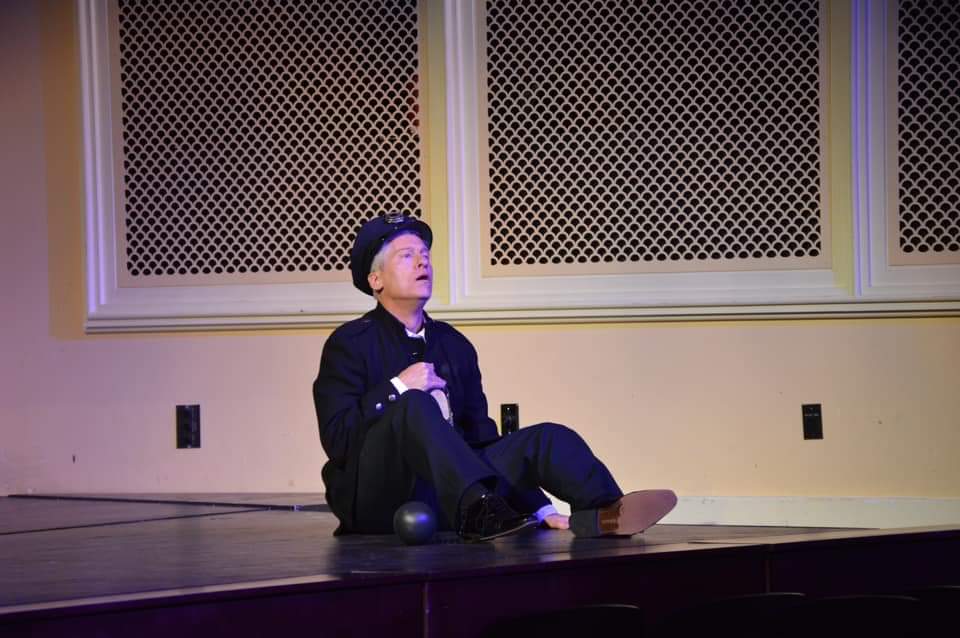
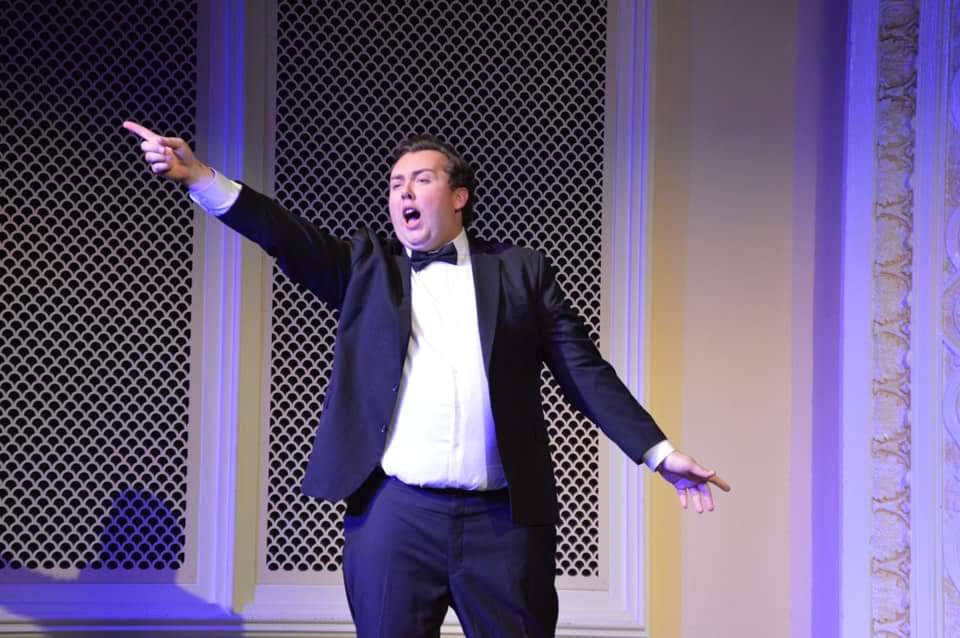
IN REVIEW: baritone ROBERT WELLS as Frosch in UNCG Opera Theatre's October 2019 production of Johann Strauss II's DIE FLEDERMAUS [Photograph © by Amber-Rose Romero, Tamara Beliy, & UNCG Opera Theatre]Falling down on the job: baritone Robert Wells as Frosch in UNCG Opera Theatre’s October 2019 production of Johann Strauss II’s Die Fledermaus
[Photograph © by Amber-Rose Romero, Tamara Beliy, & UNCG Opera Theatre]

With UNCG’s Director of Opera David Holley at the helm, this production of Die Fledermaus was destined to be a show of which cast, crew, university, and community could be proud. Both in his rôle at UNCG and as Artistic Director of Greensboro Opera, Holley brings steadfast integrity to his work, but his staging of Die Fledermaus revealed anew that a vital component of his artistry is not taking himself too seriously. Supervising an entrancingly simple staging in which the action took place in front of the closed curtain, Holley genuinely participated in the performance, not merely as a conductor on the podium but also as an actor with perfect comedic timing. The production’s small scale lent this Fledermaus an intimacy that the score possesses but many stagings lack. Big budgets can buy lavish sets, extravagant costumes, and aggressively-promoted singers, but these expenditures do not guarantee success. The enthusiasm that Holley instilled in this Fledermaus, epitomized by unwavering musicality and clever humor, cannot be bought.

Under Holley’s baton, the excellent orchestra—pianists Anja Arko (Ouvertüre and Act One) and Xiaoxiong Chen (Acts Two and Three), flautist Janet Phillips, oboist Thomas Turanchik, clarinetist Darkson Magrinelli, double bassist Rebecca Marland, and percussionist Erik Schmidt—interacted with the drama rather than merely accompanying it. Fledermaus is a richly-orchestrated score, but not even in the famous Ouvertüre did the playing of UNCG Opera Theatre’s small instrumental ensemble disappoint. In fact, their numbers were perfectly matched with the dimensions of the production, transporting the audience to a chic Viennese café. A few suspect pitches and missed entrances notwithstanding, the musicians’ work was an integral part of the evening’s fun. Similarly, the choristers, drilled by the aptly-named Pingyi Song, sang with gusto—and with English diction that could be understood! Holley’s leadership ensured that every musical detail of the performance was as clear as the chiming of Einsenstein’s troublesome watch.

IN REVIEW: baritone GUY CHAMBERS as Frank in UNCG Opera Theatre's October 2019 production of Johann Strauss II's DIE FLEDERMAUS [Photograph © by Amber-Rose Romero, Tamara Beliy, & UNCG Opera Theatre]Warbling warden: baritone Guy Chambers as Frank in UNCG Opera Theatre’s October 2019 production of Johann Strauss II’s Die Fledermaus
[Photograph © by Amber-Rose Romero, Tamara Beliy, & UNCG Opera Theatre]

The rôle of Ivan, Prinz Orlovsky’s majordomo, is barely noticed in many productions, but he heightened the hilarity of Act Two in this Fledermaus in a wonderfully droll performance by bass Rafael Alejandro Garcia. Catering to the whims of the Prinz’s snobbish guests clearly inconvenienced this servant, a fact that Garcia communicated with rolled eyes and stony expressions of contempt and annoyance. It is a pity that a solo number was not invented for him, perhaps using music from another Strauss score and a purpose-written text: like Leporello in Mozart’s Don Giovanni, what stories he might tell! The master not to be outdone by a student, eminent baritone and UNCG faculty member Robert Wells’s much-lauded experience in the Gilbert and Sullivan Savoy operas was apparent in his scene-stealing turn as the chronically-inebriated jailer Frosch. This bumbling keeper of the keys was unquestionably an ancestor of Barney Fife: thankfully, his boss did not trust him with a pistol and a bullet. With an offstage assist from Alfred, Wells’s Frosch pantomimed Nemorino’s ‘Una furtiva lagrima’ from Donizetti’s L’elisir d’amore better than some tenors sing it.

IN REVIEW: baritone GUY CHAMBERS as Frank (left) and tenor SEAN TOSO as Alfred (right) in UNCG Opera Theatre's October 2019 production of Johann Strauss II's DIE FLEDERMAUS [Photograph © by Amber-Rose Romero, Tamara Beliy, & UNCG Opera Theatre]Partners in wine: baritone Guy Chambers as Frank (left) and tenor Sean Toso as Alfred (right) in UNCG Opera Theatre’s October 2019 production of Johann Strauss II’s Die Fledermaus
[Photograph © by Amber-Rose Romero, Tamara Beliy, & UNCG Opera Theatre]

Looking stunning in a sapphire-hued gown, Beijing-born soprano Mujun Xie sparkled, musically and dramatically, as Adele’s worldly sister Ida. Though she occasionally seemed uncomfortable with the English dialogue, her comfort with the music was conspicuous. Likewise, soprano Sophie Caplin coped handily with an awkward assignment. There is an established tradition of casting a tenor rather than a mezzo-soprano—or, in recent years, a countertenor—as Orlovsky, but it is far rarer to encounter a female singer as Eisenstein’s blissfully inept solicitor, Doktor Blind. Caplin made the most of Blind’s patter in the Act One trio with Rosalinde and Eistenstein, and she displayed expert comic acting in the put-upon attorney’s appearance in Act Three.

In his guises as the prison warden and his party-going alter ego Chevalier Chagrin, Frank received from baritone Guy Chambers a vibrant, vividly-sung characterization. Launching the trio in the Act One finale, when Frank arrives to convey Eisenstein to prison but, unbeknownst to himself and the absent Eisenstein, finds Rosalinde in the company of her would-be paramour, Chambers sang attractively. Fantastic as the not-quite-French Chevalier Chagrin in Act Two, the baritone managed to avoid being upstaged in Act Three, first with a bit of boisterous stage business involving the predictably incendiary results of falling asleep with a lit cigar and a newspaper and then with a touching suggestion of humility when his real identity as the plebeian warden was revealed to Adele and Ida. Chambers’s vivacious personality and his lovely, evenly-produced voice made Frank’s every moment on stage a delight.

IN REVIEW: baritone LORENZE SPARKS as Doktor Falke (left) and mezzo-soprano BAILEY LAIL as Prinz Orlovsky (right) in UNCG Opera Theatre's October 2019 production of Johann Strauss II's DIE FLEDERMAUS [Photograph © by Amber-Rose Romero, Tamara Beliy, & UNCG Opera Theatre]The prince and the prankster: baritone Lorenze Sparks as Doktor Falke (left) and mezzo-soprano Bailey Lail as Prinz Orlovsky (right) in UNCG Opera Theatre’s October 2019 production of Johann Strauss II’s Die Fledermaus
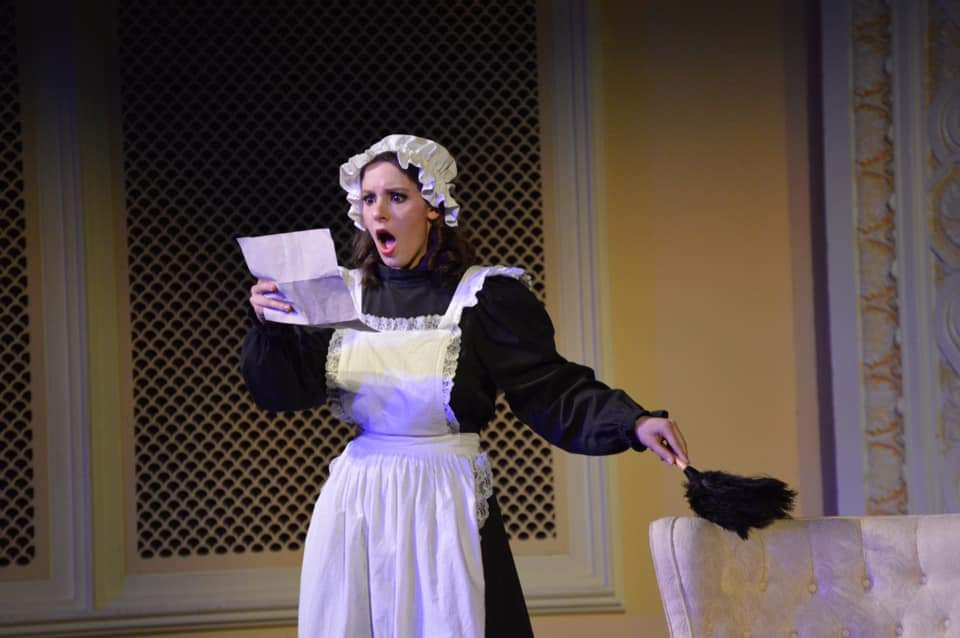
[Photograph © by Amber-Rose Romero, Tamara Beliy, & UNCG Opera Theatre]

The aristocratic boost to her emergence as an actress that Adele sought from the fraudulent Chevalier was ultimately pledged with self-congratulatory magnanimity by the glamorously androgynous Prinz Orlovsky of mezzo-soprano Bailey Lail. Act Two is Orlovsky’s realm, and Lail crowned her portrayal of the petulant, avowedly hedonistic nobleman with a rousing account of the couplets in which the Priz articulates his anything-goes credo, ‘Chacun à son goût.’ Strauss’s writing for Orlovsky is often unwieldy, especially for modern singers with higher centers of vocal gravity than their Nineteenth-Century counterparts likely had, necessitating difficult changes of register. [The voice of the first Orlovsky, Irma Nittinger, was sufficiently unique that, when she fell ill, scheduled performances of Die Fledermaus at the Theater an der Wien in late Spring 1874 were postponed until she recovered in the autumn.] Lail navigated the rôle’s challenges with aplomb and verbal acuity, though the mandated Russian accent, here sounding as though the Prinz arrived in Vienna via Warsaw, distracted more than it entertained. To distort a conceit often repeated by this production’s Prinz, hearing one Orlovsky in no way equates with having heard all interpreters of the part, but Lail was an Orlovsky whose performance was a joy to hear.

Euphoniously opening Act One with a serenade of melting lyricism, tenor Sean Toso deployed an arsenal of hysterical Italian tenor mannerisms in his portrayal of Rosalinde’s ‘special friend’ Alfred, an obvious randy relation of the great Enrico Caruso. Eisenstein’s well-timed departure facilitating an impromptu assignation with his beloved, this Alfred eagerly began his pursuit of his amorous quarry. In the Act One finale, Toso voiced the Trinklied with the zeal of a man used to playing the lover on and off the stage. In addition to the sputtering ‘Una furtiva lagrima’ commandeered by Frosch, Toso’s Alfred enlivened his time in prison with a few bars from the Duca di Mantova’s ‘La donna è mobile,’ the Brindisi from La traviata, and Radamès’s ‘Celeste Aida,’ and seizing Rosalinde’s hand after her arrival at the jail offered an irresistible chance to sing the first phrase of Rodolfo’s ‘Che gelida manina.’ Toso sang all of these excerpts appealingly, but it was in his singing in the trio with Rosalinde and Eisenstein, the latter posing as Blind in an attempt to elicit a confession of wrongdoing from his wife and her lover, that the tenor’s affinity for musical comedy was most evident. The fervor of his Alfred’s wooing of Rosalinde and his impressive sampling of music from other scores whetted the appetite for hearing Toso in Romantic—and romantic—rôles.

IN REVIEW: soprano CLAIRE GRIFFIN as Adele in UNCG Opera Theatre's October 2019 production of Johann Strauss II's DIE FLEDERMAUS [Photograph © by Amber-Rose Romero, Tamara Beliy, & UNCG Opera Theatre]No time for tidying: soprano Claire Griffin as Adele in UNCG Opera Theatre’s October 2019 production of Johann Strauss II’s Die Fledermaus
[Photograph © by Amber-Rose Romero, Tamara Beliy, & UNCG Opera Theatre]

Should anyone hear her cheerful banter and beguilingly ebullient music and think that the rôle of Rosalinde’s stagestruck maid Adele is an easy sing, considering the fact that the first note of the part is a top B should initiate a return to reality. Nevertheless, soprano Claire Griffin electrified UNCG Opera Theatre’s Fledermaus with an Adele so captivating that singing her demanding music seemed to be as natural as breathing. From her first entrance, reading the letter purportedly containing her sister’s exhortation to use the excuse of a sick aunt to procure an evening off in order to attend Orlovsky’s ball, this Adele had a solution for every problem. In the scene with Rosalinde and the subsequent trio with the chambermaid’s mistress and master, Griffin sang splendidly and animated the rôle with uninhibited antics that included exasperatedly perching herself on clarinetist Magrinelli’s knee whilst Rosalinde and Eisenstein exaggerated their sorrow at facing an eight-day separation. Adele’s couplets in the finale were dispatched with comedic flair worthy of Lucille Ball.

Orlovsky may be the most lascivious host in Vienna, but Griffin’s Adele was irrefutably the belle of the ball in Act Two. Initially the proverbial fish out of water, she quickly perceived that, whether their ranks and titles were real or fictitious, the people around her were inherently fake. Adele’s laughing song is one of the score’s best-loved numbers and on this evening fully earned that distinction. In Griffin’s performance, Adele’s couplets in Act Three were nothing short of a tour de force. Appropriating Holley’s baton, she literally became the director of her own show. Frank and Orlovsky were convinced of the viability of her theatrical abilities, and who could doubt the discernment of a warden and a prince? That Griffin accomplished such a dynamic characterization without even marginally sacrificing musical values exclaimed that she was born for a life upon the wicked stage—the operatic stage, that is.

IN REVIEW: tenor MICHAEL FRIEDRICH as Gabriel von Eisenstein (left) and baritone LORENZE SPARKS as Doktor Falke (right) in UNCG Opera Theatre's October 2019 production of Johann Strauss II's DIE FLEDERMAUS [Photograph © by Amber-Rose Romero, Tamara Beliy, & UNCG Opera Theatre]Boys will be boys: tenor Michael Friedrich as Gabriel von Eisenstein (left) and baritone Lorenze Sparks as Doktor Falke (right) in UNCG Opera Theatre’s October 2019 production of Johann Strauss II’s Die Fledermaus
[Photograph © by Amber-Rose Romero, Tamara Beliy, & UNCG Opera Theatre]

Settling a score with Eisenstein, who abandoned him in the wee hours after a masquerade ball and left him in a public place to be discovered in a bat costume, it is Doktor Falke who organizes the events that propel the plot of Die Fledermaus, but the voices to which the part is entrusted sometimes fail to embody Falke’s importance in the operetta. This is a shortcoming of which UNCG Opera Theatre’s production cannot be accused, Falke having been brilliantly sung and acted in Greensboro by Lorenze Sparks. Falke is a rôle in which one of the foremost masters of Viennese operetta, Austrian bass-baritone Erich Kunz, was greatly acclaimed [he also recorded both Frank and Frosch], and the fact that Sparks’s performance often brought the wit of Kunz’s Falke to mind is indicative of the caliber of the young singer’s efforts.

His range hugging the divide between baritone and tenor, Sparks exhibited vocal assurance throughout the compass of Falke’s music, making his Act One duet with Eisenstein as effective musically as it was comedically. Sparks’s Falke was literally and figuratively the life of the party in Act Two, conspiring with Prinz Orlovsky to bring off his plans in memorable fashion and initiating the ‘Brüderlein und Schwesterlein’ canon with burnished vocalism. Claiming victory in the final act, this Falke rejoiced without overwrought gloating. Vocally and histrionically, Sparks’s performance wielded the complexities of an Austrian Sachertorte: decadent, layered, and filled with a concoction of contrasting sweetness and tartness, it was unforgettably delectable.

IN REVIEW: soprano TAMARA BELIY as Rosalinde (left) and baritone MICHAEL FRIEDRICH as Gabriel von Eisenstein (right) in UNCG Opera Theatre's October 2019 production of Johann Strauss II's DIE FLEDERMAUS [Photograph © by Amber-Rose Romero, Tamara Beliy, & UNCG Opera Theatre]Keeping watch: soprano Tamara Beliy as Rosalinde (left) and baritone Michael Friedrich as Gabriel von Eisenstein (right) in UNCG Opera Theatre’s October 2019 production of Johann Strauss II’s Die Fledermaus
[Photograph © by Amber-Rose Romero, Tamara Beliy, & UNCG Opera Theatre]

Despite an extensive history of the music being sung honorably on stage and in recording studios by baritones, Strauss intended the rôle of Gabriel von Eisenstein, the butt of Doktor Falke’s retributory jest, for a tenor. In many instances, a tenor voice blends more pleasingly with his colleagues in ensembles, and a higher, brighter voice can give the errant husband a more youthful demeanor. Michael Friedrich’s performance in this Fledermaus was an example of a tenor Eisenstein who validated the composer’s choice of vocal range. Devilishly handsome, debonair, and as lithe as a Monty Python trouper, Friedrich’s impersonation of Eisenstein combined the slapstick shenanigans of the young Charlie Chaplin with the vocal elegance of Heddle Nash. Bemoaning the ineptitude of his counselor of record with the temper of a man sentenced to the gallows, he simultaneously sweet-talked Rosalinde and abused Doktor Blind in their Act One trio.

Prospects of champagne baths and frolicking ballerinas galvanized Friedrich’s singing in the duet with Falke, and he could not take his leave of his distracted wife and her meddling maid quickly enough. Like Chambers’s Chevalier Chagrin, Friedrich’s Marquis Renard was a ripping parody of a pretentious grand seigneur. Ensnared by his wife’s cunning, this Eisenstein reacted to the loss of his lady-baiting watch with comical tantrums and pouting. Reporting to serve his jail sentence only to find his cell occupied by a substitute Eisenstein, he was quick to recognize Alfred as a rival and to hypocritically denounce Rosalinde’s inconstancy. Mirroring Falke’s good-natured enjoyment of his revenge, Eisenstein accepted defeat and admitted his own culpability without bitterness. Never pushed beyond its natural lyricism, Friedrich’s voice was as seductive as his smile.

IN REVIEW: soprano TAMARA BELIY as Rosalinde in UNCG Opera Theatre's October 2019 production of Johann Strauss II's DIE FLEDERMAUS [Photograph © by Amber-Rose Romero, Tamara Beliy, & UNCG Opera Theatre]Lady of the house: soprano Tamara Beliy as Rosalinde in UNCG Opera Theatre’s October 2019 production of Johann Strauss II’s Die Fledermaus
[Photograph © by Amber-Rose Romero, Tamara Beliy, & UNCG Opera Theatre]

An imaginatively capricious Meg Page in UNCG Opera Theatre’s ambitious April 2019 production of Verdi’s Falstaff [reviewed here], soprano Tamara Beliy sang Rosalinde in Die Fledermaus with the same intelligence, forthrightness, and musical resourcefulness that characterized her portrayal of the merry wife of Windsor. In the scene with Adele in Act One, Beliy’s Rosalinde was the personification of domestic malaise, so lost in her own thoughts that Adele’s pleading for an evening’s holiday went unheard. The top Bs in the trio with Eisenstein and Doktor Blind rang out imposingly. Here and in the trio with Adele and Eisenstein, there was no confusion about whose will was dominant, chez von Eisenstein. Beautiful of visage, figure, and, most importantly, voice, Beliy gave Rosalinde an aura of cinematic enchantment.

Shocked to meet her husband at Orlovsky’s ball when he is supposed to be serving his jail sentence, this Rosalinde’s composure was only momentarily upset, but Beliy’s vocal control was never compromised. Toying with Eisenstein as she contrived to secure evidence of his duplicity by depriving him of his watch, Rosalinde’s trills and top Bs were sung with the supremacy of a woman who knows that she has the upper hand. Beliy voiced the familiar Csárdás, in which Holley proved to be the rare conductor who did not reduce his Rosalinde to gasping and panicking with an impossibly quick tempo for the Frischka, with panache and persuasively-feigned patriotism, and her top D at the piece’s conclusion was considerably more substantial than the shrieks typically heard. The explosions of indignation in the Act Three trio with Alfred and Eisenstein were handled without resorting to vocal harshness. In some singers’ performances, Rosalinde’s better qualities are hidden behind a minxish façade, but Beliy’s Rosalinde was as sympathetic in anger as in jubilation. In this young soprano’s graceful, expressive singing, Rosalinde’s benevolent spirit was always discernible.

That Die Fledermaus was one of the first scores to be taken into a studio in the early years of sound recording reflects the special affection that audiences have long had for the piece. That 1907 recording omitted the Ouvertüre and much of the dialogue and imposed cuts on the vocal numbers, but these and its technological limitations do not lessen its value as a glimpse into the performance history of a cherished work then only thirty-three years past its world première. With decidedly modern theatrical sensibilities that suited the staging’s ethos, UNCG Opera Theatre’s production of Die Fledermaus wrote its own chapter in the operetta’s history, replacing decades’ worth of accumulated artifice with earnest exuberance. Amidst the disconcerting events of the Twenty-First Century, laughter of the operatic variety is truly one of the best medicines.


♪     ♪     ♪     ♪     ♪

The second performance of UNCG Opera Theatre’s production of Die Fledermaus featured Lilla Keith as Rosalinde, Amber-Rose Romero as Adele, Angela Farlow-Rumball as Doktor Blind, Jenna Fife as Ida, Abigail Coy as Prinz Orlovsky, and Forrest Bunter as Frank. Other rôles were performed by the artists who appeared in the 24 October performance. Regrettably, I was unable to attend Saturday’s performance.