14 March 2016

CD REVIEW: Georg Friedrich Händel — MESSIAH (S. Yoncheva, T. Mumford, R. Villazón, B. Terfel; Mormon Tabernacle Choir; CFN 1631-2)

IN REVIEW: Georg Friedrich Händel - MESSIAH (Mormon Tabernacle Choir CFN 1631-2)GEORG FRIEDRICH HÄNDEL (1685 – 1759): Messiah, HWV 56 [Edition by Mack Wilberg]—Sonya Yoncheva (soprano), Tamara Mumford (mezzo-soprano), Rolando Villazón (tenor), Bryn Terfel (bass-baritone); Mormon Tabernacle Choir; Orchestra at Temple Square; Mack Wilberg, conductor [Recorded in the Mormon Tabernacle, Salt Lake City, Utah, USA, during sessions in February, May, July, September, and December 2014, and August, September, October, and November 2015; Mormon Tabernacle Choir CFN 1631-2; 2 CDs + DVD, 143:26 (Highlights disc also available); Available from Mormon Tabernacle Choir and major music retailers]

Few are the courageous souls who would dare to contradict the notion that Georg Friedrich Händel’s Messiah is one of the most beloved creations in the history of Western Art. Composed in a three-week period in 1741 at a pace that astounds modern observers but was unremarkable for the famously industrious Händel, the score of Messiah is noteworthy for its relative originality: per capita, more of its numbers are unique to the score than their brethren in many of the composer’s operas and oratorios. What is unjustly less frequently the subject of laypersons’ praise are the extraordinary histrionic quality and emotional impact of Charles Jennens’s (1700 – 1773) libretto for Messiah. His work was merely arranging Biblical passages, it might be argued, but he did so with the theatrical acuity of Metastasio, da Ponte, and Boito. Jennens’s was a life of comfort that enabled him to dabble in the Arts, and his appreciation of Händel’s music yielded libretti for several of the Saxon’s oratorios, not least among which is his persuasive text for the masterful Saul. Jennens’s advantageous situation afforded him considerably greater access to the Arts community in Eighteenth-Century Britain than his talent and education likely merited, but his libretto for Messiah confirms that he was not merely a dilettante with a measure of piety. Relying slightly more upon the poetic prophesying of the Old Testament than on the New Testament’s fulfillment narrative, Jennens created with a commendable economy of words as complete a portrait of the life of Christ as has grace any book, canvas, or score in the two millennia of Christian ideology. His oft-quoted low opinion of Händel’s treatment of his libretto notwithstanding, Messiah was from the time of its 1742 première in Dublin acknowledged as a pinnacle of its composer’s art. In the second decade of the Twenty-First Century, Messiah remains one of the most frequently-performed works in the standard repertory, its popularity having endured a fascinating cycle of performance trends. Like the King James Version of the Bible, Messiah is a compelling work of art whether the individual listener accepts its subject matter as fact, fable, or a synthesis of the two. Regardless of its provenance, this new recording of Messiah by the renowned Mormon Tabernacle Choir is most valuable because it approaches the score not as a dogmatic sermon in three parts but as an artistic entity of extraordinary global significance. Recorded with meticulous attention to recreating within the confines of the listener’s space the legendary acoustics of the Mormon Tabernacle, this Messiah distills nearly three centuries of traditions into a performance shaped not by fads and theories but by undeviating trust in the unimpeachable quality of Jennens’s wordsmithing and, above all, Händel’s music.

Owing in large part to the commendable emphases placed by The Church of Jesus Christ of Latter-day Saints on respecting and maintaining both body and soul, Salt Lake City, Utah, is one of America’s fittest, most vibrantly youthful metropolitan areas, its stunningly beautiful setting at the foot of the Wasatch Range reflected in the exuberantly reverent architecture of Temple Square, the Mormon Church’s Vatican City. When walking the streets of Salzburg, seeing the twin spires of Salzburger Dom and the majestic Festung Hohensalzburg towering over the city, it is impossible to ignore the ethos of the place that must have stoked the young Mozart’s imagination, and a similar energy, the spirit that has inspired generations of Utahans since Brigham Young arrived in the Salt Lake Valley in 1847, permeates modern Salt Lake City. It was on 22 August 1847, less than a month after ending his cross-continental trek to Utah, that Young organized the Mormon Tabernacle Choir, thus establishing a musical institution that now has nearly as extensive a history with Messiah as the British choral societies by which the score was stewarded throughout the Nineteenth and Twentieth Centuries. In the performance on these discs, Mormon Tabernacle Choir’s Music Director Mack Wilberg offers his own edition of Messiah, combining elements of historically-informed performance practices with vestiges of the Viennese tradition enshrined in the version of the score prepared by Mozart at Baron van Swieten’s request and the monumentally-scaled Victorian approach to the score. With its ensemble of nearly 450 singers and instrumentalists, this is a Messiah that will not find favor with many period practice purists, but not one bar of Händel’s music is expanded to proportions greater than it can support. Under Wilberg’s direction, the Orchestra at Temple Square musicians play virtuosically, the winds making their lines retained from Mozart’s edition of Messiah sound indispensable alongside Händel’s authentic scoring. Propelled by the creative but unobtrusive organ and harpsichord playing of Richard Elliott, Clay Christiansen, and Andrew Unsworth and the cello continuo of Elizabeth Marsh, the orchestra’s performance is robust yet refined. Aided by the expert engineering team, Wilberg molds a traversal of Messiah that is enjoyably grandiose without being detrimentally elephantine.

The familiar names among the quartet of soloists might at first be interpreted as a conscious endeavor to spur sales of this recording. Be that as it may, each of the soloists contributes distinctive qualities that heighten the artistic standard of the performance. The opening bars of the recitative ‘Comfort Ye My People’ reveal Mexican tenor Rolando Villazón to be in fine voice. The surprising fluency in florid writing evident in his previous recordings of Monteverdi, Händel, and Mozart works is even more prominent in his singing here. Villazón’s stylish ornamentation encompasses a genuine trill, and he mostly eschews operatic posturing, instead phrasing with intelligence and straightforward eloquence. His English is accented but clear; far more intelligible, in fact, than the diction of a number of native English speakers who have recorded Messiah. Villazón dispatches the divisions in ‘Ev'ry Valley Shall Be Exalted’ with aptly exultant ease. The sequence of anguished utterances for the tenor in Part Two receives from this tenor a performance of touching simplicity, the drama extracted from rather than imposed upon the music. The stinging bitterness of ‘All They That See Him, Laugh Him to Scorn’ and ‘Thy Rebuke Hath Broken His Heart’ is all the more visceral for the music being sung with such beauty, and Villazón voices the deceptively lilting ‘Behold, and See If There Be Any Sorrow’ as enthrallingly as any tenor who has recorded it, recalling both Jon Vickers’s power and the reedy brilliance of Philip Langridge. The halting uncertainty of his singing of ‘He Was Cut Off out of the Land of the Living’ suggests an inner struggle to express sentiments too appalling to be given voice, but the contrast with the brighter, almost cathartic ’But Thou Didst Not Leave His Soul in Hell’ is stirring, Villazón’s bronzed timbre glowing in the major-key sunlight. An atmosphere of anxiety permeates his readings of ‘Unto Which of the Angels Said He at Any Time’ and ‘He that Dwelleth in Heaven.’ Particularly impressive musically and dramatically is Villazón’s singing of the demanding ‘Thou Shalt Break Them,’ his voice darting through the runs and attacking the tricky intervals with the resonant strike of the rod of iron of which he sings. There is a sense of absolving vindication in his articulation of his lines in the brief duet ‘O Death, Where Is Thy Sting.’ Villazón is a gifted, unfailingly interesting singer whose work is not always conventionally appealing. There is nothing unappealing in his singing in this Messiah, and the healthy dose of Latin fervor that he injects into the performance is welcome when the instrument of its injection is such solid, satisfying singing.

Welsh bass-baritone Bryn Terfel is no stranger to recording Messiah, and it is encouraging to hear his voice on splendid form in this traversal of the bass solos. The passagework in ‘Thus Saith the Lord’ is no longer negotiated as suavely as it was when Terfel first recorded Messiah, but the sheer brawn with which he navigates his way through the music remains impressive. His polished-teak timbre conveys the gravity of ‘For Behold, Darkness Shall Cover the Earth’ and ‘The People That Walked in Darkness’ without artificial heaviness, and he still ascends to E above the stave without strain. The attacks on the fearsome fiorature in ’Why Do the Nations So Furiously Rage Together’ are not completely clean but lack nothing in terms of raw energy, the text coursing through the music like venom. Terfel is at his best in Part Three, in which his voicing of ‘Behold, I Tell You a Mystery’ is characterized by subtlety and enigmatic serenity. Dueling with trumpeter Alan Sedgley in ‘The Trumpet Shall Sound,’ Terfel’s sonorous voice booms authoritatively. Terfel now brings to Messiah the voice of Wotan or Hans Sachs and the slightly reduced flexibility that this implies, but his singing in this performance is by no means undistinguished. He remains a confident, captivating Händelian.

It is unusual for the contralto soloist to be the foremost attraction of a performance or recording of Messiah, but Utah-born mezzo-soprano Tamara Mumford is here a pillar of flair and finesse, traits which also defined her portrayal of Smeaton in the recent Metropolitan Opera revival of Donizetti’s Anna Bolena. Introduced in the fiery ‘But Who May Abide The Day of His Coming,’ Mumford employs her well-honed bravura technique and flickering vibrato to dig into the text, mastering words and notes with equal sagacity. The tranquility that emanates from her phrasing of ‘Behold, a Virgin Shall Conceive’ is quietly moving, and she beautifully evinces the simple joy in ‘O Thou That Tellest Good Tidings to Zion.’ Simplicity is also the hallmark of Mumford’s unaffected singing of ‘Then Shall the Eyes of the Blind Be Opened.’ Her performance of the first part of ‘He Shall Feed His Flock Like a Shepherd’ is one of the finest stretches of singing in this Messiah, followed in the opening minutes of Part Two by her exquisitely-wrought ‘He Was Despised.’ The equal of the sublime ‘Erbarme dich, mein Gott’ in Johann Sebastian Bach’s Matthäus-Passion, ‘He Was Despised’ is essential listening for anyone who questions the extent of Händel’s genius, and Mumford’s singing of it on this recording rivals unforgettable performances by Helen Watts and Dame Janet Baker. The evenness and integration of Mumford’s voice enable her to cover the full range of the music without disruptive register shifts, and she tastefully decorates the aria’s da capo with gorgeous floated notes in the upper octave. The tongue-twisting text in ‘Thou Art Gone Up on High’—try repeating ‘Thou hast led captivity captive’ in quavers and semiquavers!—is nearly as daunting as the music, but Mumford conquers every difficulty. The recitative ‘Then Shall Be Brought to Pass’ and duet ‘O Death, Where Is Thy Sting’ in Part Three draw from the mezzo-soprano radiant, resolute singing. Mumford’s may be the least-familiar of the soloists’ names to many potential purchasers of this Messiah, but her singing is one of the foremost reasons why this recording should be heard.

Bulgarian soprano Sonya Yoncheva has in the months since her 2013 Metropolitan Opera début as Gilda in Verdi’s Rigoletto become a much-lauded member of that company’s roster, opening the 2015 – 2016 MET season as Desdemona in a new prodiction of Verdi’s Otello. Though her repertoire includes ‘early’ parts like the title rôle in Monteverdi’s L’incoronazione di Poppea, mesmerizingly performed opposite the Nerone of Max Emanuel Cenčić at Opéra de Lille and preserved on DVD by Virgin Classics [reviewed here], Baroque music is hardly a cornerstone of Yoncheva’s renown. Like Villazón, she sings English with an accent that rarely compromises her elucidation of text, but English phrasing and vowel placement are audibly new territory for her. Still, from her entrance in ‘There Were Shepherds Abiding in the Field’ and through the nativity narrative of ‘And Lo! The Angel of the Lord Came Upon Them,’ ‘And the Angel Said unto Them,’ and ‘And Suddenly There Was with the Angel,’ she emits sounds of considerable allure, the focus of the tone only intermittently undermined by difficulties with English phonetics. Her top A is fantastic, however, and she sings ‘Rejoice Greatly, O Daughter of Zion’ rousingly, tossing off the roulades with appropriate zeal. Following Mumford in ‘He Shall Feed His Flock Like a Shepherd,’ Yoncheva at first seems slightly prosaic, but her experience with bel canto quickly uplifts her extension of lines, her F and G at the top of the stave rounded and full-bodied even when sung softly. In Part Two, the soprano nearly rivals Mumford’s ‘He Was Despised’ with her shimmering singing of ‘How Beautiful Are the Feet.’ After this, her lovely but earthbound traversal of the poignant ‘I Know That My Redeemer Liveth’ at the beginning of Part Three is somewhat disappointing. Nonetheless, her assured voicing of ‘If God Be for Us, Who Can Be Against Us’ just before the final chorus leaves a decidedly favorable impression. In the long history of Messiah on records, prime donne of the operatic stage have rarely been the most accomplished soprano soloists in Händel’s most popular oratorio. Though not yet fully comfortable with words or music in the performance on these discs, further experience with the score—unlikely considering the demands of her international career, alas—might well usher Yoncheva into the company of those few sopranos who sing Messiah and their preeminent operatic rôles with equal excellence.

Not surprisingly, it is the singing of the Mormon Tabernacle Choir that is the core of this Messiah even amidst an ensemble of high-calibre soloists—if not its sole raison d’être, surely its principal raison d’écouter. The precision with which a choir of such prodigious numbers executes Händel’s contrapuntal writing is staggering, but the recording fails the choristers to a small degree in this regard. Though balances are for the most part thoughtfully rendered, aside from what sounds like very close recording of the soloists, possibly in an effort to minimize the inevitable acoustical variations among even meticulously-controlled sessions, there are passages in which clarity is lost, especially at top volume. In Part One, the divergent emotions of ‘And the Glory of the Lord,’ ‘And He Shall Purify,’ and ‘O Thou That Tellest Good Tidings to Zion’ are contrasted via management of dynamics. The complementary relationship between ‘For unto Us a Child Is Born’ and ‘Glory to God’ has rarely been more apparent in a recorded performance. The wall of sound built by the choristers in ‘His Yoke Is Easy, and His Burthen is Light’ ends Part One with a deluge of unexaggerated devotion. ‘Behold the Lamb of God’ at the start of Part Two could hardly be more different, the singers’ hushed awe surging on a tide of undiluted musicality. The electrifying progression of ‘Surely He Hath Borne Our Griefs,’ ‘And with His Stripes We Are Healed,’ and the figuratively and literally breathtaking ‘All We Like Sheep Have Gone Astray’ is guided with a sure hand by Wilberg and sung with impeccable poise and formidably reliable tone by the choir. No less gripping are the articulations of ‘He Trusted in God That He Would Deliver Him,’ the exhilarating ‘Lift Up Your Heads, O Ye Gates,’ ‘Let All the Angels of God Worship Him,’ ‘The Lord Gave the Word,’ and ‘Their Sound is Gone Out into All the Lands’ that shape the central arc of the Passion chronicle. The choristers enunciate the ingenious figurations of ‘Let Us Break Their Bonds Asunder’ with gleeful accuracy of intonation and rhythm. Triumphant as the choir’s performance of ‘Hallelujah’ is here, it does not assume greater prominence in the oratorio’s musical and dramatic structures than Händel intended. It is a profound summation of faith and prophecies come to fruition, but it is not bloated as in many performances so that the music that follows seems anticlimactic. Part Three here begins with as galvanizing a performance of ‘Since By Man Came Death’ as has ever been presented in a complete recording of Messiah, and the choir’s soaring tones make ‘But Thanks Be to God’ a number similar in significance to its better-known companions in Messiah. The magnificent fugues of ‘Worthy Is the Lamb That Was Slain’ and the concluding ‘Amen’ are not so much sung as felt: the conviction with which the voices ring out is palpable, igniting sparks that illuminate the skill with which Händel ended this world-altering score.

Amidst the plethoras of challenges facing Classical Music in the Twenty-First Century, efforts to record Messiah are no longer as regular as death and taxes. This makes the appearance of a recording like this new one by the Mormon Tabernacle Choir all the more valuable. Händel’s Messiah is a perpetual feast, and this recording offers a delectable new course. Were he to hear the music performed with the sincerity and grandeur achieved on this recording, might Jennens revise his opinion of Händel’s setting of his carefully-tailored text?

05 March 2016

PERFORMANCE REVIEW: Gaetano Donizetti — LA FAVORITE (K. Lindsey, R. Bills, J. Arrey, J. Relyea, J. Harvey, R. Sanz; Washington Concert Opera, 4 March 2016)

IN PERFORMANCE: Mezzo-soprano Rosine Stoltz as Léonor and tenor Gilbert Duprez as Fernand in the first production of Gaetano Donizetti's LA FAVORITE - Paris, 1840 [Lithograph by Émile Desmaisons, after François-Gabriel Lépaulle; public domain]GAETANO DONIZETTI (1797 – 1848): La favoriteKate Lindsey (Léonor de Guzmán), Randall Bills (Fernand), Javier Arrey (Alphonse XI), John Relyea (Balthazar), Joélle Harvey (Inès), Rolando Sanz (Don Gaspar); Washington Concert Opera Chorus and Orchestra; Antony Walker, conductor [Lisner Auditorium, The George Washington University, Washington, D.C., USA; Friday, 4 March 2016]

It might never be deduced from its lamentably few appearances in the world’s major opera houses in recent seasons that La favorite is one of Gaetano Donizetti’s finest scores. Composed in fulfillment of a commission from the Paris Opéra, an offer that any ambitious composer could hardly refuse, La favorite was in part adapted from the never-performed L’ange di Nisida, replacing the aborted Le duc d’Albe. Premièred at the Académie Royale de Musique on 2 December 1840, by a cast headed by mezzo-soprano Rosine Stoltz, whose reign as prima donna of both the Opéra and its manager, Léon Pillet, may have played at least a small part in the demise of Le duc d’Albe, the heroine of which was written for a higher voice, and the famous tenor Gilbert Duprez, La favorite solidified Donizetti’s reputation in the French capital, his home since an irreconcilable feud with the Neapolitan censors prompted him to turn his back on his native Italy. Despite the advocacy of singers as gifted as Giulietta Simionato, Fiorenza Cossotto, and Shirley Verrett, the appreciation that La favorite rightfully garnered in the Nineteenth Century has not persisted in the Twentieth and Twenty-First Centuries. Last heard at New York’s Metropolitan Opera in 1978, the opera has been best served in recent years by concert performances, including Opera Orchestra of New York outings in 1975 with Shirley Verrett, Alfredo Kraus, and Pablo Elvira and in 2003 with Jennifer Larmore, Gregory Kunde, and Dmitri Hvorostovsky; a 1989 Wiener Konzerthaus presentation with Agnes Baltsa, Kraus, and Paolo Gavanelli; a previous Washington Concert Opera showing in 1991 with Florence Quivar, Vinson Cole, and Christopher Robertson; the 2014 Salzburger Festspiele account with Elīna Garanča, Juan Diego Flórez, and Ludovic Tézier; and 2015’s Bel Canto at Caramoor offering with Clémentine Margaine, Santiago Ballerini, and Stephen Powell. Compared with recorded souvenirs of these performances, Washington Concert Opera’s 2016 performance in Lisner Auditorium was finer than any of them. Opera lovers’ affection for the genre is sustained by those gloriously few occasions when every aspect of a performance excels. In the past several decades, aficionados have learned to subsist on very meager diets of memorable performances. This La favorite was a gluttonously fulfilling experience for ears and hearts that hunger for genuine bel canto.

Written by Alphonse Royer and Gustave Vaëz, the libretto of La favorite examines collisions of regal authority, the power of the Church, and individual emotions in the piquant setting of Fourteenth-Century Castile. Alphonse XI, King of Castile, is a archetypical Latin lover, a playboy whose amorous appetite is not quenched by the attentions of his consort, the daughter of Balthazar, superior of the monastery of the Order of Santiago de Compostela. The King keeps as his preferred mistress—voilà, la favorite—Léonor de Gusmán, a beautiful lady of the court whose fervor at prayer has been noticed by Fernand, a postulant in the monastery who eventually abandons his ecclesiastical intentions, accepts a commission in Alphonse’s army procured for him by Léonor, wins royal favor in battle, and claims as his reward from his sovereign Léonor’s hand in marriage—a hand given with the knowledge of everyone except Fernand that her other hand remains firmly grasped by the King. Fernand rejoices at being granted his wish to marry Léonor without knowing of her liaison with Alphonse: Léonor’s confidante Inès, dispatched before the wedding ceremony to reveal Léonor’s past, having been arrested before communicating the crucial information, Fernand pledges himself to a woman he does not truly know and who believes that she is accepted and loved despite her transgressions. Such a plot can be difficult to sort out in staged performances, and concert presentations can make it even more incomprehensible for listeners, especially those without good French—or, more frequently in the case of this opera, Italian. The atmosphere established by the efforts of all participants in Washington Concert Opera’s La favorite lent the performance a strong dramatic profile, elucidating plot elements despite erratic interactions among the principals. The singers’—soloists and choristers—generally very good diction was advantageous. Concert performances of operas often provide opportunities to more intimately savor scores’ musical qualities without visual distractions, but this La favorite in concert was more histrionically effective than many fully-staged productions of familiar works manage to be.

The leadership of Washington Concert Opera’s Artistic Director and Conductor Antony Walker reliably brings the excitement of staged opera to the concert setting, never more so than in this performance of La favorite. His work with Pinchgut Opera in his native Australia has revealed the stylistic versatility of his conducting, but his appearances with Washington Concert Opera, with which company his repertoire encompasses lesser-known scores by Rossini, Donizetti, Bellini, Verdi, and Richard Strauss, have confirmed that he has a special affinity for bel canto, spotlighting the inherent elements of bel canto as much in Strauss’s Guntram as in Rossini’s Semiramide and Bellini’s I Capuleti ed i Montecchi. In Walker’s hands, the kinship between La favorite and Verdi’s mature style was particularly apparent. Donizetti’s music for Alphonse XI, the King of Castile, would dovetail perfectly with Verdi’s music for the Conte di Luna in Il trovatore, and Fernand’s high-centered vocal lines might be uttered just as convincingly by Henri in Les vêpres sicilienne. Balthazar’s scenes might have been cut from the same cloth as similar episodes in La forza del destino and Don Carlos. Without applying pressure greater than the music can withstand, Walker’s approach made Donizetti as much a peer of Verdi, Ponchielli, and Boito as of Rossini and Bellini, and the lesson in this is unmistakably legitimized by the composers’ bodies of work. Rodolfo’s ‘Quando le sere al placido’ in Verdi’s Luisa Miller is a close relative of Fernand’s ‘Ange si pur,’ and what is la Cieca’s ‘Voce di donna’ in Ponchielli’s La gioconda if not bel canto? Walker’s tempi were consistently appropriate for music and musicians, and he enhanced the continuity of the score by refusing to linger over ‘purple’ passages. Every emotion, gleeful or doleful, was given its due but not allowed to dominate unless its domination was clearly Donizetti’s intention. The circumstances of the company’s performances prohibit extensive periods of rehearsal, but such was Walker’s commitment—and the commitment that he inspired in his colleagues on the Lisner Auditorium stage—that this La favorite sounded like the culmination of a lifetime of study and preparation.

Under Walker’s guidance, the quality of the playing by the Washington Concert Opera Orchestra continues to improve, the musicians’s slightly rough-edged account of the Ouverture’s opening Larghetto smoothing to a well-integrated, exciting account of the Allegretto mosso. The Act Two ballet, de rigueur in a score commissioned by the Opéra, was omitted from Washington Concert Opera’s performance, but plentiful opportunities for orchestral glory remained. There were a few very small mistakes and instances of imperfect ensemble, but the playing mostly set and adhered to a high standard. The horns that introduced Léonor’s celebrated ‘O mon Fernand’ were commendably sure of intonation, and harpist Eric Sabatino’s playing was always heard with pleasure. Among the sometimes thin-sounding strings, principal cellist Gita Ladd’s spirited rallying of her section remains a marvel: even her pizzicato playing is emotionally charged. As the Santiago de Compostela organist in Act Four, Joel Ayau phrased his music with bel canto sensibility.

IN PERFORMANCE: Mezzo-soprano KATE LINDSEY as Léonor, tenor RANDALL BILLS as Fernand, Artistic Director and Conductor ANTONY WALKER, baritone JAVIER ARREY as Alphonse, tenor ROLANDO SANZ as Don Gaspar, and bass JOHN RELYEA as Balthazar in Washington Concert Opera's performance of Gaetano Donizetti's LA FAVORITE in Lisner Auditorium, 4 March 2016 [Photo by Don Lassell, © by Washington Concert Opera]La favorite et ses hommes: (from left to right) Mezzo-soprano Kate Lindsey as Léonor, tenor Randall Bills as Fernand, Artistic Director and Conductor Antony Walker, baritone Javier Arrey as Alphonse, tenor Rolando Sanz as Don Gaspar, and bass John Relyea as Balthazar in Washington Concert Opera’s performance of Gaetano Donizetti’s La favorite in Lisner Auditorium, 4 March 2016 [Photo by Don Lassell, © by Washington Concert Opera]
Prepared by Assistant Conductor and Chorus Master Bruce Stasyna, the ladies and gentlemen of the Washington Concert Opera Chorus sang with potency and impressive balance. The men intoned the Andante introduction in Act One, ‘Pieux monastère, de ton sanctuaire que notre prière monte vers les cieux,’ expansively, and the ladies were luminous in the scene with Inès, sounding aptly girlist in ‘Rayons dorés, tiède zéphyre, de fleurs parez ce doux séjour.’ In both the Act Three finale and the first scene of Act Four, the dramatic force of the choral singing was gripping. Their accounts of ‘Frères, creusons l’asile où la douleur s’en dort’ and ‘Que du Très-Haut la faveur t’accompagne,’ the latter sung from the wings as Donizetti stipulated, were deeply poignant. Choral music plays a very important part in La favorite, and the success of this performance was considerably influenced by the choristers’ skillful contributions.

Interpreting the part of Don Gaspar, an officer in service to Alphonse, tenor Rolando Sanz acquitted himself expertly, his intuitive mastery of Donizetti’s style evident even in his character’s declamatory lines. Considering the quality of Sanz’s instrument, it was atypically regrettable that Donizetti and his librettists did not give Don Gaspar an aria. This talented tenor made the most of all that his character had to do, however, his voice ringing heroically—no whimpering character tenor, he!—in the scene with Alphonse at the start of Act Two. Sanz proclaimed Don Gaspar’s dramatically portentous lines in the Act Two finale with the machismo of a world-class Pollione. Of similar quality was his execution of his music in the Act Three finale. Sanz’s voice was always audible in ensembles, and even in the concert setting he was the smug, insinuating courtier to the life. Few operatic courtiers match their machinations with such firm, focused singing. It is too much to expect a Don Gaspar to sound as though he might respectably sing Fernand should circumstances necessitate it, but Sanz was one who seemed more than up to the task.

As Léonor’s confidante Inès, beautiful soprano Joélle Harvey enlivened the otherwise dark drama with singing as radiant as her smile. In her Act One scene with the young ladies of Alphonse’s court, she voiced ‘Rayons dorés, tiède zéphyre, de fleurs parez ce doux séjour’ with girlish glee, unleashing a splendid top B♭ in the cadenza. Then, her ‘Doux zéphyr, sois-lui fidèle’ wafted the fragrances and warmth of spring through the chilly auditorium, the spot-on accuracy of her pitch complemented by well-supported projection. She performed her part in the Act Two finale with poise and tireless assurance above the stave. As much a victim of Alphonse’s jealous cruelty as Léonor and Fernand, Harvey’s Inès was as good-natured and golden-voiced a champion of illicit love as Donizetti and the Washington audience could have hoped to hear in the rôle.

At the opposite end of the vocal and dramatic spectrum, the Balthazar of bass John Relyea pronounced the teachings and dictates of the Church with thundering tones that scorched the air with fire and brimstone. In the first scene of Act One, Relyea declaimed ‘Ne vas-tu pas prier avec eux?’ with gravitas, and his handling of Balthazar’s stern counseling of Fernand in the Allegro duet drew from him an imposing ‘Toi, mon fils, ma seule espérance.’ The bass’s voice relayed the wills of God and Pope in the finales of Acts Two and Three with the unanswerable authority of a man personally acquainted with both the Holy Spirit and the Holy Father. Welcoming Fernand into the monastic brotherhood at the start of Act Four, Relyea’s Balthazar assumed a paternal benevolence that shone in his singing of ‘Les cieux s’emplissent d’étincelles.’ Hearing Relyea’s portrayal, utterly solid throughout the part’s two-octave range, it is interesting to note how often Balthazar is easily ignored by recorded Alphonses. Relyea’s emphatic, smoldering singing could not be ignored by King or commoners, but who could have wanted to close his ears to such an electrifying performance of great music?

IN PERFORMANCE: Soprano JOÉLLE HARVEY as Inès, mezzo-soprano KATE LINDSEY as Léonor, and baritone JAVIER ARREY as Alphonse in Washington Concert Opera's performance of Gaetano Donizetti's LA FAVORITE in Lisner Auditorium, 4 March 2016 [Photo by Don Lassell, © by Washington Concert Opera]Le roi et ses plus belles dames: (from left to right) Soprano Joélle Harvey as Inès, mezzo-soprano Kate Lindsey as Léonor, and baritone Javier Arrey as Alphonse in Washington Concert Opera’s performance of Gaetano Donizetti’s La favorite in Lisner Auditorium, 4 March 2016 [Photo by Don Lassell, © by Washington Concert Opera]

Baritone Javier Arrey endowed the throne of Castile in this La favorite with a young, virile Alphonse XI whose vocalism was as handsomely chiseled as his visage. Among high-octane colleagues, he dominated Act Two, phrasing with distinction and respecting Donizetti enough to make an honorable effort at the trill asked of him. Arrey dispatched the libidinous King’s Larghetto aria ‘Léonor! Viens, j’abandonne Dieu, mon peuple et ma couronne’ and cabaletta ‘Léonor, mon amour brave’ with contrasting sensuality and swagger, his easy top Es and Fs ricocheting through the auditorium like musket balls. He and his Léonor blended their voices stirringly in their Larghetto duet, ‘Léonor, Léonor, tais-toi,’ and his vitriolic singing in the Act Two finale was galvanizing. To the trio with Léonor and Fernand, ‘Fernand de votre amour, Madame, vient de me faire ici l’aveu,’ Arrey brought the bemused confidence of royal prerogative, his voice radiating offended pride. A noticeably softer heart pulsed at the core of Alphonse’s Act Three aria ‘Pour tant d’amour ne soyez pas ingrate,’ the baritone revealing the soul of the man rather than the persona of the King. In the Act Three finale, Arrey depicted a touchingly wounded, suddenly frightened monarch on the brink of collapse: denounced by Rome, abandoned by his lover, and mocked by his court, he was a Mediterranean Macbeth stained by sin. Minimizing the significance of a few suspect pitches and moments of compromised tonal quality, Arrey’s performance was both pompous and poetic—and, most winningly, sung with style and nuance.

IN PERFORMANCE: Mezzo-soprano KATE LINDSEY as Léonor and tenor RANDALL BILLS as Fernand in Washington Concert Opera's performance of Gaetano Donizetti's LA FAVORITE in Lisner Auditorium, 4 March 2016 [Photo by Don Lassell, © by Washington Concert Opera]La favorite et le malheureux: Mezzo-soprano Kate Lindsey as Léonor (left) and tenor Randall Bills as Fernand (right) in Washington Concert Opera’s performance of Gaetano Donizetti’s La favorite in Lisner Auditorium, 4 March 2016 [Photo by Don Lassell, © by Washington Concert Opera]

Tall and as attractive in white tie and tails as a fair-haired Tony Curtis, tenor Randall Bills was a boyish, earnest Fernand who sang with heartwarming expressivity. In a rôle created by Gilbert Duprez, credited as having been the first tenor to publicly unveil the now-expected ut de poitrine, Bills unsurprisingly faced high tessitura, but his voice retained its youthful bloom to the top of the range. In Fernand’s Larghetto cavatine in Act One, ‘Un ange, une femme inconnue,’ he managed the ecstatic rise to top C♯ without strain, but the most gratifying aspects of his singing were his smooth, clear timbre and impeccable breath control. In the duet with Balthazar, his exclamation of ‘Mon père, je l’aime!’ soared with lovesick sincerity, and he subsequently greeted Inès with a believably awestruck ‘Gentille messagère et nymphe si discrète.’ Finally united with his beloved Léonor, her identity still withheld from him, ‘Pour toi des saints autels j’ai brisé l’esclavage’ poured from him like lava, his vocalism igniting one of Donizetti’s most incendiary duets. Bills gave an understated performance of the martiale aria ‘Oui, ta voix m’inspire,’ its sentiments being in his hands a statement of very private resolve. The first scene of Act Three was defined by Bills’s affectionately-phrased utterance of ‘Me voici donc près d’elle,’ his urgent, athletic singing in the trio with Léonor and Alphonse and the act’s finale surging with emotion and musicality. Hesitating before taking his final vows as a brother in the fraternity of Santiago de Compostela in Act Four, the tenor’s Fernand voiced ‘Dans un instant, mon frère’ with humility. Like the Duca’s ‘La donna è mobile’ in Rigoletto and Rodolfo’s ‘Che gelida manina’ in La bohème, it is Fernand’s C-major Larghetto aria ‘Ange si pur, que dans un songe’ for which audiences eagerly wait in La favorite, and Bills’s performance of the piece, one of Donizetti’s most inspired arias for tenor, fulfilled the expectation engendered by his effective singing throughout the evening. Shaping the aria with obvious mastery of bel canto, he faithfully observed Donizetti’s dynamic marking by taking the famous top C in genuine voix mixte, sustaining the tone beautifully and with the softness requested by the composer. In the harrowing final duet with the dying Léonor, he seemed transformed by ‘Ses pleurs, sa voix jadis si chère portent le trouble dans mes sens,’ his coldness towards his one true love thawed in an instant. This was a Fernand whose suggestion that his fellow monks’ prayers for the repose of Léonor’s soul would on the following day be lifted in requests of intercession for his own seemed inevitable: having borne too much, one could virtually feel the sensitive young man’s heart breaking. Particularly in early scenes, Bills’s gestures revealed nervousness, but the thoughtful young artist’s preparation and innate stylishness prevailed. Further experience will undoubtedly increase his comfort in the rôle, but few of even the most acclaimed Fernands have sung the music so securely and serenely.

After her début at the Opéra in 1837, Rosine Stoltz was frequently compared to one of the most popular singers in Paris, the sui generis Cornélie Falcon. Acclaimed for performances of rôles composed by Rossini for Isabella Colbran, as well as Falcon parts like Rachel in Halévy’s La Juive and Valentine in Meyerbeer’s Les Huguenots, Stoltz was admired for the excellent quality of her voice throughout its wide range and the dramatic verisimilitude of her characterizations, attributes that likely made her Léonor de Gusmán a memorable portrayal. The same praise can be justifiably directed at mezzo-soprano Kate Lindsey, whose Léonor for Washington Concert Opera was a spectacular junction of singer and rôle. In her Act One duet with Fernand, Lindsey caressed the line and cajoled her Fernand with a bewitching ‘Mon idole, mon idole, Dieu t’envoie.’ Her singing in the Act Two duet with Alphonse was better still, the bitterness that flooded her enunciation of ‘Dans vos palais, ma pauvre âme soupire’ altering the mood of the scene and of the opera as a whole. Her voice rocketed through the tricky writing in the Act Two finale. After enduring crippling shame in the trio with Fernand and Alphonse, depicted by Lindsey with unaffected dignity, Léonor’s majestic solo scene is the centerpiece of Act Three and the climax of the opera. Lindsey phrased the recitative ‘L’ai-je bien entendu?’ with great feeling, and her performances of the aria ‘O mon Fernand! tout les biens de la terre’ and cabaletta ‘Mon arrêt descend du ciel’ were galvanizing, a masterclass in the art of dramatic bel canto. Lindsey has flashing, unforced top Bs, used sparingly and to great effect, and her upper register was on sterling form throughout the performance, not least in the difficult Act Three finale. Entering in Act Four, Lindsey delivered ‘Fernand! Fernand! pourrai-je le trouver?’ with a voice already touched by death, and her piano singing of ‘Fernand, imite la clémence du ciel à qui tu t’es lié’ in the final duet was ravishingly plaintive. When singing quietly, Lindsey's tones sporadically lost focus, and her cautious management of vocal registers, commendably maintaining head resonance in the interest of preserving the line, led to a few moments of awkwardness at the bottom of the range. Like Bills, however, she reduced minor imperfections to immateriality with a performance that, taken as a whole, qualified her as a Léonor worthy of the legacy of Simionato, Cossotto, and Verrett.

It is never easy to explain why some of a composer’s operas enjoy enduring success while others of equal or greater quality languish in relative obscurity. For Donizetti’s La favorite, the argument is often made that the opera is neglected because there are no singers active today who are capable of doing justice to the score. Washington Concert Opera’s performance delightfully disavowed that notion. Are audiences’ collective attention spans too brief to enable exploration beyond the handful of Donizetti’s operas that remain in the standard repertory? Do today’s listeners fail to respond to the tragedy of La favorite as readily as Nineteenth-Century observers must have done? Whichever reasons are most valid for explaining the infrequency with which La favorite adorns the world’s stages, performances of the prowess of Washington Concert Opera’s traversal of the magnificent score are worth waiting for.

IN PERFORMANCE: the cast of Washington Concert Opera's performance of Gaetano Donizetti's LA FAVORITE in Lisner Auditorium, 4 March 2016 [Photo by Don Lassell, © by Washington Concert Opera]Receiving thanks for a job well done: (from left to right) Bass John Relyea (Balthazar), mezzo-soprano Kate Lindsey (Léonor), tenor Randall Bills (Fernand), Artistic Director and Conductor Antony Walker, baritone Javier Arrey (Alphonse), soprano Joélle Harvey (Inès), and tenor Rolando Sanz (Don Gaspar) in Washington Concert Opera’s performance of Gaetano Donizetti’s La favorite in Lisner Auditorium, 4 March 2016 [Photo by Don Lassell, © by Washington Concert Opera]

03 March 2016

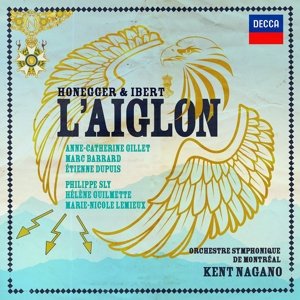
CD REVIEW: Arthur Honegger & Jacques Ibert — L’AIGLON (A.-C. Gillet, M. Barrard, É. Dupuis, P. Sly, P. Charbonneau, I. Bell, T. Duncan, J.-M. Richer, H. Guilmette, M.-N. Lemieux, J. Boulianne, K. McLaren; DECCA 478 9502)

IN REVIEW: Arthur Honegger & Jacques Ibert - L'AIGLON (DECCA 478 9502)ARTHUR HONEGGER (1892 – 1955) and JACQUES IBERT (1890 – 1962): L’AiglonAnne-Catherine Gillet (L’Aiglon, duc de Reichstadt), Marc Barrard (Séraphin Flambeau), Étienne Dupuis (Prince de Metternich), Philippe Sly (Maréchal Marmont, L’autre, Arlequin), Pascal Charbonneau (L’attaché-militaire, Un manteau vénitien, Pierrot), Isaiah Bell (Frédéric de Gentz, Un matassin, Un polichinelle), Tyler Duncan (Chevalier de Prokesch-Osten, Un Gilles), Jean-Michel Richer (Comte de Sedlinsky), Hélène Guilmette (Thérèse de Lorget), Marie-Nicole Lemieux (Marie-Louise), Julie Boulianne (Fanny Elssler), Kimy McLaren (Comtesse Camerata, Une marquise, Isabelle); Chœur de l’Orchestre Symphonie de Montréal; Orchestre Symphonie de Montréal; Kent Nagano, conductor [Recorded ‘live’ during three concert performances in Maison symphonique de Montréal, Québec, Canada, on 17, 19, and 21 March 2015, and in sessions with Hélène Guilmette and Marie-Nicole Lemieux in the same venue during September 2015; DECCA 478 9502; 2 CDs, 92:29; Available from DECCA Classics, Amazon (USA), jpc (Germany), Presto Classical (UK), and major music retailers]

There are many reasons why operas disappear from the repertory. Some scores quickly outlived their usefulness for the occasions for which they were composed. Others were conceived for individual artists whose singular qualities have not been replicated among singers of subsequent generations. Some of the music simply does not merit revival, and some libretti are rubbish. There are also operas afflicted with the inseparable baggage of uncomfortable associations. The neglect of some scores can only be attributed to ignorance, however, and this must be the case with Arthur Honegger’s and Jacques Ibert’s L’Aiglon. With the problems created by the interventions of multiple pairs of hands in operas like Mussorgsky’s Boris Godunov and Puccini’s Turandot looming large in the international repertory, perhaps there is a stigma attached to the appearance of more than one composer’s name at the head of a score. Premièred at the Opéra de Monte-Carlo in 1937 by a cast that included Fanny Heldy and Vanni Marcoux, L’Aiglon is an opera with none of the hallmarks of merited obscurity. Its libretto, based upon a play by Edmond Rostand, respected throughout the world for his Cyrano de Bergerac, is of high literary quality, the characters convincingly drawn and differentiated. The opera’s plot is engaging and fast-paced, its ending restrained but no less touching than the final scenes of La traviata, La bohème, and Werther. Most significantly, Honegger’s and Ibert’s music—extant evidence discloses that Honegger substantially composed Acts Two and Four, Ibert Acts One and Five, and that they worked closely together on Act Three—is consistently superb, the cohesiveness produced by their collaboration nodding to virtually every idiom in French opera from Grétry and Philidor to Debussy and Ravel. Recorded by DECCA with unobtrusive but unmistakable technical wizardry during concert performances that furnished the opera’s long-overdue North American première, L’Aiglon here receives an introduction to the Twenty-First Century wholly worthy of the progeny of one of the most fascinating figures in human history.

Napoléon François Charles Joseph Bonaparte, history’s and Honegger’s and Ibert’s l’Aiglon, was born at the Tuileries in Paris on 20 March 1811, the son of Napoléon and his second empress consort, Marie Louise, the eldest daughter of Holy Roman Emperor Francis II. Napoléon’s sole legitimate heir, the young Prince Imperial was from the time of his birth the titular King of Rome, but his crowns ultimately shielded him from few of life’s difficulties. His tenuous claim to the French imperial throne when his father abdicated, provisionally in 1814 and unconditionally in 1815, was not recognized by Napoléon’s vanquishers: safe in exile in his mother’s native Austria, the tyke may never have known that he was briefly proclaimed emperor after Napoléon’s decisive defeat at Waterloo. Sadly, the younger Napoléon’s life was destined to be little longer than his unheralded tenure as the head of the Empire Français. Sidelined by statesmen understandably wary of seeing another Bonaparte rising to power, Napoléon II lived in a sort of official limbo, his brief career in the Austrian army largely an exercise in keeping him distant from the goings-on at the court of his Hapsburg relatives. Chancellor von Metternich having used the youth as a pawn in his eternal chess match with France, a tribulation that figures prominently in Henri Caïn’s libretto, politics may even have hastened his demise when a request to be allowed to relocate to the healthier climate of Italy was denied. His constitution undermined first by a long bout with pneumonia and then a virulent strain of tuberculosis that plagued Austria in the wake of the cholera pandemic of 1832, l’Aiglon stretched his wings for the last time on 22 July 1832, four months after his twenty-first birthday.

His skill in leading Twentieth-Century French operatic repertory, not least Francis Poulenc’s harrowing Dialogues des Carmélites and Olivier Messiaen’s sprawling Saint François d’Assise, having been revealed in numerous critically-acclaimed performances and recordings, California-born conductor Kent Nagano was an inspired choice for presiding over the Orchestre symphonique de Montréal performances planned to lift L’Aiglon aloft. The orchestra’s lauded mastery of Tchaikovsky repertory during the tenure of former Artistic Director Charles Dutoit was a fantastic preparation for approaching L’Aiglon. Fusing elements of the French and Viennese traditions so beloved by Tchaikovsky, Honegger’s and Ibert’s score mixes portions of Stroh and Courvoisier into an intoxicating musical cocktail. The brief scene for L’Aiglon and Thérèse in Act One is reminiscent of Richard Strauss’s Presentation of the Rose in Act Two of Der Rosenkavalier, and there are echoes of Massenet’s Don Quichotte, the libretto of which was also written by Henri Caïn, in the final scene of Honegger’s and Ibert’s score. The opera’s surrealistic fourth act would not seem out of place in the pages of Balzac’s Colonel Chabert. If these resemblances suggest a disconcerting stylistic mélange, the unimpeachable continuity of the music will be especially astonishing to the listener. Even in Act Three, on which both composers toiled, transitions are seamless. The fluidity of Nagano’s conducting makes them seem even more so. Under his baton, the spirited waltz of the ballet music—a sequence that might easily be assumed to be the work of Johann Strauß II—sounds like bona fide music for dancing, and every dramatic point made by Honegger, Ibert, and Caïn is recreated by Nagano. There are no suggestions of ticking boxes or crossing moments off of a list, however. The whole of the Impressionistic Act Four is paced with the abstract inevitability of a play by Harold Pinter, and Act Five, which has the potential to be maudlin and treacly, is all the more moving for being allowed to progress steadily, eschewing tears and hollow dramatics. The conductor’s baton often seems to soar as if borrowing the eaglet’s wings. Not one passage in the opera’s ninety minutes sounds anything other than ideally-paced.

Following Nagano’s lead, both the orchestra and the Chœur de l’OSM contribute accounts of their parts that none of their Parisian counterparts could surpass. Whether playing passages scored with the gossamer effects of chamber music or those steeped in the bloody din of battle on the hills of Wagram, the OSM musicians play with authentically Gallic elegance and bristling intensity. The ballet receives from them the requisite grace, and the contrasting tumult of Act Four and melancholic subtlety of Act Five are conveyed with complete conviction. The inventiveness of the composers’ instrumentation is apparent throughout the performance owing to orchestral playing that is without shortcomings. As the disembodied voices of the Wagram battlefield, the twenty singers of the chorus, trained by Andrew Megill, deliver the utterances of the veterans of the engagement and those of the hallowed ground itself with menace, mystery, and resounding musicality. Allied with Nagano’s imaginative but accurate conducting, the OSM instrumentalists’ and choristers’ performances give L’Aiglon a brilliant, cloudless sky into which to take flight.

One of the most enjoyable aspects of this recording of L’Aiglon is the uncompromisingly excellent work of a true ensemble cast of native French speakers. Large casts without weaknesses among their ranks are now only very rarely encountered in the world’s opera houses. Honegger’s and Ibert’s music is good enough to make a vivid impression even if not ideally sung, but the artists assembled in Montréal’s acoustically spectacular Maison symphonique prove on disc to be a far better-integrated ensemble than many casts with extensive experience in staged productions. Among the alluringly phonogenic gentlemen, tenor Jean-Michel Richer is a Comte de Sedlinsky whose brief presence in the drama lingers in the memory, the character’s lines poured out in a stream of silvery tone. Fellow tenors Isaiah Bell and Pascal Charbonneau are similarly effective in their respective rôles, including their turns in the Act Three masque as Un polichinelle and Un manteau vénitien and Pierrot. Bell’s dulcet-toned Frédéric de Gentz matches Richer’s Sedlinsky in seizing the listener’s attention. As L’attaché militaire, Charbonneau’s slender, pointed voice chills and calms in equal measures, his timbre perfect for the character who clings to the periphery of the plot with ambiguous intentions. The Chevalier de Prokesch-Osten was among the young Prince’s few true friends, and it is impossible to imagine his operatic incarnation being more deserving of the confidence of an emperor’s son than he is as portrayed here by baritone Tyler Duncan. Both his Prokesch and his Gilles in Act Three are luxuriously voiced, the warmth of both the sound and the demeanor endearing him to the listener as an inspiringly reliable beacon of safety and genuine camaraderie for the increasingly isolated l’Aiglon.

Alongside such a strong cast of male singers, the female contingent of DECCA’s L’Aiglon command admiration for their own finely-judged, capably-voiced portrayals. Mezzo-soprano Julie Boulianne sings Fanny Elssler so attractively as to make the character markedly more appealing to the senses than Caïn’s words permit her to be in the drama. Soprano Kimy McLaren’s Comtesse Camerata, the agent of l’Aiglon’s escape from his Austrian wardens, and impersonations in the masque in Act Three are also sung and acted with youthful charm and tones that seem to effervesce from a freshly-uncorked bottle of champaign. Soprano Hélène Guilmette’s Thérèse de Lorget, the widowed empress’s reader and the young Prince’s de facto love interest, is distinguished by radiant singing, her voice glowing with ardor even when the words that she articulates express the character’s embarrassment in the presence of l’Aiglon. ‘Little Brooklet’ is a wonderfully appropriate epithet for Guilmette’s Thérèse: her singing flows like the crystalline waters of an unspoiled spring.

Though dismissive of her concern for him in one scene, the operatic Napoléon II is kinder to his mother than his historical counterpart is known to have been, accounts of his life documenting his wish that the more famous Joséphine were his mother rather than Marie-Louise. Who would not be inclined to deal affectionately with a mother sung by contralto Marie-Nicole Lemieux? Throughout the opera, Lemieux depicts Marie-Louise as a stern, aptly imperious figure who loves her son and regards him wistfully as the only remaining vestige of a glorious past. Hers are the misfortunes of political disgrace and outliving both spouse and child. Lemieux’s vocalism occasionally sounds flustered, the pitch secure but the tone not as formidably solid as it has often been. Marie-Louise’s music does not provide Lemieux with opportunities for the kind of bold, full-throttled singing at which she excels, but her artistry engenders a consequential performance.

Singing the rôle of Maréchal Marmont, bass-baritone Philippe Sly enriches the performance with every note that he sings. The shame and sadness with which he intones ‘Je ne l’ai pas revu’ when confronted by l’Aiglon about having abandoned Napoléon on the battlefield are deeply poignant. Still more stirring is the sense of honor with which Sly phrases ‘Ah! monseigneur, accusez la fatigue. Que voulez-vous?’ Sly’s burnished timbre lends his portrayal of the Maréchal both humanity and tragic grandeur, but it is the beauty of his singing that sustains his haunted, haunting performance.

The Prince de Metternch and Séraphin Flambeau of baritones Étienne Dupuis and Marc Barrard are the dueling forces that collectively form the fulcrum upon which the opera’s diegesis teeters. Vocally and dramatically, the gentlemen are on equal footing, the importance of their opposing loyalties cogently expressed through their impactful singing. Dupuis and Barrard spar with the sure aim of Olympic fencers in the second and third scenes of Act Two, when Flambeau terrorizes Metternich with the pseudo-shade of Napoléon. Barrard’s vocal acting in Flambeau’s phantasmagorical death scene affords the character’s suicide the honor of a hero’s passing. In the opera’s final scene, Dupuis manages to suggest that Metternich at last sympathizes with l’Aiglon. Perhaps his compassion is born solely of the relief of the legacy of Napoléon finally receding into the past, but the dignity with which Dupuis pronounces ‘Vous lui remettrez son uniforme blanc’ as the curtain falls rings with sincerity. Like Sly, Barrard and Dupuis proffer such expressive performances principally because they sing so handsomely.

Continuing the tradition established by Monteverdi with Nerone in his L’incoronazione di Poppea and advanced by Sesto in Händel’s Giulio Cesare, Mozart’s Cherubino and Massenet’s Chérubin, and Richard Strauss’s Octavian in Der Rosenkavalier and Komponist in Ariadne auf Naxos, Honegger and Ibert made their l’Aiglon a brother of Gounod’s Siébel and Stéphano. If her singing on this pair of discs is indicative of her work in general, l’Aiglon could hope for no better interpreter than Belgian soprano Anne-Catherine Gillet. Hearing her assured command of the wide range of l’Aiglon’s music, it is hardly unexpected that she is also a noted interpreter of Massenet’s Manon. Gliding through the awkward adolescent exchanges of Act One, Gillet’s upper register gleams. Gillet garners pity for the merciless treatment that l’Aiglon receives from Metternich in Act Two. The son that Gillet depicts in Act Four wants desperately to live up to the impossibly imposing stature of his diminutive father. In Act Five, the serenity and simplicity with which Gillet’s Prince takes leave of life, revisiting the grandeur of his christening, elevates the opera’s final scene to the heights of Machiavellian tragedy. Not surprisingly, the soprano’s diction is splendid. Every word that she caresses with her dazzling voice has its place in her captivating portrayal of l’Aiglon. This eaglet’s plumage is a musical wonder of nature.

The lion’s share of artistic works fashioned by collaborative efforts suffer from an unequal distribution of riches. In L’Aiglon, a passage here emphatically says, ‘Honegger,’ and a passage there just as emphatically says, ‘Ibert,’ but every passage in the score renders a message of artistically advantageous cooperation. Indeed, the heart of this recording of L’Aiglon is cooperation: respect among artists for themselves, one another, and the score in their hands yields a performance that enchants and enlightens. A more plaintive memorial to the hapless Eaglet of Napoleonic France and a finer performance of L’Aiglon are unfathomable.

IN REVIEW: Le Chevalier de Prokesch-Osten and Napoléon II in a scene from Edmond Rostand's L'AIGLON [Print by LaCroix, Paris, circa 1910; public domain]Un prince et son ami: Le Chevalier de Prokesch-Osten and Napoléon II in a scene from Edmond Rostand's L'Aiglon [Print by Lacroix, Paris, circa 1910; public domain]

02 March 2016

SINGER SPOTLIGHT: Cosmopolitan Queen of Bel canto — soprano JESSICA PRATT

SINGER SPOTLIGHT: Cosmopolitan Queen of Bel canto - soprano JESSICA PRATT [Photo © 2015 by Benjamin Ealovega]The radiant face of Twenty-First-Century bel canto: Soprano Jessica Pratt [Photo © 2015 by Benjamin Ealovega]

There are voices that are wholly forgettable and voices that one actively endeavors to forget. There are voices that, try as one might, can never be purged from the memory. Very rarely, though, there are voices that one hears and, for all the right reasons, never forgets, voices that etch into the memory the circumstances of the first hearing with the vivid significance of a life event. There was the Metropolitan Opera broadcast of Wagner’s Die Walküre on 6 December 1941, for instance, when, with the world on the brink of cataclysmic war, an untested soprano named Astrid Varnay introduced herself to the airwaves as Sieglinde. There were MET performances when Plácido Domingo and Dame Kiri Te Kanawa unexpectedly made company débuts as substitutes for ailing colleagues. There was that 1959 Covent Garden Lucia di Lammermoor when an Australian soprano who had been on the Royal Opera’s roster for nearly a decade, Dame Joan Sutherland, became a sensation. Much as the perceived paucity of important voices among today’s singers is lamented, the truth is that Melbas and Nordicas, Flagstads and Callases, Slezaks and Pertiles have ever been rare: even in the Eighteenth Century, when singers first gained celebrity-status notoriety in the modern sense, it was reportedly said that there were one God and one Farinelli, deities of equal scarcity. In this remarkable Twenty-First Century, when young singers face pressures for which conservatories can only partially prepare them, the future of opera depends more than ever before upon unforgettable voices—voices, that is, like that of soprano Jessica Pratt. Though hardly a novice, she remains a fresh-voiced young lady on the cusp of stardom, but her dedication to continually honing her craft reveals that she is anything but blinded by her success. A lovely lady of integrity both on and off the stage, she embodies bel canto in art and in life.

Born in England, Pratt relocated to Australia in her teens but now makes her home in Italy. It seems only natural that an artist with an insatiable thirst for knowledge of her chosen profession should reside upon the land from which the first founts of operatic creativity sprung, but Pratt is delightfully clear-sighted about the benefits of her intercontinental upbringing. ‘As a singer growing up in Australia​,​ Joan Sutherland and Nellie Melba were and are great examples whom I find extremely inspiring​,’ she says with obvious affection and respect for her forebears. In opera, there’s nothing like a Dame from Down Under, but this sophisticated soprano’s musical perspective is unusually global. ‘I also adore listening to recordings of Sills, Cuberli, Studer, Devia, Scotto, Olivero, Anderson, Moffo, Caballé, and Callas, among others,’ she confides. ‘I also find Fritz Wunderlich to be a very healthy singer to listen to. I think [that], as time goes on, I have started to realize that the wonderful sounds these singers produce are done with their minds and without forcing.’ An equilibrium of mental acuity and physical exertion is critical to vocal well-being, especially among singers at the starts of their careers, Pratt advocates. ‘As young singers, we always try to make something happen physically: however, the more that you step out of the way and just let your body do what is essentially a natural thing, the better the quality of sound. Less is more.’ This is wisdom with which one of her Australian idols concurred. ‘Nellie Melba writes at the beginning of her treatise on singing, The Melba Method, [that] “it is easy to sing well, and very difficult to sing badly! How many students are really prepared to accept that statement? Few, if any. They smile, and say: ‘It may be easy for you, but not for me.’ And they seem to think that there the matter ends. But if they only knew it, on their understanding and acceptance of that axiom depends half their success. Let me say the same in other words: In order to sing well, it is necessary to sing easily.” That phrase struck me as a young singer, and only after years of study and performance experience am I actually, really understanding it.’ Has this understanding changed her reactions to the work of the predecessors she so admires? ‘Yes, now, with experience, I admire the ease and freedom in Sutherland’s recordings more than anything else,’ she muses.

SINGER SPOTLIGHT: Soprano JESSICA PRATT in the title rôle of Gaetano Donizetti's LUCIA DI LAMMERMOOR at Teatro di San Carlo in Naples, Italy [Photo by Luciano Romano, © by Teatro di San Carlo]Method of her madness: Soprano Jessica Pratt in the title rôle of Gaetano Donizetti’s Lucia di Lammermoor at Teatro di San Carlo, Napoli [Photo by Luciano Romani, © by Teatro di San Carlo]

Though still well shy of forty, Pratt has already sung many of the most challenging rôles in the bel canto repertory, garnering critical acclaim and the appreciation of audiences throughout the world. Whether breathing new life into well-traveled characters like Elvira and Amina in Bellini’s I puritani and La sonnambula, Donizetti’s Lucia di Lammermoor, and Violetta in Verdi’s La traviata or resurrecting long-forgotten or under-served heroines like Donna Isabella in Nicola Vaccaj’s La sposa di Messina [recorded in performance at the XXI ROSSINI IN WILDBAD Festival by NAXOS] and Verdi’s Giovanna d’Arco [recorded in performance at the 2013 Festival della Valle d’Itria and recently released on CD and DVD by Dynamic], her performances are noteworthy for the intelligence in planning her career that her singing divulges. Especially in the first few seasons of a singer’s career, staying on the path that is healthiest for the voice can be nearly as daunting an effort as discerning that path in the first place. ‘In the beginning,’ Pratt recalls of the foremost hurdles of the earliest days of her international career, ‘it was the constant pressure to accept more lyric rôles which would have been entirely inappropriate as I did not yet have the discipline to measure out the voice over the entire performance of an opera and to resist the urge to push when things get dramatic.’ Nonetheless, there are forces at work that are not wholly within even an exceptionally wise singer’s control. ‘Of course, the temptation is strong because it is more common for a theatre to put on La traviata, for example, so there are more offers with a higher cachet, but I prefer to keep to the repertoire I love singing and that I believe is right for my voice for as long as possible.’ She quickly adds, ‘That is not to say I don’t enjoy singing Violetta. [She] is a part of my repertoire, too, but must remain a minor part like the Queen of the Night’—the rôle in which she will make her début at the Metropolitan Opera in the 2016 – 2017 Season—‘and eventually the more lyric Donizetti and Bellini rôles. I think that keeping eighty percent of my engagements in a year to lighter bel canto rôles and then adding the occasional rôle which is slightly more lyric gives me the basis to keep things healthy.’

Even so, there is nothing formulaic about Pratt’s artistry. ‘Purity, vulnerability, honesty, and intimacy come to mind,’ she responds when asked how she might describe her artistry, and her interpretation of the eponymous Babylonian queen in Rossini’s Semiramide—a rôle added to her repertory in 2015 with performances for Opéra Municipal de Marseille and Washington Concert Opera [reviewed here]—is an ideal manifestation of those qualities and the care that she exercises in discerning among the notes of a composer’s music not just a character but also indications of how to portray her. Significantly, Pratt’s performances epitomize the delicate balance between score and self. Her characterizations are redolent not of the ostentatious concept of being a woman like Semiramide in a Stanislavskian sense but of in-depth connections with composers’, audiences’, and her own perspectives. ‘I think it is natural for us to portray parts of ourselves or to see ourselves reflected in the characters we play,’ she suggests. ‘For singers, it is also a type of catharsis: we can work on exploring more vulnerable or more powerful parts of ourselves which might help those parts to grow in real life, too. I certainly feel like I have lived many lives through the characters I have played on stage.’ She sees finding the points at which composers’ and singers’ creative capacities intersect as the key to providing audiences with engaging portrayals. ‘Obviously, we often have to use our imaginations and exaggerate smaller feelings or observe others in similar states to the characters we play as we cannot live all the experiences we portray—I would be locked up in an asylum by now!’ she explains. ‘I enjoy playing Lucia di Lammermoor very much as it is a chance to put absolutely everything out before an audience. It is a portrayal of madness, a depression that fascinates me.’ Viewed through various lenses, this fascination is at the heart of Pratt’s artistic philosophy. She goes on to say, ‘I also felt a strong connection with Violetta in La traviata because the society who judged her​ ​for her lifestyle reminded me of being judged badly in the past as a possible partner because I am an opera singer, traveling the world alone [and] thus not marriageable because of my independence and not being able to be physically present all the time.’

SINGER SPOTLIGHT: Soprano JESSICA PRATT, star of Festivale della Valle d'Itria's 2013 production of Giuseppe Verdi's GIOVANNA D'ARCO, released on CD and DVD by Dynamic [Cover art © by Dynamic]Lady with a mission: Soprano Jessica Pratt, star of Festivale della Valle d’Itria’s 2013 production of Giuseppe Verdi’s Giovanna d’Arco, released on CD and DVD by Dynamic [Cover art © by Dynamic]

Pratt’s candid observation illuminates an aspect of a singer’s career that proves a challenge too insurmountable for some artists. Further outlining her approach to Violetta, she says. ‘I had also experienced in my life some very difficult health situations, and when Verdi portrays the moment that Violetta realizes she has been betrayed by her own body, which will no longer do what she wants, which is simply to get dressed and leave the house, I saw myself in hospital many years ago, when all I wanted in the world was to just stand up. I think that certain situations come with extremely strong emotions, and they can remain blocked inside us. Music is an important part of our social fabric because it helps us to explore these emotions and to unblock them.’ Contemplating the hardships that she has overcome gives Pratt pause to think of the toll that the realities of a singer’s life take on the individual. ‘Harder sacrifices are missing weddings and family milestones and not being present in the day-to-day lives of my nieces and my family in Australia and England,’ she reflects. ‘The worst [sacrifice] is being far away in a time of crisis. A recent example of this is having to go on stage and perform a comedy, Barbiere di Siviglia, in front of 14,000 people at Arena di Verona when I’d just found out [that] my father was diagnosed with lung cancer. I went on stage, played the part, and cried in my dressing room during the breaks. The lady who was doing my makeup very kindly kept fixing my face all evening without saying a word about it. Thankfully, a few days later, I had six days off and could fly to Australia to be with my father during his operation to remove the lung. He is now on the road to recovery. We have a strange kind of pressure on us in the theatre: “the show must go on” is really ingrained in our character, a sense of responsibly towards all the people who have bought tickets and traveled to see a performance.’

What makes such deprivation and isolation worthwhile? How can the pain and guilt of absence be justified? Every singer must answer these questions from her or his own unique point of view, and Pratt’s thoughts again stem from her undeviating attention to the quality of the product that she is ‘selling’ to audiences. ‘The most fulfilling [aspect of an artist’s career] is when someone tells you that watching the opera helped them in some way to overcome or to explore emotions,’ the soprano opines. She endeavors to dispel one of the hoary myths of opera, sharing that ‘the difficulties are of course many. It is not glamorous living out of a suitcase for eleven months of the year.’ Far from being glamorous, the life of a conscientious singer—a singer, that is, with as much concern for her health and happiness off the stage as for her success on the stage—is a continual process of self-evaluation. ‘We have to stay constantly healthy and well-rested, especially in my repertoire, as the vocal line is so exposed that any glitch in the legato or sounding tired is immediately noticeable,’ she imparts. ‘This means, at least in my case, hardly ever going out in the evening, not drinking alcohol or being in noisy places, a whole series of foods to avoid to reduce the possibility of reflux and so on and so forth. These lifestyle changes in all honesty are not so difficult to do and not much of a sacrifice for the moment in the theatre when a cadenza or a phrase [comes] off just right and [everyone in] the whole theatre holds their breath together.’

SINGER SPOTLIGHT: Soprano JESSICA PRATT as Violetta in Victorian Opera's 2014 production of Giuseppe Verdi's LA TRAVIATA in Melbourne, Australia [Photo by Jeff Busby, © by Victorian Opera]Sempre libera: Soprano Jessica Pratt as Violetta in Victorian Opera’s 2014 production of Giuseppe Verdi’s La traviata in Melbourne, Australia [Photo by Jeff Busby, © by Victorian Opera]

With the demands that today’s singers face focusing her thoughts on the progress of her career, Pratt ponders the choices that she has made and, could she begin anew, how she would advise her younger self with the benefit of her experience. ‘I could say take an easier life path, but I would never have listened!’ she laughs. ‘I would advise her to learn as many languages as possible as they are absolutely necessary: it is much easier to cover a memory lapse when you speak the language you are singing in!’ A vital lesson seldom relayed to young singers in lecture halls, Pratt affirms, is that the greatest obstacle to a singer’s success—and, perhaps more momentously, to a singer’s enjoyment of that success—is the singer’s own drive. ‘Don’t let perfectionism get in your way,’ she remarks with special concentration. ‘If you get eighty percent of the things you wanted to do right in a performance, that is good. The next time will be better. It is not a perfect reading of the score that the audience needs. We have to move the audience with our performance. Let go of perfectionism and interpret.’ In the midst of such introspection, the serious young lady’s innate good humor gushes to the surface with a flourish of the practical applications of her sixth sense. ‘Oh, and by the way,’ she jokingly whispers to the Jessica Pratt of years past, ‘the last five Super Bowls were won by...’

Pratt’s début solo recital disc, Serenade, a programme of songs by the defining geniuses of Italian bel canto Rossini, Donizetti, and Bellini, the French masters Gounod, Delibes, Massenet, and Bachelet, and the unjustly-neglected Belgian composer Eva Dell’Acqua, now remembered almost solely for her 1893 song for coloratura soprano ‘Villanelle,’ splendidly sung on the disc by Pratt, was recently released in the Opus Arte label’s Rosenblatt Recitals series. The combination of French and Italian music on Serenade, delivered with musical and linguistic naturalness exemplified by her unaffectedly charming performance of Rossini’s 1822 ‘Addio ai viennesi,’ highlights an invaluable facet of Pratt’s artistry. Unlike many singers of any age, she is sensitive to the extent to which the expressive power of music is markedly undermined by indifferent use of text. ‘Young singers should learn as many languages as they can,’ she explains. ‘They will need them and will have no time to learn them later.’ This, she contends, should be supplemented by literary awareness. ‘As to approaching rôles, read books, as they will develop your imagination, especially with similar characters and in time periods similar to [those] in which operas [are] staged so that you can immerse yourself in that world,’ she advises. Pratt is adamant that textual acuity must be paralleled by vigilant, unending refinement of the technique. ‘Do your technical training and study so that the mechanical part of singing is in your muscle memory when you go on stage,’ she counsels. ‘You cannot express an emotion properly if you are thinking about how to make a sound. Do your technique at home, and then you mentally put it in a box and close it with the key so it will be there when you come back, but you must go on stage and express emotions and trust that your muscle memory and technique will take care of the vocal production. You will have to sing in every position imaginable, and many are not conducive to good singing. Very​ ​few stage directors care about this: you will be wasting your breath asking them for pity, so you might as well start practicing singing lying upside down on the couch now​.’

SINGER SPOTLIGHT: Soprano JESSICA PRATT as Gilda in Teatro de la Maestranza’s 2013 production of Giuseppe Verdi’s RIGOLETTO in Sevilla, Spain [Photo by Jesús Morón, © by Teatro de la Maestranza]Bella figlia: Soprano Jessica Pratt as Gilda in Teatro de la Maestranza’s 2013 production of Giuseppe Verdi’s Rigoletto in Sevilla, Spain [Photo by Jesús Morón, © by Teatro de la Maestranza]

Advice is easily given but far less easily followed. How does this uncommonly shrewd singer apply her insights about the methodology of singing to her own career? Not surprisingly, she starts at the beginning—as Julie Andrews and Maria von Trapp might agree, a very fine place to start. ‘I never listen to the operas until I know them well myself, have written my variations, and [have] decided what I want to do with the phrasing as I am afraid I will be subconsciously influenced by another artist’s performance,’ she discloses. ‘I imagine that when these rôles were written they were all learned without the chance to ever hear them sung by other performers as there were obviously no recordings. Now we have this wonderful wealth of knowledge and ideas at our fingertips, but we also are in danger of losing our individuality. Not only the singers but also the audience perhaps run the risk of getting stuck into stereotyping rôles, expecting to hear the same type of voice and the same variations in a role that originally was varied by each individual performer to suit their particular vocal gifts. Lucia di Lammermoor is a perfect example of this. The audience waits all night to hear the traditional flute cadenza written by Tetrazzini (most call it the Callas cadenza as our recording memory only goes so far), resulting in a situation in which one of the most famous parts of the opera was not written by Donizetti!’ Losing her individuality hardly seems a reason for anxiety for an artist of Pratt’s discernment. Understandably, though, she would cherish the occasion to create a rôle written for her by one of her operatic idols. ‘I would love [for] Donizetti to come back and write an opera on the novel Tess of the d’Urbervilles by Thomas Hardy. [Hardy’s] description of Tess’s descent into madness due to a string of terrible life circumstances and societal pressure is haunting.’

In many ways, hearing Jessica Pratt sing—or hearing her talk about singing, for that matter—offers the Twenty-First-Century listener extraordinary opportunities to relive the Golden Age of bel canto, a time when Giuditta Pasta, Giulia Grisi, and Maria Malibran graced the stages of Europe. From these legendary ladies of the distant past to more recent luminaries, Pratt is commendably reverential of the now-endangered legacy of true bel canto and her place in it. ‘Bel canto is just that: beautiful singing,’ she says. ‘It has very little to do with how high you can sing but of how purely you can sing. Bel canto is about ease and beauty of sound. One has to spin an uninterrupted web of sound the whole evening, expressing emotions through beauty like a painter might paint a terrible scene but with beauty and elegance that take your breath away.’ This analogy is wonderfully appropriate for an artist who summarizes the focus of her creative energy with three compelling words: ‘observe, experience, and portray.’ Words are cheap, but voices like Jessica Pratt’s are priceless.

SINGER SPOTLIGHT: Soprano JESSICA PRATT's début solo recital disc SERENADE on the Opus Arte label [Cover art © by Opus Arte]First lady of song: Soprano Jessica Pratt’s début recital disc, Serenade, on the Opus Arte label [Cover art © by Opus Arte]

To learn more about Jessica Pratt, please visit her website and follow her on Facebook and Twitter. The author’s sincerest thanks are extended to Ms. Pratt for her time and openness and to Tim Weiler at O-PR Communications for his assistance and patience.

29 February 2016

CD REVIEW: Franz Schubert — WINTERREISE (Dimitris Tiliakos, baritone; Vassilis Varvaresos, piano; Navis Classics NC16008)

IN REVIEW: Franz Schubert - WINTERREISE (Navis Classics NC16008)FRANZ SCHUBERT (1797 – 1828): Winterreise, D911Dimitris Tiliakos, baritone; Vassilis Varvaresos, piano [Recorded in Stichting Westvest 90, Schiedam, Netherlands, 21 – 25 July 2015; Navis Classics NC16008; 1 CD, 76:27; Available from Navis Classics, Amazon (USA), fnac (France), jpc (Germany), Presto Classical (UK), and major music retailers]

In the wondrously discombobulating realm of music written for the human voice, there are works that artists with sufficient good sense to safeguard their vocal endowments and respect their places in the distinguished history of song approach—or should approach—with healthy reverence. The soprano who regards Norma’s ‘Casta diva,’ Isolde’s Liebestod, or Brünnhilde’s Immolation as mere intersections of notes and words is unlikely to find lasting success singing any of these epic pieces. The violinist who perceives in the scores of the Beethoven, Brahms, and Bruch concerti only opportunities for technical peacocking is not worthy of the music. For the conscientious Lieder singer, Franz Schubert’s genre-defining Winterreise is a work of similar significance, one that must be studied, absorbed, felt, even loved before it can be satisfactorily sung. In this music, it is not enough to master the notes and correctly pronounce the words. Unsurprisingly, the Schubert discography is littered with merely competent recordings of Winterreise, many of which sound beautiful to the ears but communicate nothing to the heart. For those who cherish the Art of Song, the release of a new recording of Winterreise is cause for equal excitement and trepidation. Recorded with great skill and obvious affection by the label’s manager, Daan van Aalst, with the ideal natural acoustical balance between voice and piano for which all labels recording Lieder repertory should strive, Navis Classics’ Winterreise is a traversal of this epic cycle that is truly a journey, one that takes the listener into ominous, uncomfortable recesses of the psyche with the emotional directness and collaborative musicality missing from so many performances and recordings of Winterreise. Most crucially, the heart that beats tumultuously at the core of this Winterreise is Schubert’s, an attribute that has eluded the endeavors many of the most famous names in the cycle’s storied history on records.

Born on the picturesque island of Rhodes, situated just off the southwest coast of Turkey but one of Greece’s Dodecanese islands, baritone Dimitri Tiliakos brings to his work an artistry steeped in the millennia of history and traditions of his homeland. Following study of the viola, he honed his vocal technique under the tutelage of his illustrious countryman, the still-too-little-appreciated baritone Kostas Paskalis. Upon that foundation, he has built an impressive international career that, to date, has taken him to many of the world’s important opera houses, including New York’s Metropolitan Opera, where he débuted as Schaunard in Puccini’s La bohème in 2010. His resonantly masculine but sympathetic Aeneas opposite Simone Kermes’s Dido on Teodor Currentzis’s fascinating recording of Purcell’s operatic magnum opus will soon be joined by his performance of the title rôle in the conductor’s Sony recording of Mozart’s Don Giovanni, recorded in Perm in December 2015. His partner in this Winterreise, prize-winning pianist Vassilis Varvaresos, is also a native of Greece, born in Thessaloniki, the capital of Greek Macedonia. Having been heard in prestigious venues including New York’s Carnegie Hall, Amsterdam’s Concertgebouw, Paris’s Salle Gaveau, and The White House, where he played at the invitation of President Barack Obama, Varvaresos has garnered a reputation as an exceptional interpreter of a wide repertory that includes his own compositions. It is fanciful to suggest that the baritone’s and pianist’s common nationality engenders heightened artistic accord, but the synergy that this pair of artists bring to their performance of Winterreise is incredible. The songs, first published in 1828, here sound as though they are being extemporized by a single artist before the studio microphones. Tiliakos and Varvaresos phrase in tandem with the synchronicity of dance partners, the baritone’s voice and the pianist’s fingers executing an eloquent pas de deux that bridges the two centuries between Schubert’s composition of the Lieder and today with startling immediacy. This is a reading of Winterreise that does not shrink from extremes of dynamics and tempo and is all the better for it. Winterreise is not a dainty odyssey: why do so many performers fidget with the music as though it were?

From the start of ‘Gute Nacht,’ it is apparent that this will be no ordinary, ‘safe’ Winterreise. Tiliakos’s mezza voce is wonderful, sustained and projected by his exemplary breath control, and his soft singing is often mesmerizing. He touches notes above the stave gently but without resorting to falsetto, and he shares with Hermann Prey and Heinrich Schlusnus the ability to sing piano without crooning or condescending. The modulation to the major for the last stanza of ‘Gute Nacht’ is cathartic as Tiliakos sings it, the tension unostentatiously resolved. Varvaresos executes the trills in the opening bars of ‘Die Wetterfahne’ with uncommon rhythmic crispness, the ornaments for once bring perfectly in time with the melodic line as they should be but seldom are, and Tiliakos displays the strength of his voice, slight hints of unsteadiness at the top of the range showing themselves when the volume increases. However, the baritone does not use Schubert’s most animated passages as an opportunity to overwhelm the music with pseudo-operatic grandstanding. Varvaresos’s playing of the restless accompaniment of ‘Gefrorne Tränen’ complements Tiliakos’s listless, almost embarrassed interpretation of the song, and their sensitive but unsentimental ‘Erstarrung,’ a song that goes for nothing in many performances of Winterreise, is unexpectedly one of the most vivid numbers in their cycle. ‘Der Lindenbaum’ is justifiably among Schubert’s most admired Lieder, and the delicacy of singing and pianism with which it is shaped here is very effective, disclosing the inherent rightness of handling the song with simplicity. The effortlessness with which Tiliakos braves Schubert’s awkward intervals in ‘Wasserflut’ lends the song eerie charm.

The enigmatic atmosphere of ‘Auf dem Flusse’ is conjured by the pianist and deepened by the singer, their work highlighting the haunting power of the song. The rumbling accompaniment of ‘Rückblick’ is played by Varvaresos with pinpoint accuracy and Stravinskian buoyancy. Tiliakos traces the uncertain, somewhat disjointed vocal line with the kind of technical security that enables searching dramatic introspection. Their ‘Irrlicht,’ too, possesses an unnerving charisma that permeates the performance: the song’s essence is both chilling and comforting. With its suspended resolutions of cadences and ritornello-like piano part, ‘Rast’ is a link with the Baroque, its dialogue between voice and instrument reminiscent of music like the Largo ma non tanto movement of Bach’s D-minor Concerto for Two Violins (BWV 1043). Tiliakos and Varvaresos duet with the sacrosanct trust of chamber musicians. Echoes of Haydn resound in ‘Frühlingstraum,’ translated by both singer and pianist into statements in Schubert’s most concentrated Romantic language. In a sense, the first strains of ‘Einsamkeit’ are like a fun-house mirror reflection of ‘Der Lindenbaum,’ but Tiliakos sings it so unaffectedly that the song’s latent spiritual grotesqueries seem less like torments and more like much-needed companions.

‘Die Post’ is an example of the breadth of Schubert’s talent for cinematic use of the piano, the unmistakable sounds of galloping post carriage horses and the post horn in the song’s accompaniment contrasting with the unperturbed stasis of the vocal line. Varvaresos and Tiliakos present the song straightforwardly, completely avoiding some performances’ intimation that it is a piano recital into which a singer wanders. There is a vein of affection in ‘Der greise Kopf’ that many artists do not bother to tap, but Tiliakos and Varvaresos extract the plasma from the piece and transfuse it into their musical veins, portentously imparting the text’s ambivalence about growing old. The inquisitive crow that appears in ‘Die Krähe’ is welcomed as a comrade by Tikiakos’s narrator rather than being dismissed as an intruder, and he and Varvaresos give the song a gentle humor. ‘Letzte Hoffnung’ is not as bleak as its title suggests, and this performance focuses on an unexaggerated articulation of the text, eschewing the melodramatic wailing in which some performers mire the song. As sung here, ‘Im Dorfe’ is an unusually clear-sighted examination of the perceived manifestations of human emotions in their physical surroundings, an exploration furthered in ‘Der stürmische Morgen,’ imaginatively played and sung. Throughout his survey of the Lieder in Winterreise, Tiliakos exhibits propitious confidence in the full range demanded by the music, rising without strain to notes above the stave and descending with similar assurance to the bottom of the compass. His diction is clear without seeming stilted or artificial, and so well-matched is Varvaresos’s phrasing, even when piano and voice pursue divergent paths, that it would be easy to erroneously regard this Winterreise as the product of a single musician.

The unique sensibilities of Tiliakos’s and Varvaresos’s explication of the psychological intricacies of Winterreise are distilled into a laser-like focus in the sequence of the final six songs of the cycle. The subtleties of ‘Täuschung’ are insightfully differentiated from the prevailingly desolate mood of ‘Der Wegweiser,’ and the hymn-like ‘Das Wirtshaus’ is expansively phrased, giving the song’s ethos a proto-Wagnerian depth. The dramatically alert elocution of ‘Mut!’ takes its strength from the performers’ organic musicality, the song’s expressive potency—undermined by many artists’ over-emphatic approaches—intensified by the singular metaphysical sagacity with which Tiliakos and Varvaresos convert the meaning of the text into sound. The stark imagery of ‘Die Nebensonnen’ is brought to disconcerting life by the baritone’s visceral singing: one practically squints at the blinding glare of the fraudulent suns of which he sings. In this performance, the hurdy-gurdy man of ‘Der Leiermann’ is not a terrestrial Charon demanding remuneration for passage to another plane of existence but a Delphic harbinger of a new reality. As elucidated by Tiliakos and Varvaresos, the narrator’s journey does not reach a tragic terminus: here, Winterreise is truly a cycle, an orbit through an ever-changing landscape scarred but not obliterated by loss and disillusionment.

Perhaps the most telling ambiguity in Classical Music in the Twenty-First Century is the contrast between the disheartening lack of civility among artists and the damning politeness of their work upon the world’s stages. When Giulietta Simionato’s Santuzza hurled tidings for a ‘mala pasqua’ in Turiddu’s face, the audience, whether in the theatre or listening at home, felt the blow down to the marrow of their bones. When Maria Callas’s Anna Bolena demanded justification of ‘giudici—ad Anna?’ from the hypocritical Enrico, she for a moment wore not costumes and rhinestone jewels but the martyr’s crown of the unjustly accused. When the Busch Quartet played the music of Beethoven, one listened not for particular notes or phrases but for whispered messages from the composer. Schubert’s Winterreise deserves this same level of commitment from those who perform it—and from those who hear it. The performance by Dimitris Tiliakos and Vassilis Varvaresos allows the listener to genuinely experience Winterreise. If the sonnets of Shakespeare, the canvases of El Greco, and the novels of Zora Neale Hurston could be condensed into seventy minutes of song, this Winterreise might be the result, but this Winterreise is a compelling work of art all on its own, a vision of humanity shared by three artists—Franz Schubert, Dimitris Tiliakos, and Vassilis Varvaresos—courageous enough to look beyond the façades of pretty fusions of music and text.