21 February 2016

ARTS IN ACTION: Washington Concert Opera resurrects Donizetti's rarely-performed La favorite — et en français!

ARTS IN ACTION: Gaetano Donizetti's LA FAVORITE resurrected by Washington Concert Opera, 4 March 2016 [Image of a scene from LA FAVORITE by Lee Woodward Zeigler, © 1899]Le roi, l’amant, et la favorite: Scene from Gaetano Donizetti’s La favorite, to be performed in concert in Lisner Auditorium by Washington Concert Opera on 4 March 2016, by artist Lee Woodward Zeigler [Image © 1899 by the artist; public domain]

Many events in the life of Gaetano Donizetti would not seem out of place in the plots of his operas. Born in the town of Bergamo in Lombardia in 1797, Donizetti was only five years younger than Gioachino Rossini but is often regarded by modern observers as belonging to a markedly different generation of bel canto. Rather than an elder statesman and a younger protégé of sorts, Rossini and Donizetti were for a decade of their respective careers rivals on Italy’s stages. Though he retired from the composition of opera after the première of Guillaume Tell in 1829, before the scores for which Donizetti is most remembered—Anna Bolena (1830), L’elisir d’amore (1832), Lucrezia Borgia (1833), Maria Stuarda (1835), Lucia di Lammermoor (1835), La fille du régiment (1840), and Don Pasquale (1843)—were first performed, Rossini outlived Donizetti by twenty years, after all. In the half-century of his life, Donizetti endured crippling hardships on and off the stage, many of which inevitably exerted indelible influences on his artistic development. Unlike many of his contemporaries who were born into musical lineages, Donizetti’s very humble beginnings did not afford him the luxury of an established artistic pedigree. Enrolled by his father in a school for choirboys in his native city, his prodigious musical gifts were soon discovered and cultivated by Johann Simon Mayr, the Bavarian maestro di capella at the Duomo di Bergamo throughout most of Donizetti’s life. None of Donizetti’s three children survived infancy, and the death of his young wife Virginia in 1837, less than a year after the deaths of both his parents, left him a lonely widower whose two brothers were seldom in proximity. Battered by failures and legal entanglements, clashes with theatres’ managers and impresarios, the underhanded machinations of rivals and their cabals, the damaging work of censors, and decades-long effects of ailments ultimately diagnosed as symptoms of syphilis, the final years of the composer’s life were a dispiriting maelstrom of depression, mental and physical decline, and dedicated but increasingly desperate work. It was in the midst of what must have been near-constant struggles to meet his professional commitments whilst confronting the tribulations of his life beyond Europe’s opera houses that La favorite clawed its way to life in the autumn of 1840. Now rarely heard, La favorite will receive from Washington Concert Opera on 4 March not only the gift of being performed by an exceptionally well-chosen cast with the technical dexterity that the music requires but also the great benefit of being sung in the original French rather than the more familiar but largely ineffectual Italian translation.

​A setting of an adaptation by Alphonse Royer and Gustave Vaëz of François-Thomas-Marie de Baculard d’Arnaud’s play Les Amants malheureux, ou le Comte de Comminges, La favorite was composed to order for the Paris Opéra, Donizetti’s initial subject for his second commission from that venerable institution, his never-completed Le duc d’Albe, having reputedly fallen victim to a force far more insurmountable than government censorship—the objection of a theatre manager to a score without an appropriately significant rôle for his paramour, in this case the renowned mezzo-soprano Rosine Stoltz. [Scholarship in the Twenty-First Century has called this theory into question, citing Nineteenth-Century accounts that repudiate the allegation, hinted at in Donizetti’s correspondence, that the lack of a choice part for Stoltz begat Le duc d’Albe’s doom. Whether or not the prima donna’s pride was truly the cause of Le duc losing his title, it certainly makes for a delectably operatic story!] Repurposing his music for an opera entitled L’ange de Nisida, composed in 1839 [and itself a reworking of an earlier score that was never performed, 1834’s Adelaide] but never performed first because of anticipation of the Italian censors’ rejection of the subject matter and then owing to the French institution contracted for the work’s première crumbling into insolvency, Donizetti followed the example of his first opera for Salle Le Peletier, Les martyrs, a French adaptation of Poliuto. For Rosine Stoltz, the soprano rôle of Comtesse Sylvia de Linares was transformed into the mezzo-soprano Léonor de Guzman, and the action was transplanted from the original Naples to Fourteenth-Century Castile. Examining an opera through the lens of its composer’s life is often a dangerous business, but it is difficult to imagine that Donizetti was not affected by the intrinsic sentimental parallels among the situations in La favorite and his own experiences. To the extent of the knowledge that history permits, Donizetti never suffered the misfortune of falling in love with a royal personage’s mistress, but, by the time that La favorite was premièred at the Académie Royale de Musique on 2 December 1840, he surely knew all too well the agonies of loss and isolation. Musically, La favorite is by no means an inadequate companion for the scores upon the virtues of which Donizetti’s enduring popularity rests, so why is it performed so infrequently when Lucia di Lammermoor and L’elisir d’amore remain in regular rotation in the repertories of virtually every major opera house?

Such a question is never answered easily. With the Metropolitan Opera’s 2015 – 2016 Season including the company’s first performances of Roberto Devereux, alongside revivals of Anna Bolena and Maria Stuarda as components of the so-called Tudor Trilogy, the mounting of which is also a first in MET history, a lauded production of Poliuto having been one of the triumphs of Glyndebourne Festival Opera’s 2015 offerings, and revivals and new productions of a number of Donizetti operas occupying prominent places in many opera company’s current and future seasons, the neglect of La favorite seems perplexing, at least on the surface. In truth, however, wholly satisfying performances of Anna Bolena, Lucia di Lammermoor, La fille du régiment, or any of Donizetti’s operas—performances, that is, in which every musical element fully meets the composer’s demands—are no more common than flawless stagings of Tristan und Isolde and Die Frau ohne Schatten. Perhaps, then, familiar imperfections are more palatable to Twenty-First-Century tastes than unfamiliar ones. The four acts of La favorite, the last of which was reputedly composed in less than four hours (an accomplishment of which Rossini would have been proud), contain music of consistently high quality that necessitates the participation of singers possessing bel canto techniques of the highest order in each of the principal rôles. By heeding this necessity with the engagement of a cast distinguished by the presence of a singer as gifted as tenor Rolando Sanz in the supporting rôle of Don Gaspar, as well as liberating the cast, all singing their rôles for the first time, from the worries of stage action by presenting the opera in concert under the baton of Artistic Director and Conductor Antony Walker, Washington Concert Opera’s performance advances a singular opportunity to make the acquaintance of La favorite as Donizetti intended.

CONFIDENT CONFIDANTE: Soprano JOÉLLE HARVEY, Inès in Washington Concert Opera's performance of Gaetano Donizetti's LA FAVORITE, 4 March 2016 [Photo by Arielle Doneson, © by Joélle Harvey]Confident confidante: Soprano Joélle Harvey, Inès in Washington Concert Opera's performance of Gaetano Donizetti's La favorite, 4 March 2016 [Photo by Arielle Doneson, © by Joélle Harvey]

Hailing from Bolivar, New York, soprano ​​Joé​lle Harvey​​ comes to Washington, where her Sophie in Washington Concert Opera’s 2011 performance of Massenet’s Werther was delightful, to portray Inès in La favorite with an impressive array of operatic portraits already on display in her musical gallery. Among interpretations of music from many niches of the repertoire, her performances of the music of Georg Friedrich Händel, not least in radiant accounts of the soprano arias in Messiah with the Indianapolis and Virginia Symphonies, have been particularly memorable. Though her technique easily encompasses period-appropriate handling of Händelian filigree, Harvey belongs to a rare class of singers for whom mastery of Baroque repertory is not a specialized undertaking but a vital element of the healthiest, most organic method of true bel canto singing. ‘I love singing Händel,’ she recently commented, ‘and find that doing so has allowed me to develop a palette of colors that serves me well in the other repertoire that I sing. Händel requires the musician to be able to open up the voice (or instrument) fully and also to be able to pare it down to a simple and honest sound.’ In preparing her depiction of Inès, whose arrest before she can reach Fernand with Léonor’s confessional message precipitates the ultimate tragedy of La favorite, she has focused first and foremost on preserving that ‘simple and honest sound.’ ‘I think that it would be easy to over-sing a rôle like Inès simply to make an impression due to the relative brevity of the rôle,’ Harvey confided. ‘However, understanding that making music isn’t about being the loudest—or lengthiest [in terms of duration of one’s music]—on stage is a very important step. As with the smaller rôle of Giannetta in L’elisir d’amore, I believe that Inès’s purpose is to bring some levity to the proceedings.’ With this singer in command of her music, her purpose is also to markedly enhance the beauty of the performance.

MAN OF THE CLOTH: Bass JOHN REYLEA, Balthazar in Washington Concert Opera's performance of Gaetano Donizetti's LA FAVORITE, 4 March 2016 [Photo by Shirley Suarez, © by John Relyea]Man of the cloth: Bass John Relyea, Balthazar in Washington Concert Opera’s performance of Gaetano Donizetti’s La favorite, 4 March 2016 [Photo by Shirley Suarez, © by John Relyea]

To the rôle of Balthazar, Supérieur of the monastery of the Orden de Santiago de Compostela and father of Alphonse XI’s queen consort, Toronto-born bass John Relyea brings an astonishingly wide spectrum of experience exemplified by his appearances at the Metropolitan Opera, where his assignments have included Garibaldo in Händel’s Rodelinda, the Voce dell’oracolo di Nettuno, Figaro, and Masetto in Mozart’s Idomeneo, re di Creta, Le nozze di Figaro, and Don Giovanni, bel canto parts like Rossini’s Don Basilio in Il barbiere di Siviglia, Alidoro in La Cenerentola (the rôle of his MET début in 2000), Giorgio in Bellini’s I puritani, and Raimondo in Lucia di Lammermoor, and later repertory such as Banco in Verdi’s Macbeth, Méphistophélès in Berlioz’s La damnation de Faust and Gounod’s Faust, Colline in Puccini’s La bohème, and Vodník in Dvořák’s Rusalka. One of the finest Verdi singers of his generation, Relyea is acutely attentive to the strong link between Donizetti’s Balthazar and the bass rôles in several of Verdi’s greatest scores. ‘Balthazar’s character is set in a similar position to the Monk in Don Carlo,’ Relyea remarked. ‘Both have broad, stentorian, declamato passages in the music.’ Even the oft-analyzed suspicion of ecclesiastical authority that pervades Verdi’s mature operas is suggested in the interactions of Balthazar and Alphonse in La favorite. ‘The aspect of the church’s power over the crown is evident, similar to Don Carlo’s Inquisitor,’ Relyea observed, ‘but Balthazar is a much more sympathetic, less fiery character, dramatically and musically, as shown in some rather flowing lyrical lines, especially in the final scenes with chorus—a rôle best suited to a true basso cantante.’​ In the twenty-five MET performances, in New York and on tour, of La favoriteLa favorita, actually, as all performances were sung in Italian—between its 1895 company première and its most recent outing at Virginia’s Wolf Trap in 1978, Balthazar’s habit has been donned by only three singers: Pol Plançon, Bonaldo Giaiotti, and James Morris. In voice and appreciation of Balthazar’s significance in both La favorite and the broader context of the development of rôles for bass in the course of Nineteenth-Century opera, Relyea is a sensationally worthy successor to these very different but imposing artists.

IN PERFORMANCE: Baritone JAVIER ARREY, Alphonse XI in Washington Concert Opera's performance of Gaetano Donizetti's LA FAVORITE, 4 March 2016 [Photo © by Javier Arrey / Harrison Parrott]Un jour de règne: Baritone Javier Arrey, Alphonse XI in Washington Concert Opera’s performance of Gaetano Donizetti’s La favorite, 4 March 2016 [Photo © by Javier Arrey / Harrison Parrott]

The singing of ​Chilean baritone ​Javier Arrey​​ portends a welcome restoration to Donizetti’s troubled King of Castile, Alphonse XI, like Balthazar an ancestor of dynamic figures in the Verdi canon (in Alphonse’s case, Don Carlo in Ernani, Conte di Luna in Il trovatore, and Anckarström/Renato in Un ballo in maschera, primarily), of the regal profile that he enjoyed when sung in years past by Louis Quilico and Sherrill Milnes. Combining the rugged vocal strength of Paolo Silveri with the insightfulness of Rolando Panerai, Arrey constructs his interpretation of Alphonse upon the foundation of the confounding ambiguity of the king’s predicament. ‘One of the most interesting and difficult things about Alphonse is the contrast that takes place in this character, the mix as a powerful king and also a vulnerable man in love capable of [doing] everything for the love of his life,’ he shared. This critical duality is, Arrey maintains, the heart of Alphonse. ‘For me,’ he went on, ‘one of the more complex things in the interpretation of this rôle is to be able to maintain his core temperament—as a king—alongside the shades of the man in love, vulnerable and betrayed.’ Arrey cited as an ideal example of this dichotomy Alphonse’s aria in Act Three, ‘Pour tant d’amour.’ Here, the king’s public persona and private emotions come into open conflict, passion warring against decorum. Baritones losing their lovers to tenors is as essential a part of opera as costumes and scenery, but in La favorite the stakes are higher than in many operatic amorous intrigues. The opera’s outcome is determined, of course, but Arrey is a singer adept at credibly giving Alphonse the strength of a king and the suavity of a lover.

IN PERFORMANCE: Tenor RANDALL BILLS, Fernand in Washington Concert Opera's performance of Gaetano Donizetti's LA FAVORITE, 4 March 2016 [Photo by Crystal Pridmore, © by Randall Bills]O mon Fernand: Tenor Randall Bills, Fernand in Washington Concert Opera’s performance of Gaetano Donizetti’s La favorite, 4 March 2016 [Photo by Crystal Pridmore, © by Randall Bills]

The ranks of tenors with the vocal wherewithal needed to sing Fernand are hardly over-populated, but even fewer are those singers whose work induces one to truly want to hear them sing the character’s ​difficult, high-flying music. Celebrated for his performances of bel canto heroes including Don Ramiro in La Cenerentola, Elvino in Bellini s La sonnambula, and Ernesto in Don Pasquale, native Californian tenor ​Randall Bills​​ is a Fernand with the skill set needed to soar, not solely survive, in the part. Like his colleagues in Washington Concert Opera’s performance of La favorite, Bills approaches his rôle as both a musical and an histrionic challenge. ‘I think Fernand and La favorite as a whole [have] a lot of ideas and issues relevant to today, perhaps dressed up in some fancy French (and later Italian),’ he opined. Likewise, he views Fernand not solely as a standard-issue operatic swain but also as a study in the delicate balance between desire and duty. ‘As tenors, we are always in love, it’s part of our territory,’ Bills stated, ‘but I feel [that], throughout the piece, Fernand is trying to put together this idea of being in love versus the religious [and] social constraints he’s accustomed to—something that’s not far removed from today. The ideal of “honor” prevents him from accepting his true feelings of love towards Léonor, but only after he discovers her status! Fortunately, in the end, love wins out: “Mon amour est plus fort,” but that resolution comes with a price. On top of all this, there’s the non-stop beautiful music propelling these dramatic life moments forward before our very eyes and ears. That’s why people go to experience opera!’ The collisions of life-or-death situations with exquisite music are indeed among the most spellbinding attractions of opera, but how much more attractive they are when they are sung with the savvy of an artist like Bills.

IN PERFORMANCE: Mezzo-soprano KATE LINDSEY, Léonor de Guzmán in Washington Concert Opera's performance of Gaetano Donizetti's LA FAVORITE, 4 March 2016 [Photo by Rosetta Greek, © by Kate Lindsey]La belle favorite: Mezzo-soprano Kate Lindsey, Léonor de Guzmán in Washington Concert Opera’s performance of Gaetano Donizetti’s La favorite, 4 March 2016 [Photo by Rosetta Greek, © by Kate Lindsey]

​​In the Twentieth and Twenty-First Centuries, what interest La favorite has garnered has been sustained by a​ procession of eminent mezzo-sopranos who have sung the central rôle of Léonor, an honorable sorority including Ebe Stignani, Giuseppina Corbelli, Fedora Barbieri, Giulietta Simionato, Fiorenza Cossotto, Shirley Verrett, Dolora Zajick, Daniela Barcellona, Elīna Garanča, and Alice Coote​​​. Returning to Lisner Auditorium, where she sang Romeo in Washington Concert Opera’s 2014 performance of Bellini’s I Capuleti ed i Montecchi [reviewed here], to sing Léonor in La favorite, ​mezzo-soprano ​Kate Lindsey​​ is uniquely qualified to chisel her name among those of the superlative Léonors past and present. In the seasons since her company début as Javotte in Massenet’s Manon in 2005, Richmonder Lindsey has been heard at the MET as one of the Three Ladies in Die Zauberflöte, a Wagnerian Norn and Rhinemaiden, and a wood sprite in Rusalka, but her artistic flair has shone most compellingly in travesti rôles like Cherubino in Le nozze di Figaro, Siébel in Faust, Stéphano in Roméo et Juliette, Nicklausse and the Muse in Offenbach’s Les contes d’Hoffmann, Tebaldo in Don Carlo, and Hänsel in Humperdinck’s Hänsel und Gretel. Surveying her rightly-applauded turns in trousers, especially her Romeo for Washington Concert Opera, Lindsey ponders the contrasting responsibilities of portraying operatic heroes and heroines. ‘Well, as I’ve been preparing Léonor, I must be honest in saying that I haven’t considered the idea of singing the rôle any differently than I would have sung Romeo, outside of the fact that I have to remind myself to take some time to go through my closet and find a gown to wear before I depart for DC!’ she quipped. She then added, ‘I think if I considered this more closely, I would probably notice that I do make alterations in the way that I might approach a portamento or how I might consider my approach to the expression of the text. However, I am not conscious of the “gender” within that approach, truthfully, just as I’m really not conscious of trying to be more “manly” when I sing or play trouser rôles. I know I do make adjustments based on the gender of the character, but I don’t consider it on a conscious level, if that makes any sense.’ It is indicative of Lindsey’s commitment to her craft that she not only thinks deeply about creating individual characters but also expresses a wish that her thoughts about doing so are intelligible! ‘Rather than think in terms of gender,’ she continued, ‘I tend to prefer to think in terms of what is honest within the emotion of the text, along with, certainly, the musical intentions. For me, the music always signifies the heartbeat and subtext for the character, and I find the deepest expression emerges from this source. That being said, after ten months playing trouser rôles, it will be nice to wear a dress on stage again!’ The adage that the clothes make the man was likely no less applicable at the Fourteenth-Century Castilian court than it is today, but it is the voices that make Donizetti’s La favorite: with Kate Lindsey, whichever frock she selects from her closet, at the center of a cast of singers for whom bel canto is not a chapter in a vocal primer but a way of life, these voices promise to make this La favorite an event that, 175 years ago, would have brought comfort and sadly uncommon happiness to its disconsolate composer.


Washington Concert Opera’s performance of La favorite begins at 7:00 PM on Friday, 4 March 2016, at Lisner Auditorium, 730 21st Street NW, on the campus of The George Washington University in Washington, D.C. To purchase tickets for the performance, please visit Washington Concert Opera’s ticketing website or phone the Box Office at 202.364.5826.

19 February 2016

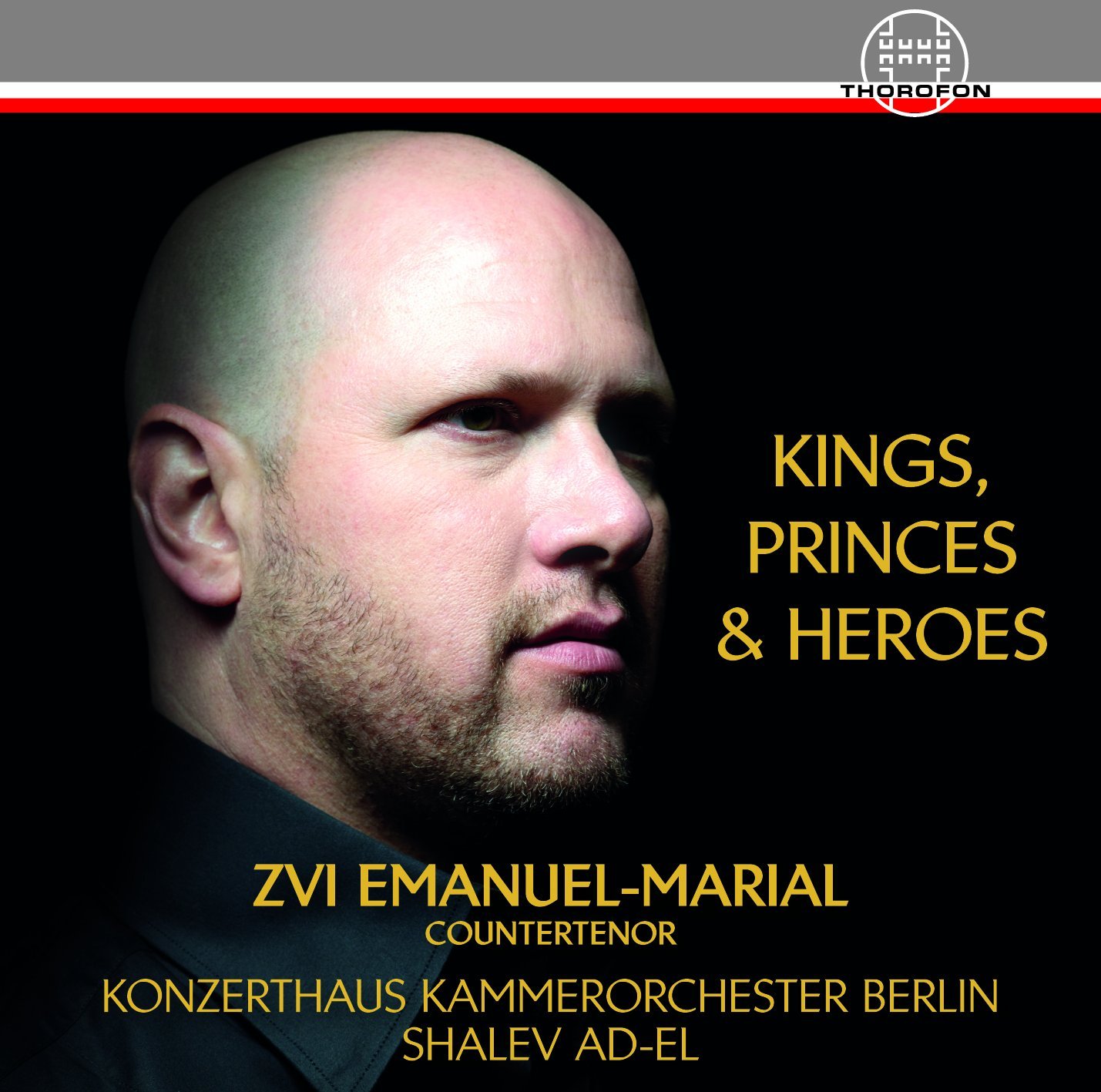
RECORDING OF THE MONTH / February 2016: G. F. Händel, C. W. Gluck, & W. A. Mozart — KINGS, PRINCES & HEROES (Zvi Emanuel-Marial, countertenor; Thorofon CTH2622)

CD REVIEW: G. F. Händel, C. W. Gluck, & W. A. Mozart - KINGS, PRINCES & HEROES (Zvi Emanuel-Marial, countertenor; Thorofon CTH2622)GEORG FRIEDRICH HÄNDEL (1685 – 1759), CHRISTOPH WILLIBALD GLUCK (1714 – 1787), and WOLFGANG AMADEUS MOZART (1756 – 1791): Kings, Princes & Heroes – Opera AriasZvi Emanuel-Marial, countertenor; Konzerthaus Kammerorchester Berlin; Shalev Ad-El, conductor [Recorded in b-sharp Studio, Berlin, Germany, 19 – 21 April 2015; Thorofon CTH2622; 1 CD, 52:42; Available from Amazon (USA), iTunes (USA), jpc (Germany), and major music retailers]

For the Twenty-First-Century listener with interest in and affection for music composed before 1800, one of the most frustrating missing pieces in the puzzle of musical history is the inability to know precisely how the legendary castrati of the Seventeenth, Eighteenth, and early Nineteenth Centuries actually sounded. It is possible through careful study of the music written for them to ascertain profiles of their technical proficiencies, but evidence of the characteristics of the sounds that they produced is circumstantial at best. Comparing critical assessments of today’s singers with what the ears hear often reveals broad chasms between the two points of view, and it cannot be assumed that writers of previous centuries were any more reliable in translating aural realities into literary mementos. It must be assumed, however, that among the ranks of castrati were as many varied timbres and distinct tonal palettes as exist among modern singers. The sole recordings of a castrato, made when their subject, the greatly-admired Cappella Sistina singer Alessandro Moreschi, was in his mid-forties, are invaluable documents but preserve a voice that bears no resemblance to the instruments described in Eighteenth-Century accounts of the work of singers like Senesino, Farinelli, and Carestini. Moreschi was trained for liturgical rather than operatic singing, of course, but his quavery tones as bequeathed to posterity via his 1902 and 1904 recordings, though poignant and sporadically lovely, only hint at the extraordinary brilliance attributed to his similarly-altered forebears. In some cases readied for the stage by the composers who wrote rôles for them, how can the castrati of the Baroque and Classical eras have sounded? Were the thoughts of diarists and writers like Charles Burney and Tobias Smollett, who wrote—fictionally but almost certainly reflecting authentic opinion among his contemporaries—in his 1771 picaresque novel The Expedition of Humphrey Clinker that the voice of Giusto Tenducci, a tremendously popular singer in London and among the few castrati who married, ‘to be sure is neither man’s nor woman’s but...is more melodious than either,’ clouded by the kind of hero worship that star castrati obviously inspired?

From the pioneering efforts of Alfred Deller and Russell Oberlin to the generation of singers like James Bowman and René Jacobs who reclaimed a place for their Fach in the world’s opera houses, perhaps the most significant vocal development of the past half-century has been the emergence of countertenors who sing the music written for castrati with passion and polish that at least suggest the inimitable mastery of their physically-metamorphosed ancestors. Since the 1988 Metropolitan Opera débuts of Jeffrey Gall and Derek Lee Ragin in Händel’s Giulio Cesare, countertenors have prevailed both in the MET’s National Council auditions and in international competitions, excelled in virtually all of the world’s major opera houses, and revitalized repertory not performed—or performed badly—since the deaths of the original interpreters. Moreover, countertenors of varying degrees of showmanship and natural vocal talent have in the past quarter-century significantly expanded the Fach’s territory beyond the confines of lute songs and Baroque repertory, an effort furthered by the gifted artist featured on this disc. Following a mesmerizing, superbly-sung Thorofon recording of Schubert’s Winterreise [reviewed here], Israeli-born countertenor Zvi Emanuel-Marial further enriches that label’s catalogue with Kings, Princes & Heroes, this recital of arias by Georg Friedrich Händel, Christoph Willibald Gluck, and Wolfgang Amadeus Mozart—arias first sung by castrati and now central to the modern countertenor repertory. Under the direction of Shalev Ad-El, whose uniformly ideal tempi disclose both affinity for the repertory and excellent working relationships with soloist and orchestra, the Konzerthaus Kammerorchester Berlin musicians provide period-appropriate but full-bodied accompaniments that, without miring the performances in idiosyncrasies, simply sound right for music by Händel, Gluck, and Mozart. Moreover, the conductor’s tempi and the orchestra’s sonorities complement the singer’s musical and dramatic inflections, providing him with a wholly sympathetic environment in which to explore the musical legacy of which his strikingly beautiful and immaculately-trained alto voice make him a natural and deserving inheritor.

Opening his thoughtfully-arranged programme with the title character’s aria ‘Dopo l’orrore’ from Händel’s superb (and still too-little-known) 1723 opera Ottone, re di Germania (HWV 15), Emanuel-Marial begins his journey into the heart of the castrato repertory with music composed for one of the most celebrated of these musical marvels, Francesco Bernardi. Using the nom de guerre Senesino, Bernardi frequently collaborated with Händel, who entrusted to him the creation of the primo uomo rôles in a number of his London operas. Emanuel-Marial sings both ‘Dopo l’orrore’ and Ottone’s ‘Ritorna, o dolce amore’ with considerable depths of feeling and focused tone. Especially in ‘Ritorna, o dolce amore,’ he compellingly uses the text to shape and propel the melodic line, both revealing the intelligence of Händel’s word setting and suggesting the intuition with which the composer clearly expected his star castrato to interpret the music. In all of the arias on Kings, Princes & Heroes, Emanuel-Marial exhibits an exceptional ability to depict three-dimensional characters within the duration of a single aria. He gives the listener a more comprehensive portrait of Ottone in a pair of arias than many singers have managed to do in performances—and recordings—of the full opera.

It was also Senesino who originated the rôles of the presumed-dead king Bertarido in Rodelinda (HWV 19, 1725) and the title warrior in Orlando (HWV 31, 1733), the second of these having earned the castrato particular praise for his nuanced performance of the character’s innovative mad scene. The furious fiorature of Bertarido’s ‘Vivi, tiranno’ challenge Emanuel-Marial’s technique and breath control, but he emerges unscathed: his natural gifts are better suited to lyrical effusions, but he dispatches the difficult divisions in ‘Vivi, tiranno’ with even tone, precise pitch, and exciting brio—qualities that bring to mind Charles Burney’s oft-quoted 1775 description of Senesino’s ‘powerful, clear, and sweet contralto voice,’ ‘perfect intonation,’ and ‘excellent shake.’ Indeed, Burney’s assertion that Senesino’s ‘manner of singing was masterly, and his elocution unrivalled’ is equally valid as an assessment of Emanuel-Marial’s singing of the Händel arias on this disc, an impression furthered by the countertenor’s dramatically fiery but vocally unperturbed account of Orlando’s ‘Fammi combattere mostri e tifei.’ As in Bertarido’s music, he emotes poetically without neglecting the sheer athleticism demanded by ‘Fammi combattere mostri e tifei.’ His negotiations of passagework are as clean as his insights into Händel’s characters are intelligent.

The title rôle in Händel’s idiosyncratic 1738 charmer Serse was created by Gaetano Majorano, acclaimed as Caffarelli by audiences in virtually all of the major European cities where opera was performed in the first half of the Eighteenth Century. An ingenious departure from the opere serie that typified Händel’s scores composed for London, Serse baffled Londoners in 1738, but the popularity of the aria rediscovered in the Nineteenth Century and ultimately—and stupidly—christened ‘Händel’s Largo’ rapidly endeared itself to listeners who had never so much as walked by an opera house. In the performance on this disc, Emanuel-Marial lends great tenderness to his delivery of the recitative ‘Frondi tenere e belle del mio platano amato,’ and his subdued, sincere traversal of the famous aria ‘Ombra mai fu’ evinces an almost erotic sensitivity: this Serse’s affection for his beloved plane tree permeates to the cellular level. Even more expressive is his traversal of Ruggiero’s exquisite ‘Verdi prati, selve amene’ from Alcina. First sung by Giovanni Carestini, the aria is one of Händel’s most haunting numbers, its lilting principal theme exuding a tranquility so profound as to almost seem disquieting. Emanuel-Marial’s dulcetly-phrased singing grants his Ruggiero a vulnerability that he ought to possess but so rarely does in performance, and the simplicity of his reading is touchingly effective.

Hearing his music alongside arias like those for Ruggiero and Serse reveals that Gluck learned much from Händel, but, though the Saxon had been dead for less than four years when Gluck’s Orfeo ed Euridice premièred in Vienna in 1762, much had changed in the composition of opera. Like Johann Adolf Hasse, Gluck was a contemporary of both masters of the late Baroque like Händel and Johann Sebastian Bach and avant-garde exponents of Viennese Classicism like Joseph Haydn, Antonio Salieri, and Mozart. By the time that Gluck revised Orfeo for Paris in 1774, however, the advocacy by rival camps for French and Italian opera had reached its fervent peak. Gluck’s operas energized and epitomized the argument on behalf of eschewing Italianate excess in favor of Gallic grandeur, thereby ostensibly returning opera’s ethos to its roots in Greek drama. Ironically, though, Orfeo became more florid, not less, when the opera was staged in Paris, the daunting bravura canzonetta ‘L’espoir renaît dans mon âme’ borrowed from Il Parnasso confuso and Le feste d’Apollo in order to provide the Paris Orphée, haute-contre Joseph Legros, with a suitably decorative showpiece. His own notes reflect that the renowned castrato Gaetano Guadagni, Gluck’s first Orfeo, ornamented his vocal lines in Vienna but tastefully and in a manner that gave his interpretation of the rôle heightened spontaneity. The effect of Guadagni’s vocalism in Orfeo’s ‘Che puro ciel’ cannot have failed to enchant audiences, but it can hardly have been more eloquent or unaffectedly musical than Emanuel-Marial’s singing of it on this disc. It is again the utter simplicity of the singer’s approach that awes: the concentration on purity of line engenders an acutely hypnotic performance. Emanuel-Marial movingly imparts the despair of ‘Che farò senza Euridice’ without wallowing in it, the voice poised even in the expression of tragic grief. This most famous of Gluck’s arias receives from Emanuel-Marial a voicing entirely free of routine but replete with the doleful sentiments of a fabled musician mourning the loss of his true love.

Mozart was an old man of fourteen years when his Mitridate, re di Ponto (KV 87/74a) premièred at Milan’s Teatro Regio Ducal in 1770. The feuding brothers Farnace and Sifare, a veritable operatic Cain and Abel, were first interpreted by the castrati Giuseppe Cicognani and Pietro Benedetti, the latter known to the public as Sartorino. The ingenuity with which Mozart differentiated the brothers by varying their music is remarkable for a composer of any age but thoroughly gobsmacking for one on the boyhood side of adolescence. In his brief survey of the young Mozart’s writing for castrati, Emanuel-Marial sings arias for both of Mitridate’s sons. Farnace’s ‘Venga pur, minacci e frema’ and ‘Va, l’error mio palesa’ are subtly contrasted, Mozart’s instrumentation already displaying noteworthy maturity, and the countertenor’s vocalism here adds a further level of individualization. In ‘Venga pur, minacci e frema,’ Emanuel-Marial’s voice glistens with the steely glint of indolence, his impassioned singing of the roulades aptly hinting at the character’s self-serving ambition and ruthlessness. His performance of ‘Va, l’error mio palesa’ manifests confidence and swagger, though, as in ‘Vivi, tiranno,’ the coloratura demands are met capably but not completely comfortably. Of an altogether divergent spirit is Sifare’s ‘Lungi da te, mio bene.’ Emanuel-Marial duets magnificently with the virtuosic horn obbligato, played wonderfully by the unidentified Konzerthaus Kammerorchester Berlin soloist, but the foremost accomplishment of his singing is the spectrum of emotions that he unfurls by emphasizing not sequences of notes but words and long-breathed phrases. Emanuel-Marial’s prowess at so palpably distinguishing Farnace from Sifare in the context of a recital disc is indicative of the magnitude of his artistry.

It is impossible to judge whether Zvi Emanuel-Marial’s singing on Kings, Princes & Heroes in any way resembles the sounds with which Senesino, Caffarelli, Carestini, Guadagno, Cicognani, and Sartorino beguiled audiences in the Eighteenth Century, but it is impossible to judge Kings, Princes & Heroes as anything but a very enjoyable, often enlightening disc. It is regrettable that history and technology do not allow today’s listeners to hear the great castrati as they sounded when the ink was still wet on Händel’s, Gluck’s, and Mozart’s scores. With the work of a singer as skilled as Zvi Emanuel-Marial to savor, though, that regret disappears the moment that his first notes take flight.

09 February 2016

PERSONAL PERSPECTIVES: Revisiting Dame Joan Sutherland’s Norma in its infancy, courtesy of Immortal Performances

REASON FOR CELEBRATION IN GAUL: Vincenzo Bellini - NORMA (Immortal Performances IPCD 1055-3)VINCENZO BELLINI (1801 – 1835): Norma—Dame Joan Sutherland (Norma), Marilyn Horne (Adalgisa), John Alexander (Pollione), Richard Cross (Oroveso), Betty Phillips (Clotilde), Karl Norman (Flavio); Chorus and Orchestra of Vancouver Opera; Richard Bonynge, conductor [Recorded ‘live in performance at Vancouver Opera on 26 October 1963; Immortal Performances IPCD 1055-3; 3 CDs, 216:41; Available from Immortal Performances; includes bonus material featuring Sutherland in arias and scenes from La traviata, Die Meistersinger von Nürnberg, Alcina, Lucia di Lammermoor, Rigoletto, and Tosca]

When writing about music, my foremost goals are to assess performances fairly and as knowledgeably as my flawed and woefully incomplete education and comprehension permit and to do so in a manner that always remains respectful of artists and their endeavors. Reconciling the pursuit of the first of these goals with adherence to my commitment to the second is not always an easy task, but my work is guided by a maxim often quoted by my grandmother, who still personifies its wisdom at the age of ninety-five: if I have nothing positive to say, it is better that I say nothing at all. In this age in which artists must endure the venomous barbs not only of wagging tongues and agenda-laden pens but also of likes and shares, tweets and retweets, and every imaginable public degradation of dignity and privacy, there is a war on criticism that is not unjustified. What I regret most is that the demands faced by artists—demands that often have little to do with singing—beget an environment in which the insecurities even of singers with little to fear from the stupidities of would-be critics diminish their abilities to reciprocate the conviction of those writers who respect them whether they sing like paragons or pillocks. With every good intention under heaven, however, there are performances about which I cannot be wholly impartial. One of these is the Vancouver Opera performance of Vincenzo Bellini’s Norma of 26 October 1963, an illustrious evening in the production that inaugurated one of the most widely-traveled operatic portrayals of the second half of the Twentieth Century, the Norma of Australian soprano Dame Joan Sutherland. It was for her singing of the title rôle in Händel’s Alcina, also the rôle of her American début in Dallas in 1960, that the Venetian public christened her as La Stupenda, but her impersonation of Norma, a characterization revealed by the near-miraculous sonics achieved by Richard Caniell and Immortal Performances—an achievement described in a 2001 letter, reproduced in Immortal Performances’ typically superb liner notes [both Fanfare critic Henry Fogel’s introductory essay and Caniell’s and Robert Dales’s remembrances of Irving Guttman, the director of the Vancouver Opera Norma and source of the original recording that yielded this release, meaningfully enhance enjoyment of this Norma], by the conductor of the performance, Sutherland’s husband and frequent collaborator and Artistic Director of Vancouver Opera from 1974 until 1982, Richard Bonynge, as ‘wonderful, so present and vibrant’—to have been remarkably consistent from its inception in Vancouver to its final outings in staged form in Costa Mesa, California, and Detroit, Michigan, in 1989. After being exposed as a musically unambitious high-schooler to John Pritchard’s studio recording of Raymond Leppard’s abridged edition of Monteverdi’s L’incoronazione di Poppea, Lorin Maazel’s DECCA Fidelio with Birgit Nilsson and James McCracken, and Sir Colin Davis’s Philips La bohème with Katia Ricciarelli and José Carreras, it was hearing the 1980 DECCA recording of Verdi’s La traviata—recommended to the aspiring singer that I was twenty years ago for Matteo Manuguerra’s under-appreciated Giorgio Germont rather than for its Violetta—that introduced me to Sutherland, and it was Sutherland whose tenacious dedication to respecting audiences by always giving of her best planted the seeds of my own diligence in respecting conscientious artists even when they fail. The most savage of Sutherland’s detractors, those who complain that her Norma lacked the psychological acuity brought to the part by Maria Callas and the fire-breathing abandon of Leyla Gencer’s study of the character, could never accuse her of outright failure; not when she sang the music as she does on these discs. What would a critic like Winthrop Sargeant, who wrote in The New Yorker in response to Sutherland’s first Norma at the Metropolitan Opera in 1970, among words of praise for the overall quality of her vocalism, that ‘hers is a cold coloratura voice, without much emotional coloring,’ say were he able to hear Immortal Performances’ restoration of this document of Sutherland’s Norma in its infancy with performances of Norma at the MET—indeed, in any of the world’s opera houses—in recent seasons in his mind’s ear?

Richard Bonynge said of his wife in a 2011 interview with The Australian, not long after her passing on 10 October 2010 [perhaps some sort of cosmic symmetry is reflected in this most balanced of artists having made her final exit from life’s stage on 10.10.10], that ‘she didn’t need applause, she was a very down-to-earth, practical lady. It’s quite true she had no idea of the importance of what she’d done in the world. You could tell her, but I don’t think she really listened. She loved to sing and that was it.’ The bonus material included on this Immortal Performances release confirms the validity of Bonynge’s appraisal of his consort’s musical ethos. From her first North American performances of Violetta in La traviata with Opera Company of Philadelphia, also directed by Irving Guttman, are drawn the final ten minutes of Act One and the magnificent scene for Violetta and Germont père in Act Two, pairing Sutherland first with Mississippi-born tenor John Alexander’s Alfredo and then with French baritone Gabriel Bacquier’s Giorgio. Predictably superb in ‘Sempre libera degg’io folleggiar di gioia in gioia,’ she reaches more exalted heights of expression in her interactions with Bacquier than contemporary accounts of her Violetta, most of which are founded upon unfavorable comparisons with Callas’s very different interpretation of the rôle, suggest were within her purview.

An especially valuable addition to Sutherland’s discography is the scene from Act Three of Richard Wagner’s Die Meistersinger von Nürnberg that culminates in the great Quintet, here sung in English in a performance extracted from a 1957 Covent Garden gala and nobly conducted by Rafael Kubelík. Alongside James Pease’s Hans Sachs, the young Jon Vickers’s Walther, John Lanigan’s David, and Noreen Berry’s Magdalene, Sutherland voices Eva’s lines with an ideal blend of vocal freshness and amplitude. This is an Eva with a genuine trill whose tones are not apt to go missing in ensembles! Die Meistersinger, sung in Wagner’s original German, was in Covent Garden’s repertory in the 1956 –1957 Season, during which Sutherland’s Eva auf Deutsch was complemented by the David of Sir Peter Pears and the Beckmesser of Sir Geraint Evans, with Pease singing Sachs and the little-remembered Erich Witte as Walther: perhaps some collector has a recording of a complete Meistersinger from the January 1957 run that could be shared with Immortal Performances.

Sampling the opera that was the vehicle for her Teatro La Fenice and North American débuts in 1960 and the rôle of her triumphant MET début a year later, excerpts from a 1959 BBC concert broadcast conducted by Sir Malcolm Sargent offer arias from Alcina and Donizetti’s Lucia di Lammermoor. The brilliance of Sutherland’s fiorature in Lucia’s ‘Regnava nel silenzio’ is unsurprising, but ears accustomed to the avian fluttering of the small voices frequently employed in Baroque repertory since the 1970s may be stunned to hear an instrument as vast as Sutherland’s reveling in the intricacies of Alcina’s ‘Dì, cor mio, quanto t’amai’ and Morgana’s familiar ‘Tornami a vagheggiar,’ the Dame from Down Under hardly being the only Alcina guilty of usurping her sister’s showpiece aria. Sutherland was a far more stylish Händel singer than many historically-informed performance practice advocates have been willing to acknowledge, her ornamentation when left to her own devices—the differences among the Kölner Rundfunk performance of Alcina conducted by Ferdinand Leitner and the DECCA studio recording prepared and led by Bonynge are particularly telling in that regard—unfailingly tasteful and far more restrained than might be imagined. The richness of the timbre and, of course, the trills are truly revelatory and inarguably period-appropriate. After all, she famously quipped whilst recording the title rôle in Händel’s Athalia with The Academy of Ancient Music late in her career that she was the oldest period instrument in the room! Under the direction of Donald Vorhees in gems from the Bell Telephone Hour transmission of 22 March 1968, Sutherland’s Gilda manages to marginalize Tito Gobbi’s Rigoletto, Nicolai Gedda’s Duca di Mantova, and Mildred Miller’s Maddalena in the rightly beloved Quartet from Act Four of Verdi’s Rigoletto. Gobbi takes revenge of sorts in Scarpia’s confrontation with the heroine from Act Two of Puccini’s Tosca. Gobbi is not as secure of voice or dramatic instincts as when he sparred with Callas’s Tosca in the 1950s, but he remains a Scarpia of visceral menace, here facing a Tosca he could not dominate solely via vocal means. Sutherland’s studio recording of Tosca’s ‘Vissi d’arte, vissi d’amore’ was appended in one CD reissue to her DECCA recording of Suor Angelica, another piece in which she excelled, not least in Australian Opera performances that united her in 1977 with the implacable Zia Principessa of Rosina Raisbeck, but the thoroughly competent studio reading of the aria pales in comparison with this performance. For once, one need not make apologies for the sounds with which the Tosca at hand professes to have lived for Art. Sound quality in these selections is not High Fidelity, but, as in the Vancouver Norma, Caniell’s wizardry produces aural ambiances in which one hears all that one needs to hear in order to marvel at the stylistic variety of which Sutherland—she of the ‘cold coloratura voice’—was capable.

Recorded at Irving Guttman’s request via a house feed in the Queen Elizabeth Theatre, the audio quality of the Vancouver Norma is imperfect, the voices sounding varyingly distant as the singers move about the stage and the orchestra frequently over-prominent, but, based upon surveys of previous recorded incarnations of this performance, the source materials for which are conspicuously unidentified, Caniell has considerably brightened the sonic landscape, granting the voices clear focus without jeopardizing accuracy and stability of pitch. Vitally, though, the depth of the sound enables a far better cognition of the size and thrust of Sutherland’s voice than her studio recordings permit, and one adjusts to the sound quickly as the performance draws one into the drama. To Vancouver Opera’s credit, Sutherland is surrounded by an ensemble of singers who merit the distinction of taking part in such an historic occasion. Bonynge remained ‘green’ as a conductor of opera when he mounted the podium for the Vancouver performances of Norma, and if his pacing of the performance on these discs lacks the idiomatic drive and command of nuance brought to the score by Vittorio Gui and Tullio Serafin there is no want for attentive support of the singers, an element for which one often searches in vain in today’s performances. The Vancouver Opera Chorus and Orchestra, giving Bellini’s score its first hearing in Canada, obviously prepared fastidiously for their tasks, their work undermined by commendably—astonishingly, really—few mistakes and virtually no lapses in ensemble. Soprano Betty Phillips and tenor Karl Norman are more than serviceable as Clotilde and Flavio, never embarrassing themselves in their scenes with their larger-voiced colleagues. Bass-baritone Richard Cross is a vocally solid Oroveso who evinces a measure of sympathy for the father’s predicament, his voicing of ‘Ite sul colle, o druidi’ in Act One and ‘Ah! del Tebro al giogo indegno’ in Bellini’s Act Two—Vancouver Opera’s Act Four—gratifyingly secure. Sutherland’s Philadelphia Alfredo, as well as her leading man in MET performances of La sonnambula, Lucia di Lammermoor, Norma, La fille du régiment, Les contes d’Hoffmann, La traviata, and Esclarmonde, John Alexander is in this Vancouver performance an even more reliable Pollione than he was in the 1964 RCA Victor/DECCA studio recording of Norma, in which he and Sutherland were also reunited with their Vancouver Adalgisa and Oroveso. Here, Alexander sings ‘Meco all’altar di Venere era Adalgisa in Roma’ phenomenally, his top notes impressive despite the paucity of the squillo of a Lauri-Volpi, Penno, or Corelli, and machismo mixes with suavity in his red-blooded account of the cabaletta ‘Me protegge, me difende un poter maggior di loro.’ The impact of Alexander’s bronze-toned singing of ‘Va', crudele; al dio spietato offri in dote al sangue mio’ in the duet with Adalgisa is tremendous, and he continues to build momentum with fearless showings in the trio that ends Act One and the stirring duet with Norma in Act Two [again, Act Four in the Vancouver production], ‘In mia man alfin tu sei,’ in which he proves more capable than many Polliones by singing all of the roulades entrusted to him by Bellini rather than ceding half of them to Norma. Moreover, when he sings ‘Ma tu morendo, non m'aborrire, pria di morire, perdona a me’ in the opera’s final scene, Alexander is the rare Pollione who sounds as though he means it.

MIRA, O NORMA: Mezzo-soprano MARILYN HORNE as Adalgisa (left) and soprano DAME JOAN SUTHERLAND as Norma (right) in San Francisco Opera's 1982 production of Vincenzo Bellini's NORMA [Photographer not credited; photo © by San Francisco Opera]Mira, o Norma: Mezzo-soprano Marilyn Horne as Adalgisa (left), Thomas Garadis as Norma’s and Pollione’s son (center), and soprano Dame Joan Sutherland as the title heroine (right) in San Francisco Opera’s 1982 production of Vincenzo Bellini’s Norma [Photographer not credited; photo © by San Francisco Opera]

Listeners familiar with the 1964 studio recording or the storied MET broadcast of 4 April 1970, one of the truly legendary afternoons in MET history, are already acquainted with the feats that Marilyn Horne accomplished in her performances of Bellini’s music for Adalgisa. Composed for Giulia Grisi, the rôle was commandeered by mezzo-sopranos by the beginning of the Twentieth Century, but Horne, though a mezzo-soprano herself, restored to the part the flair and unflinching command of the range of the music that Grisi surely brought to it. From the first notes of her expansively-phrased ‘Sgombra è la salva secra’ in this performance, she fashions a depiction of Adalgisa that veritably defines bel canto, musically and dramatically. She answers Alexander’s ‘Va', crudele’ with a firm but feminine ‘E tu pure, ah! tu non sai quanto costi a me dolente!’ Then, divulging the shame of her affair with Pollione to Norma, she projects both embarrassment and the frisson of young love in ‘Sola, furtiva, al tempio io l’aspettai sovente.’ Sutherland’s and Horne’s singing of ‘Ah! sì, fa' core, e abbracciami’ was one of the musical wonders of the Twentieth Century, and here, in one of its earliest manifestations, it is an artistic equivalent of Old Faithful—a sensation both in the moment and in the dependability with which it was repeated throughout the duration of the singers’ Norma partnership. Horne articulates ‘Oh! qual traspare orribile dal tuo parlar mistero!’ and ‘Ah! non fia, non fia ch’io costi al tuo core sì rio dolore’ in the trio with the potency of an earnest Sieglinde pleading for Brünnhilde’s protection. Norma’s and Adalgisa’s ‘Deh! con te, con te, li prendi,’ ‘Mira, o Norma, a' tuoi ginocchi questi cari pargoletti,’ and ‘Sì, fino all’ore estreme compagna tua m’avrai’ in Act Two constitute one of the finest sequences in Italian opera, and no listener past, present, or future could hope to hear this music executed more electrifyingly than Sutherland and Horne sing it in this performance. One of the gnawing enigmas of Norma is the uncertainty of Adalgisa’s fate after her final duet with Norma: some productions insert her into the opera’s final scene as an observer, but this is an extrapolation rather than a faithful realization of Bellini’s and his librettist Felice Romani’s stage directions. The singing of many recent Adalgisas has inspired an ‘out of sight, out of mind’ reaction: having endured their vocalism, one is not overly concerned with the future of the character they portrayed. Horne’s Adalgisa, on the other hand, deserves her own opera in which to explore her life post-Norma. Horne did not long retain Adalgisa in her repertory, reuniting with Sutherland at Covent Garden in 1967 and for seven performances at San Francisco Opera in 1982 and singing the rôle at the MET twenty-five times in 1970 from her company début on 3 March until the matinée broadcast performance of 19 December, Sutherland her Norma in each of those performances, but not returning to the part at the MET between the opening of the 1973 revival of the Deiber production for Montserrat Caballé and her retirement from the company in 1996, but she was already an Adalgisa for the ages at the time of this Vancouver performance. From perspectives of both technical prowess and histrionic credibility, few singers in recent memory have as completely inhabited a rôle as Horne did Adalgisa.

Vocally, neither Callas nor any other singer consistently sang Norma’s music as accurately or as easily as Sutherland sang it, and this performance reveals that her dominion over the notes of the part was present from the inception of her interpretation. That an artist as attentive as Sutherland was to ensuring that she gave every audience who gathered to hear her a memorable experience should have sung a rôle only when she was painstakingly prepared to do so might be taken for granted, but this recording confirms the breadth of Sutherland’s artistic integrity. A weapon in Sutherland’s vocal arsenal that few singers in the Twenty-First Century can cite as a component of their own work is the immediately-identifiable timbre: she has here produced no more than two notes in ‘Sedizïose voci, voci di guerra’ before an irrefutable signal rushes from the ears to the brain, saying, ‘Ah, yes, this is definitely Dame Joan!’ Few Normas would be likely to dispute the assertion that ‘Casta diva, che inargenti queste sacre antiche piante’ is one of the most difficult arias in the soprano repertory, its exacting legato—the ‘melodie lunghe, lunghe, lunghe’ of which Verdi wrote—taxing a singer’s breath support as dauntingly as the most fiendish fiorature. Nevertheless, there is nothing tentative about Sutherland’s singing of the aria in this performance. She must have been nervous to some degree, but whatever apprehension she felt was kept far from the vocal cords. It was frequently said even at this juncture in her career that Sutherland’s diction was quite poor, but I am apparently fluent in the idiosyncratic dialect in which she sings on these discs as I encounter little trouble with discerning the text. The aria’s cantilena is shaped with intelligence and imagination. Sutherland does not treat ‘Fine al rito; e il sacro bosco sia disgombro dai profani’ merely as a conduit from aria to cabaletta, but, once arriving at the cabaletta, she hurls out the divisions and top notes in ‘Ah! bello a me ritorna del fido amor primiero’ with almost insouciant assurance. The first duet with Horne is pure magic: if Giuditta Pasta and Giulia Grisi sang this more beautifully than Sutherland and Horne sing it here, they can hardly have been of this world. Not even Callas and Ebe Stignani or Giulietta Simionato sang the passages in thirds so precisely. Bonynge has not yet fully sorted out how to keep the sprawling trio moving seamlessly, but Sutherland, Horne, and Alexander generate energy that propels the music towards its organic conclusion. Many Normas come to grief in the coloratura outbursts that preface a pair of top Cs, but Sutherland is unperturbed, her calm negotiations of her part’s obstacles encompassing unflappable traversals of ‘Oh, non tremare, o perfido’ and ‘Oh! Di qual sei tu vittima crudo e funesto inganno!’ Vehemence seemingly was not part of her natural temperament, but her singing of ‘Vanne, sì: mi lascia, indegno, figli oblia, promesse, onore’ is not without flashes of the anger of a scorned woman. Among her Normas widely available on compact disc, only the top Ds that brought the curtains down on Act One in the 1969 Teatro Colón broadcast and the earlier of the two 1970 MET broadcasts match the stellar D6 in this performance in conveying a sense of the titanic dimensions of Sutherland’s voice.

Sutherland was not the singing actress to unleash Imelda Staunton-esque intensity in the scene at the start of Act Two in which the distraught Norma contemplates slaying her own children, but in this performance her ‘Dormono entrambi’ throbs with the conflicting passions of a betrayed lover and maternal instincts. It is inconceivable that any Norma could ignore the entreaties of Horne’s Adalgisa in ‘Mira, o Norma,’ but Sutherland’s Norma’s acquiescence is all the more touching for being voiced with such beauty and impeccable sculpting of line. Assiduous students of bel canto could find no better models for perusal than Sutherland’s and Horne’s singing of the duets for Norma and Adalgisa in this performance: their tones ideally projected, the breath support unfaltering, with lines driven by vowels, the ladies’ endeavors perfectly embody the primary tenet of bel canto defined when Mathilde Marchesi wrote that ‘sound is a property of the air, as colour is of light, for there can be no sound without air, any more than there can be colour without light.’ Following his colleagues’ examples, Alexander’s singing in the duet ‘In mia man alfin tu sei’ is gloriously heroic but unimpeachably stylish, but even his sterling efforts are eclipsed by Sutherland’s Herculean performance. What warmth and profundity of emotion that ‘cold coloratura voice’ radiates! The interpolated E♭6 with which she crowns the duet—a note that she attempted in performances of Norma only in Vancouver and in her first Covent Garden Normas in 1967, when Horne was again her Adalgisa—is staggering, a colossal, thrillingly secure sound from the throat not of a canary but of a cannon cloaked in velvet. Sutherland does not rival Callas’s dramatic fervor with her utterance of Norma’s critical mea culpa, ‘Son io,’ but her unaffected enunciation of those two most important words in the opera is effective on its own terms. The sheer tonal pulchritude with which she delivers ‘Qual cor tradisti, qual cor perdesti’ and ‘Deh! non volerli vittime del mio fatale errore’ is arresting, ending the opera not as a singer who has put in a good evening’s work but as a Norma who, burned by life, seeks refuge and respite in a fiery death.

As mind-boggling as the sangfroid with which Sutherland ascended to this summit of Lyric Art on her first attempt is the fact that Norma remained in her repertory for nearly twenty-six years. Amassing more than 120 performances of the rôle in the quarter-century spanning the period from her Vancouver performances to those for Opera Pacific and Michigan Opera Theatre, she is likely the most-heard Norma in the opera’s history. In a Los Angeles Times interview after a rehearsal for one of her valedictory Costa Mesa Normas in 1989, Sutherland responded to a question about bel canto purists who objected to her downward transpositions of certain passages by saying, ‘Well, the purists don’t have to sing, do they?’ This epitomizes her candor and no-nonsense approach to maintaining equilibrium among service to the composer, management of her vocal resources, and fulfilling audiences’ expectations. Listening to Immortal Performances’ edition of this Vancouver Opera Norma has given me pause to consider why Norma is my favorite opera—a favorite opera alongside Händel’s Tamerlano, Verdi’s Don Carlos and Strauss’s Die Frau ohne Schatten, that is. The enchantingly diverse Normas of Gina Cigna, Zinka Milanov, Maria Callas, Leyla Gencer, Cristina Deutekom, Rita Hunter, and Marisa Galvany are those that have molded my understanding of the opera’s theatrical potential, but hearing this Vancouver performance with the clarity and scope of detail that Richard Caniell’s restoration facilitates causes me to fully appreciate and extol the extent to which Dame Joan Sutherland is as responsible as Bellini might claim to be for my love for Norma.

BELLES OF BEL CANTO: Soprano DAME JOAN SUTHERLAND as Norma and mezzo-soprano MARILYN HORNE as Adalgisa in Vincenzo Bellini’s NORMA at the Metropolitan Opera in April 1970 [Photo by Louis Mélançon, © by The Metropolitan Opera]Belles of bel canto: Soprano Dame Joan Sutherland as Norma and mezzo-soprano Marilyn Horne as Adalgisa in Vincenzo Bellini’s Norma at the Metropolitan Opera in April 1970 [Photo by Louis Mélançon, © by The Metropolitan Opera]

01 February 2016

PERFORMANCE REVIEW: Charles Gounod — ROMÉO ET JULIETTE (J. Boyd, S. J. Miller, K. Sogioka, K. Langan, E. Solís, B. Arreola, S. Nicely, A. Sewailam; Opera Carolina, 30 January 2016)

IN PERFORMANCE: Soprano MARIE-EVE MUNGER and tenor JONATHAN BOYD as the title couple in Opera Carolina's production of Charles Gounod's ROMÉO ET JULIETTE, January 2016 [Photo by Jon Silla, © by Opera Carolina]CHARLES-FRANÇOIS GOUNOD (1818 – 1893): Roméo et Juliette, CG 9Jonathan Boyd (Roméo), Sarah Joy Miller (Juliette), Kimberly Sogioka (Stéphano), Kevin Langan (Frère Laurent), Efraín Solís (Mercutio), Brian Arreola (Tybalt), Susan Nicely (Gertrude), Ashraf Sewailam (Le comte Capulet), Eric Loftin (Le comte Pâris), Andrew McLaughlin (Grégorio), Martin Bakari (Benvolio), Keith Brown (Le duc de Vérone); Opera Carolina Chorus; Charlotte Symphony Orchestra; James Meena, conductor [Bernard Uzan, Director and Production Design; Michael Baumgarten, Production, Lighting, and Projection Designs; Kara Wooten, Ph.D., Fight Director; Martha Ruskai, Wig and Makeup Designs; A. T. Jones and Sons, Inc., Costume Designs; Opera Carolina, Belk Theater, Blumenthal Performing Arts Center, Charlotte, North Carolina; Saturday, 30 January 2016]

When William Shakespeare died on 23 April 1616, opera in the form typified by the works of Mozart, Verdi, Wagner, and Puccini was in its infancy. Jacopo Peri’s Dafne, now widely though not universally acknowledged as the earliest known work recognizable as an opera in the modern sense, was first performed less than two decades before Shakespeare’s death, and the operas of Claudio Monteverdi, like Peri a close contemporary of the English playwright, influenced the development of Italian opera in the Seventeenth Century as powerfully as Shakespeare’s plays propelled writing for the English stage. Whether Shakespeare was musically inclined is unknown, but his characteristic iambic pentameter undeniably possesses an inherent melodiousness. This, combined with the psychological perspicacity of his depictions of the aspects of humanity that he brought to life in London’s theatres, makes Shakespeare’s dramas uncommonly fertile fodder for operatic treatment. From Francesco Bianchi’s La morte di Cesare, premièred in Venice in 1788, to Thomas Adès’s Twenty-First-Century masterpiece The Tempest, Shakespeare’s plays have inspired an astounding array of works spanning virtually the entire stylistic spectrum of opera. A pair of operas could hardly be more different than Rossini’s and Verdi’s settings of Otello, but they share a genuine dedication to translating the poetry of Shakespeare’s iconic play into music of equal sentimental impact. If Rossini succeeded in this aim only in his music for Desdemona, Verdi arguably produced a score that is a paragon of the art of setting a Shakespeare text—in this case, superbly adapted by Arrigo Boito—to music. In its very different way, so, too, is Charles Gounod’s Roméo et Juliette, Jules Barbier’s and Michel Carré’s libretto for the opera having been justifiably praised as an exceptionally faithful recreation of Shakespeare’s play at the time of the work’s première at the Théâtre-Lyrique Impériale du Châtelet in Paris on 27 April 1867. Owing in no small part to the espousal of Hector Berlioz, whose symphonie dramatique Roméo et Juliette was first performed in 1839, Shakespeare was as revered in Nineteenth-Century France as Corneille, Molière, Racine, Voltaire, and Hugo, a reality of which Gounod, Barbier, and Carré were keenly aware. It is hardly surprising that English critics, de facto guardians of their literary heritage, found much to criticize when Roméo et Juliette reached London later in 1867, with the legendary Adelina Patti as Juliette, but it is intriguing—and, admittedly, amusing—to note that Gounod’s opera was unfavorably compared as a Shakespearean homage to Nicola Vaccai’s now largely-forgotten [except for its celebrated final scene, a favorite of Maria Malibran] 1825 Giulietta e Romeo, the libretto for which, like that of Bellini’s I Capuleti ed i Montecchi, was not even derived from Shakespeare! Gounod was taken to task for composing a score that was dismissed as nothing more than an extended duet for the title couple, but, the complications of its drama notwithstanding, are the interactions between its hero and heroine not also the heart of Shakespeare’s Romeo and Juliet? Directed by Bernard Uzan and framed by Michael Baumgarten’s lighting and projections with the blend of imagination and insight absent from so many productions not just of Roméo et Juliette but of all the works that enliven the world’s stages, Opera Carolina’s new production, soon to also be seen at Virginia Opera, Toledo Opera, Opera Grand Rapids, and Lyric Opera Baltimore, excelled precisely as Gounod’s music and Shakespeare’s drama demand: in placing Roméo and Juliette at the center of the opera’s psychological journey. In details large and small, on the stage and in the pit, this was a Roméo et Juliette that kindled a suggestion that the Place du Châtelet runs through Charlotte.

It is indicative of the affection that Roméo et Juliette inspired in the first few decades after its première that the opera entered the repertory of New York’s Metropolitan Opera in April 1884, during the company’s inaugural season, albeit in Italian and on tour in Philadelphia. The opera subsequently opened the MET’s 1891 – 1892 Season with a phenomenal cast headed by the brothers Jean de Reszke and Édouard de Reszke as Roméo and Frère Laurent and Emma Eames—the MET’s first Contessa in Le nozze di Figaro, Pamina in Die Zauberflöte, Charlotte in Werther, Alice Ford in Falstaff, Santuzza in Cavalleria rusticana, Mascagni’s eponymous Iris, and Ero in Luigi Mancinelli’s forgotten Ero e Leandro!—as Juliette and, remarkably, was revived to launch the 1894 – 1895, 1895 – 1896, 1899 – 1900, 1900 – 1901, and 1906 – 1907 Seasons. The star-crossed lovers portrayed by Jean de Reszke and Dame Nellie Melba, Beniamino Gigli and Lucrezia Bori, and Jussi Björling and Bidú Sayão are rightly legendary, and it was as Juliette that Geraldine Farrar débuted at the MET in 1906. The stylistically insensitive but vocally refulgent Roméo of Franco Corelli looms large in the opera’s history in the second half of the Twentieth Century, contrasting markedly with the more refined Roméos of Nicolai Gedda, Alain Vanzo [never heard at the MET, unfortunately], and Alfredo Kraus. Extending this legacy into the Twenty-First Century, Opera Carolina’s production exuded respect for Gounod’s score, the team of artists performing it, and the audience gathered to enjoy their endeavors. The evocative juxtapositions of fantasy and realism in the production team’s set and projection designs, the rich tones of A. T. Jones and Sons’ costumes, and the unfailingly becoming wigs and makeup by Martha Ruskai credibly situated the drama in Fourteenth-Century Verona as stipulated by original source, librettists, and composer, compellingly depicting the isolation imposed upon Roméo and Juliette by the belligerent environment in which their love somehow takes root.

The grandeur conjured on the stage was enhanced by the Gallic sophistication that emanated from the orchestra pit. Without mimicking any of their individual styles, Opera Carolina’s General Director and Principal Conductor James Meena paced a performance of Roméo et Juliette—the score that was the vehicle for his début with Opera Carolina in 2001—that sporadically brought to mind celebrated traversals of the score led by Emil Cooper, Jules Gressier, and Jean Fournet. Like his conducting of Gounod’s Faust in Charlotte in 2008, Meena’s handling of this performance of Roméo et Juliette was attentive to the score’s nuances, reveling in the exuberance of the Ball Scene, luxuriating in the romance of the Balcony Scene, and mixing pained emoting with restraint in the opera’s final scene, but there were conspicuous lacks of cohesion among scenes and cumulative momentum. Using an edition that bizarrely restructured Gounod’s five acts into two [Opera Carolina’s website suggested that the production presented the opera in four acts, but the playbill specified two—and then the break curiously did not correspond with that indicated in the printed synopsis: for the sake of clarity for those readers not in Charlotte whose acquaintance is with Gounod’s five-act structure as published by Choudens, references in this review adhere to the five-act form], Meena nonetheless achieved musical and sentimental equilibrium on an impressive scale, managing orchestral textures and layers of ensemble with concentration that gave the singers the support that they needed without downplaying the music’s moments of Wagnerian largesse. Occasionally, the inconsistent energy of the conductor’s work threatened to break the silken thread of delicacy that envelops even the score’s most ironclad pages, and there were numerous instances in which tempi were sluggish. Under his baton, however, the playing of the Charlotte Symphony Orchestra was competitive with the sounds produced by the world’s foremost opera house orchestras. Gounod’s music is often damned with the faint praise of being said to predominantly be pretty. Indeed, the music in Roméo et Juliette is frequently very pretty, but is that really a quality to be condemned? There are passages of great difficulty in the orchestral parts of Roméo et Juliette, and the Charlotte Symphony musicians executed them splendidly. Individually—the clarinet solo that prefaces Roméo’s ‘Ah! lève-toi, soleil!’ and the chamber-like writing for small groups of strings were fantastically played—and in ensemble, the musicians reacted to Meena’s leadership with shared vision, acquitting Gounod of charges of being a composer of tuneful but mostly uninspired music.

Whether making merry at the Capulets’ ball, perpetrating the street violence between the rival families, or reacting to Roméo’s banishment by the Duke, the choristers in Roméo et Juliette are, en masse, a character in their own right. In this performance, that character was entrusted to performers as committed to singing well as any of the principals. Building on their strong showings in Turandot and Fidelio, the ladies and gentlemen of the Opera Carolina Chorus ably partnered their colleagues in the pit by offering singing that challenged the performances by any of the world’s preeminent opera houses’ choruses. The choristers’ training resonated in every bar in this performance, the balances among parts often virtually ideal without the ensemble seeming transformed into an over-sized church choir. In the opening chorus of what Gounod and his librettists, following Shakespeare’s example, designated as the opera’s brief Prologue, ‘Vérone vit jadis deux familles rivales,’ the choristers proclaimed the familiar introduction of the feuding families and their beleaguered offspring with ominous depth of tone. At the Capulet ball in Act One, they voiced ‘L’heure s’envole joyeuse et folle’ with the carefree zeal of people ready for a good party. Their exclamation of ‘Ah! qu’elle est belle!’ upon catching sight of Juliette was appropriately filled with awe, but the ladies infused their singing of ‘Nargue! nargue des censeurs’ with darker implications. Sobriety also defined the choristers’ account of ‘Mystérieux et sombre’ in Act Two. The choral singing was at its peak when it counted most, in the Act Three finale. Every singer on stage contributed to a rousing performance of ‘Ô jour de deuil!’ that sparked a spiritual conflagration that was not extinguished until the curtain fell on Juliette dead in Roméo’s arms. Choral singing is a weakness in many performances of Roméo et Juliette: in Opera Carolina’s performance, it was a decided strength. Regrettably, the audience seemed not to realize that the chorus’s curtain call at the close of Gounod’s Act Three marked the choristers’ last appearance on stage: the tepid applause surely cannot have reflected the audience’s assessment of the choral singing.

IN PERFORMANCE: Mezzo-soprano SUSAN NICELY as Gertrude (center) with members of Clan Capulet in Opera Carolina’s production of Gounod’s ROMÉO ET JULIETTE, January 2016 [Photo by Jon Silla, © by Opera Carolina]Oh, Nurse: Mezzo-soprano Susan Nicely (center) as Gertrude with her Capulet tormenters in Opera Carolina’s production of Charles Gounod’s Roméo et Juliette, January 2016 [Photo by Jon Silla, © by Opera Carolina]

Opera Carolina’s Roméo et Juliette drew from a deep well of talent in casting supporting rôles. Donning the elaborate habit of the stern Duc de Vérone, bass-baritone Keith Brown articulated ‘Eh quoi? toujours du sang!’ in the Act Three finale with easy command of the compass of his part, resonantly sentencing Roméo to exile and futilely attempting to reconcile Capulet and Montague pères. Baritone Andrew McLaughlin’s bronze-voiced Grégorio and tenor Martin Bakari’s live-wire Benvolio were vibrant characterizations, the latter’s singing of ‘Sa blessure est mortelle!’ in the Act Three finale escalating the tension of the scene. As le comte Pâris, bass-baritone Eric Loftin potently portrayed the character’s wide-eyed wonder at the opulence of Capulet’s ball and Juliette’s beauty with a nobly-phrased ‘Richesse et beauté tout ensemble sont les hôtes de ce palais!’ in Act One. Mezzo-soprano Susan Nicely provided much-needed moments of levity with her effervescent portrayal of Juliette’s nurse Gertrude. She was delightful in her Act One scene with Juliette, breathlessly singing ‘Respirez un moment!’ with unerring comedic timing. Accosted by the roving Capulets, Nicely’s Gertrude safeguarded her matronly honor with hilarious seriousness. The mezzo-soprano’s best singing was done in the two quartets in which Gertrude participates, first joining with Juliette, Roméo, and Frère Laurent following the young lovers’ nuptials and then with Juliette, Capulet, and Frère Laurent in the scene in which her father informs the already-married Juliette that she is to wed Pâris. The quality of Nicely’s vocalism did not always parallel her histrionic dynamism, but she lifted the spirits of every scene in which she appeared. Though Opera Carolina’s production made her part seem even more superfluous than is sometimes the case, mezzo-soprano Kimberly Sogioka dispatched Stéphano’s chanson ‘Que fais-tu, blanche tourterelle’ attractively, negotiating its triplets and the top C in the cadenza with aplomb.

There was a time not so long ago, a time still remembered by many opera lovers, when opera houses fostered genuine troupes of singers rather than being the impersonal arrivals and departures lounges they have now largely become. Opera Carolina’s roster has an ensemble artist of the first order in tenor Brian Arreola, an accomplished singing actor who, among many lauded portrayals for the company, graced Opera Carolina’s recent productions of Verdi’s Nabucco and Beethoven’s Fidelio with world-class performances as Ismaele and Jacquino. He added another well-drawn portrait to his gallery with his bellicose Tybalt in Roméo et Juliette. He launched Act One with a bright-toned ‘Eh! bien? cher Pâris!’ and sang strongly in the Act One finale, in which the character’s rabble-rousing nature was fully revealed. In the Duel Scene in Act Three, Arreola proved marvelously balletic in his combats with both Mercutio and Roméo, and he exhibited rare perfection of the elusive art of dying on stage. In truth, Gounod’s declamatory music for Tybalt gives an artist of Arreola’s abilities limited opportunities for lyrical expression [he would undoubtedly prove a poetic, euphonious Roméo], but the tenor’s voice rang out excitingly, and his blade-to-the-throat acting provided the oppressive danger that must permeate a production of Roméo et Juliette if the opera’s tragedy is to be on a par with that of Shakespeare’s play.

IN PERFORMANCE: Tenors BRIAN ARREOLA as Tybalt (left) and JONATHAN BOYD as Roméo (right) in Opera Carolina’s production of Charles Gounod’s ROMÉO ET JULIETTE, January 2016 [Photo by Jon Silla, © by Opera Carolina]Mortal enemies: Tenors Brian Arreola as Tybalt (left) and Jonathan Boyd as Roméo (right) in Opera Carolina’s production of Charles Gounod’s Roméo et Juliette, January 2016 [Photo by Jon Silla, © by Opera Carolina]

Acclaimed for assignments as diverse as the Pirate King in Lyric Opera San Diego’s rollicking 2010 presentation of the Gilbert and Sullivan chestnut The Pirates of Penzance and the black-hearted assassin Sparafucile in New Zealand Opera’s 2012 production of Verdi’s Rigoletto, Cairo-born bass Ashraf Sewailam introduced himself to Charlotte with a flinty but not unfeeling impersonation of Capulet, Juliette’s father. In Act One, his robust voicing of ‘Soyez les bienvenus, amis, dans ma maison!’ and ‘Allons! jeuenes gens!’ was intermittently compromised by weakness at the top of the range, but his singing in later scenes was unfailingly secure in all registers. Looking like a figure who stepped out of a Holbein portrait, Sewailam’s Capulet demanded justice for the slain Tybalt in tones of granitic solidity, and, unaware of his daughter’s union with Roméo, he informed Juliette of his accedence to Tybalt’s final desire for her betrothal and imminent marriage to Pâris with a concerted effort at lessening her dismay that only gradually metamorphosed into an angry insistence upon obedience. Sewailam’s vocal and dramatic representation of unbending paternal sovereignty placed a character often on the fringes at the nucleus of the drama in this performance of Roméo et Juliette.

After exchanging a few lines of recitative with his friend Roméo, Mercutio takes charge of Act One with the familiar Ballade de la Reine Mab, ‘Mab, la reine des mensonges.’ In this performance, baritone Efraín Solís took charge of the Ballade with an outpouring of soaring, virile vocalism, scaling the heights of the music with absolute confidence. Even this inadequately prepared the audience for Solís’s galvanizing singing in the Duel Scene. Sparring with Arreola’s Tybalt with feline prowess, the baritone proved a swashbuckler worthy of Douglas Fairbanks films. Solís delivered Mercutio’s famous ‘a plague o’ both your houses’ aggressively but sadly, his character sensitive even as his life was ending to the impact of the interminable violence on people he loves. Solís’s Mercutio allied swaggering machismo with refreshing subtlety, but it was the quality of Solís’s singing that truly exhilarated.

Anyone who heard his Timur in Opera Carolina’s 2015 production of Puccini’s Turandot cannot have been surprised by the humor, sincerity, and sonorous authority of bass Kevin Langan’s depiction of Frère Laurent, Shakespeare’s benevolent friar whose involvement in Roméo’s and Juliette’s predicament both engenders their greatest joy and precipitates their eventual tragedy. Langan sang ‘Eh! quoi! le jour à peine se lève et le sommeil te fuit?’ eloquently, and, in the trio in which Laurent clandestinely joins Juliette and Roméo in matrimony, his expansively-phrased ‘Dieu, qui fit l’homme à ton image’ radiated kindness and magnanimity. He anchored the subsequent quartet with Juliette, Roméo, and Gertrude with velvet-cloaked power. In the scene following Capulet’s announcement of Juliette’s engagement to Pâris, Langan reacted with heartbreak and compassion to Juliette’s longing for death. Giving her the potion intended to liberate her from her suffering and reunite her with Roméo, he became the father that Capulet was incapable of being, the natural father’s judgment clouded by insurmountable violence. Langan’s was the most distinguished singing of the evening, and his Frère Laurent was the poignant epicenter of the performance.

IN PERFORMANCE: Tenor JONATHAN BOYD as Roméo (left) and soprano MARIE-EVE MUNGER as Juliette (right) in Opera Carolina’s production of Charles Gounod’s ROMÉO ET JULIETTE, January 2016 [Photo by Jon Silla, © by Opera Carolina]Man and wife: Tenor Jonathan Boyd as Roméo (left) and soprano Marie-Eve Munger as Juliette (right) in Opera Carolina’s production of Charles Gounod’s Roméo et Juliette, January 2016 [Photo by Jon Silla, © by Opera Carolina]

Tenor Jonathan Boyd was a hardworking, handsome, and earnestly heroic Roméo whose interpretation of the rôle stopped laudably short of emotional excess. Gamboling across the stage with libidinously boyish athleticism, he seemed endearingly out of place in Act One, both as an intruder in Capulet’s house and as a hapless voyager lured by the siren song of Juliette’s beauty and demeanor. The conversational bite that Boyd brought to his singing of recitatives was most welcome, and the fluidity of line with which he intoned ‘Ange adorable, ma main coupable profane, en l’osant toucher’ in the Madrigal with Juliette was beautifully maintained. In Act Two, his awestruck ‘Ô nuit! sous tes ailes obscures abrite-moi!’ was a suitably exultant prelude to Roméo’s widely-known cavatine, ‘Ah! lève-toi, soleil!’ Boyd manfully braved the number’s difficulties, applying every ounce of his technique to preserving legato. The three top B♭s did not come effortlessly, but the singer’s intonation was steady. Taking the nasalized vowels of French into consideration and noting that the tenor’s diction was, on the whole, quite good, the voice often sounded forced and pinched, particularly in and above the passaggio. Nevertheless, his stylish use of falsettone to achieve a diminuendo on the final B♭ was admirable. In the first duet with Juliette, Boyd’s impassioned ‘Ô nuit divine!’ throbbed with newly-minted eroticism that persisted into Act Three, his part in the trio with Juliette and Laurent in the Wedding Scene conveying irrepressible joy. Roméo’s elation quickly turned to horror and rage in the Act Three finale, Boyd detonating ‘Allons! tu ne me connais pas, Tybalt, et ton insulte est vaine!’ with the force of a thunderbolt. His despondent, desperate singing of ‘Ah! jour de deuil et d’horreur et d’alarmes’ was telling evidence of the extent to which this Roméo, stained with both Mercutio’s and Tybalt’s blood, matured from a optimistic lover into a tragic hero. Though on pitch and undeniably exciting, Boyd’s interpolated top C was an error in judgement: what the tone added to the scene was outweighed by the risk to the singer’s vocal health. In the Act Four duet with Juliette, Boyd caressed the melodic line in his hypnotically-phrased ‘Nuit d’hyménée!’ From his first notes in ‘C'est là! Salut! tombeau sombre et silencieux!’ at the start of Act Five until his poison did its work, Boyd’s Roméo followed his fate wherever it led. Courageous even in the throes of death, his foremost care was Juliette’s wellbeing. Roméo’s music sometimes taxed Boyd perilously, but he shrank from none of the part’s demands, depicting an impetuous but deeply-feeling young man whose path to happiness wound through snares from which he could not escape.

To beamingly youthful soprano Sarah Joy Miller fell the unenviable task of assuming the heroine’s gossamer mantle when the scheduled Juliette was taken ill after the production’s opening night. Making her entrance in Act One blindfolded, she sang ‘Ecoutez! ecoutez! C'est le son des instruments joyeux’ charmingly despite faltering in her first excursion into the upper register. Juliette’s F-major waltz arietta ‘Je veux vivre dans le rêve qui m’enivre’ is arguably the opera’s most famous number, and Miller sang it captivatingly, with secure top B♭s and sparkling fiorature. She did not quite reach the top D to which one roulade takes the line, but her performance of the piece was otherwise commendably assured. She voiced ‘Calmez vos craintes!’ in the Madrigal with Roméo pointedly, and her lovely timbre shone in the din of the Act One finale. Appearing on the fateful balcony in Act Two, Miller offered an ‘Hélas! moi, le haïr!’ that exuded girlish innocence and the awakening of unfamiliar passions. In the duet with Roméo that followed, Miller notably gained confidence, her vocalism growing ever more focused and lustrous. She joined Boyd, Langan, and Nicely in alluringly bel canto performances of the trio and quartet in Act Three before being crushed in the finale by the shock and dismay of seeing her cousin felled by a wound inflicted by her husband. Gently contradicting Roméo’s interpretations of the harbingers of dawn in their Act Four duet ‘Nuit d’hyménée!’ drew from the soprano sounds of radiant purity that contrasted unmistakably with her despair when reminded by Capulet of Tybalt’s dying directive that she should marry Pâris. Robbed by Laurent of the dagger intended to end her tribulations, Miller’s Juliette resolved to bow to the friar’s well-meaning advice in the often-cut aria ‘Amour ranime mon courage.’ Miller’s strong-willed singing of the aria, its trills and top Cs utterly secure and employed as dramatic as well as vocal devices, provided the zenith of her reading of Juliette and the dramatic climax of the performance as a whole. Miller and Boyd blended their voices seductively in Act Five, the soprano’s disarmingly simple statement of ‘Où suis-je? Ô vertige!’ lending Juliette’s final moments a touching sense of dedication, her physical fragility giving way to ethereal fortitude. On the whole, Miller’s potential seemed greater than her actual performance, but she brushed aside the adverse circumstances of her appearance, conquered the nerves those circumstances are likely to have induced, and sang with undaunted poise and professionalism.

Opera is an adventure that in ways seen and unseen by audiences epitomizes Charles Dickens’s frequently-quoted words from the opening page of A Tale of Two Cities, an art form that can in a single performance be both the best of times and the worst of times. The worst of times in opera is undoubtedly when a production’s leading lady succumbs to illness, but Opera Carolina’s Roméo et Juliette represented the ‘show must go on’ mentality at its best. Saturday evening’s performance displayed many of the qualities necessary to fashioning a memorable Roméo et Juliette, but what was missing despite diligent, thoughtful efforts from cast, chorus, orchestra, and production team was heart. Beautiful as the stage tableaux and music-making often were, one ultimately had to take on faith that one’s tears should flow for Juliette and her Roméo.


[Note: Production photographs of Opera Carolina’s Roméo et Juliette feature soprano Marie-Eve Munger, the originally-scheduled Juliette who sang only in the opening-night performance on 24 January. Apologies to Ms. Miller for this unintentional neglect.]