17 November 2016

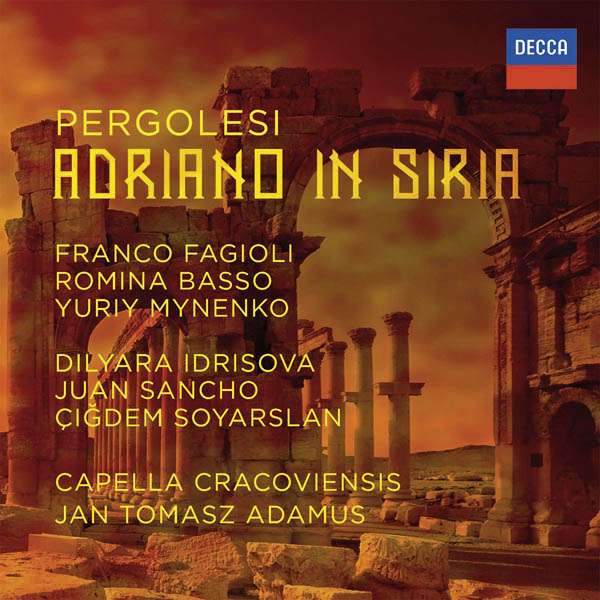
BEST BAROQUE RECORDING OF 2016: Giovanni Battista Pergolesi — ADRIANO IN SIRIA (Y. Mynenko, R. Basso, F. Fagioli, D. Idrisova, J. Sancho, Ç. Soyarslan; DECCA 483 0004)

BEST BAROQUE RECORDING OF 2016: Giovanni Battista Pergolesi - ADRIANO IN SIRIA (DECCA 483 0004)GIOVANNI BATTISTA PERGOLESI (1710 – 1736): Adriano in SiriaYuriy Mynenko (Adriano), Romina Basso (Emirena), Franco Fagioli (Farnaspe), Dilyara Idrisova (Sabina), Juan Sancho (Osroe), Çiğdem Soyarslan (Aquilio); Capella Cracoviensis; Jan Tomasz Adamus, conductor [Recorded in the studios of Radio Kraków, Kraków, Poland, 19 – 26 August 2015; DECCA 483 0004; 3 CDs, 177:59; Available from Amazon (USA), fnac (France), iTunes, jpc (Germany), Presto Classical (UK), and major music retailers]

It could not have been surmised at the time at which the infant’s first cries resounded in Rome in 1698 how indelibly the course of opera was altered by the birth into a grocer’s family of Pietro Antonio Domenico Trapassi. A boy with precocious gifts for poetic improvisation and the artful use of words as an expressive device, the young Trapassi was ceded to the custody of an aristocrat who recognized and wished to further cultivate the lad’s talents. It was from his noble patron that Trapassi received the nom de plume that appeared more frequently than any other on opera playbills in the Eighteenth Century: Metastasio. Inheriting and mostly squandering a substantial fortune before he reached the age of twenty-five, the handsome, enterprising Metastasio tried his hand at writing libretti with a flattering text for a serenata celebrating a royal birthday. The first performance of the serenata, set to music by Nicola Porpora, was distinguished by the participation of two of the greatest singers of the age, the castrato Farinelli and soprano Marianna Bulgarelli, both of whom were impressed by the poet’s work. With Bulgarelli’s unstinting advocacy, Metastasio was launched on the path that led to his eventual succession of Apostolo Zeno as imperial court poet to the Austrian Habsburgs. In 1730, the thirty-two-year-old Metastasio settled in Vienna, his name already associated with operas by several of Europe’s most respected composers.

Among Metastasio’s many libretti, his text for Adriano in Siria, a dramatization of episodes in the reign of the Roman emperor Hadrian, was one of the most successful, its appeal to composers continuing well into the Nineteenth Century. First set to music by Antonio Caldara in 1732, the libretto was taken up by Geminiano Giacomelli, Francesco Maria Veracini, Riccardo Broschi (brother of Farinelli), Baldasdare Galuppi (twice), Carl Heinrich Graun, Johann Adolf Hasse, Johann Christian Bach, Josef Mysliveček, Pasquale Anfossi, Luigi Cherubini, Johann Simon Mayr, and hosts of other composers in the century before its last use by a well-known composer, Saverio Mercadante, in 1828. The typically convoluted plot concerning the amorous and political intrigues among Hadrian, the Parthian king Osroa and prince Farnaspe, and the ladies Emirena and Sabina clearly seized composers’ imaginations with its rich lodes of subdued passions, shifting loyalties, and near-constant deception, all rife for musical mining. Two years after the première of Caldara’s Adriano in Siria in Vienna, a treatment of the text by Giovanni Battista Pergolesi reached the stage of Naples’s Teatro San Bartolomeo. First performed on 25 October 1734, the opera was created by a cast that included Maria Marta Monticelli, Giustina Turcotti, Catarina Fumagalli, and the ill-tempered castrato Caffarelli, begrudgingly acknowledged by Porpora as the finest singer in Italy. Overshadowed in the past half-century by Lo frate ’nnamorato, La serva padrona (originally an intermezzo in Il prigionier superbo), and L’Olimpiade, also a setting of a Metastasio libretto, Adriano in Siria is a masterful example of Neapolitan opera seria and a work that deserves the near-perfectly-executed attention that it receives on this DECCA recording.

His life ended prematurely by consumption before he reached his twenty-seventh birthday, Pergolesi is a figure whose importance to the progressive development of the Italian Baroque is difficult to assess owing to the mythology spurred by Romanticized accounts of his last days and the legacy of his Stabat mater, alleged to have been the best-known and most-published musical work of the Eighteenth Century. This recording of Adriano in Siria significantly expands today’s listeners’ ability to assess Pergolesi’s work within the boundaries of performance practices appropriate for the music. Hearing this recording, it is virtually impossible to accept that the first production of Adriano in Siria did not meet with success. The quality of the performance on these well-engineered discs is extremely high, it is true, but can a performance with Caffarelli at its center really have been markedly inferior? Perhaps even with the light-hearted intermezzo that accompanied it at its première Adriano in Siria was too somber for the farce-loving Neapolitans.

Today’s listeners are certainly no strangers to the phenomenon of genius being rejected whilst mediocrity is embraced, but the performance of Adriano in Siria led here by Jan Tomasz Adamus manifests Pergolesi’s genius in ways that cannot be ignored. The conductor implements tempi that invigorate the now-archaic formulae of opera seria with bristling vitality, only occasionally applying slightly more pressure than the music can withstand, and his work is complemented by the stylish, alert playing of Capella Cracoviensis. Joined on harpsichord by Marcin Świąkiewicz and on theorbo by Ophira Zakai, Adamus keeps the long stretches of secco recitative moving, generating welcome linear continuity among scenes but also granting the singers latitude in highlighting passages of particular importance. The sounds produced by oboists Magdalena Karolak and Aleš Ambrosi and horn players Nicolas Chedmail and Gijs Laceulle contribute excitingly to the orchestral canvas upon which the singers create their character portraits. There is nothing strikingly original in the opera’s Sinfonia, but Adamus and Capella Cracoviensis make it a true introduction to the drama that follows rather than merely a noisy bit of music tacked on at the head of the score. In a few instances, most notably in those arias in which extroverted emotions burst forth, the orchestra’s emphatic playing yields abrasive, excessively-accentuated chords, but every whimper and roar is justified by elements of the plot. Much of Pergolesi’s music warrants the clichéd assessment that the composer was ‘ahead of his time.’ In this performance of Adriano in Siria, Adamus and his colleagues keep pace with Pergolesi’s musical soothsaying from the first note of the Sinfonia to the last bar of the chorus that ends Act Three.

The Roman tribune Aquilio, Adriano’s friend and confidant, has a vested interest in encouraging the emperor’s designs on Emirena: by abandoning the intended imperial consort, Sabina, there would be no obstacle to Aquilio revealing his own love for Caesar’s betrothed. Turkish soprano Çiğdem Soyarslan’s timbre is unmistakably feminine, but she credibly evinces the young man’s romantic dilemma with carefully-managed vocal acting. Hers is an endearingly youthful, almost naïve performance: not even Aquilio’s scheming deprives her singing of its buoyancy. In Act One, Soyarslan delivers ‘Vuoi punir l’ingrato amante?’ with bright, sharp-edged tone and forthright clarity of purpose. Aquilio’s aria in Act Two, ‘Saggio guerriero antico,’ is solidly done, and the soprano’s performance of ‘Contento forse vivere del mio martir potrei’ in Act Three lacks only a prevailing dramatic profile. Still, Soyarslan’s Aquilio is an active participant in the machinations that upset the opera’s amatory equilibrium. Vocally, she is not apt to be mistaken for a man, Roman or otherwise, but she possesses every trait needed to be identified as a singer with great promise.

Portraying the proud Parthian king Osroa, histrionic cousin of Bajazet in Händel’s Tamerlano, Spanish tenor Juan Sancho sings incisively, limning the hot-tempered sovereign’s dogged pursuit of vengeance with musical braggadocio. The intentions are sometimes more enjoyable than the results, but Sancho holds nothing back in his analysis of the character’s arrogance, animosity, and eventual ambivalence. The Act One aria ‘Sprezza il furor del vento’ is lustily sung, its volleys of fiorature blazingly dispatched. Later, Osroa declares that his daughter and Farnaspe perishing as collateral damage in his plot to burn the seats of Roman power is an acceptable outcome, but his music tells a vastly different story. Sancho expertly but unpretentiously executes every hairpin emotional turn of the accompagnato ‘E pure, ad onta del mio furor,’ the potential consequences of the king’s rash actions suddenly flooding his conscience. The tenor’s voicing of the aria ‘A un semplice istante’ seethes with doubt and guilt. Sancho heightens the contrasts between Osroa’s arias in Acts Two and Three, ‘Leon piagato a morte’ and ‘Ti perdi e confondi,’ by using the texts as the blueprints for his construction of musical edifices. Sancho is an exceptionally intelligent singer who unflinchingly meets every challenge of the parts that he sings, but the stress that his no-holds-barred approach exerts on his upper register can be worrying. His vocalism is as resilient as it is intuitive, however, and his conflicted, rabble-rousing Osroa in this performance is an exhilarating depiction of a flawed, fascinating man.

Assuming the patrician mien of Sabina, whose betrothal to Adriano the emperor is all too willing to ignore in order to woo the conquered Emirena, young Russian soprano Dilyara Idrisova illuminates Pergolesi’s melodic lines with a voice that shimmers like the last rays of twilight on autumn foliage. Still a very young singer, her technique remains noticeably ‘green’ in fiorature, and her placement of tones is not always completely steady. Nevertheless, the unaffected beauty of her singing of Sabina’s aria in Act One, ‘Chi soffre, senza pianto,’ is profoundly fulfilling and wholly appropriate to the dramatic situation. In Act Two, she meaningfully imparts the indignation of ‘Ah, ingrato, m’inganni’ without over-emoting or distorting the lovely timbre of her voice. ‘Splenda per voi sereno’ draws from her a wholly different spectrum of vocal colors, used with the utmost delicacy even when the character is under duress. The Act Three aria ‘Digli ch’è un infedele’ receives from Idrisova a performance of maturity and refinement that belie her youth. The noble lady’s trials do not seem out of place in the handling of her young interpreter, and the music is movingly, sometimes magically sung. What an auspicious introduction this is for a singer who seems poised to prove an invaluable asset to performances of Baroque repertory.

When Adriano in Siria was first performed, both Aquilio and the title rôle were assigned to female singers in travesti, a boon to the production’s irascible primo uomo that serendipitously avoided pitting Caffarelli against a rival castrato. For this recording, though, Adriano is restored to the proper gender in a mercurial performance by Ukrainian countertenor Yuriy Mynenko. Gilding his attractive voice with a bright edge, Mynenko convincingly projects Adriano’s regal bearing, articulating text imperiously and phrasing with authority. His aria in Act One, ‘Dal labbro che t’accende,’ is delivered with abundant feeling and technical prowess. Of an altogether different ethos is Adriano’s aria in Act Two, ‘Tutti nemici e rei,’ and Mynenko impresses by adapting his comportment so discernibly within the parameters of the characterization he has created. Furthering this achievement, he fashions a traversal of ‘Fra poco assiso in trono Cesare parlerà’ in Act Three that adds another dimension of complexity to his Adriano. The efficacy of Mynenko’s artistry is revealed by the adroitness with which he transforms a petulant, self-centered autocrat into an approachable, sympathetic man whose heart is as volatile as his empire. Teatro San Bartolomeo’s impresario got it right in 1734: had he been compelled to compete with singing as dexterous, thoughtful, and even throughout the range as Mynenko provides here, Caffarelli would have been fuming.

Pergolesi’s music for Emirena, the daughter of Osroa who, though betrothed and deeply devoted to Farnaspe, has the misfortune of rousing Adriano’s passion, is ideally suited to the voice and dramatic attitudes of Italian mezzo-soprano Romina Basso. In fact, reviving Adriano in Siria was worthwhile solely for the opportunity that it afforded Basso to be heard in this part. The lone native Italian in the cast, her diction is a beacon for her colleagues, who strive to reach the level of communicativeness that she effortlessly exhibits. Basso’s voice, here sounding at its absolute peak, is an extraordinary instrument, her ebony-hued, contralto-like lower register ideally integrated with the rich upper reaches. It is a voice in which the tears of tragic heroines sparkle—a voice in which, in the context of Adriano in Siria, the pain of a woman who believes that she has been abandoned by her lover resounds with heart-wrenching beauty. Both of Emirena’s arias in Act One, ‘Prigioniera abbandonata’ and the sublime ‘Sola mi lasci piangere,’ are sung with impeccable musicality and in-depth understanding of the texts. Not surprisingly, Basso shapes recitatives nearly as memorably as she sculpts arias, her impassioned but reliably tasteful utterances in secco recitatives constituting the dramatic spine of the performance. As she brings it to life, ‘Quell’amplesso e quel perdono’ in Act Two becomes a poignantly intimate expression of uncertainty. The Act Three duet with Farnaspe, ‘L’estremo pegno almeno ricevi,’ is lofted by Basso’s singing to dizzying heights of ecstatic sensuality. Basso is the rare artist in whose singing early composers’ goals of using the new genre of opera to recreate the exalted ideals of Greek drama are fully realized. As potent an exponent of her repertory as Stignani and Simionato were of theirs, Basso here offers a performance of Pergolesi’s Emirena to stand alongside Stignani’s Adalgisa and Simionato’s Eboli.

If Caffarelli sang Farnaspe more brilliantly in Naples in 1734 than Argentine countertenor Franco Fagioli does on these discs, the most flattering contemporary commentary about the castrato did not do him justice. Few singers possess the technical wherewithal to sing music composed for Caffarelli, and this is especially true of Pergolesi’s music for Farnaspe in Adriano in Siria. Ferocious in terms of both its near-ridiculous bravura writing and its two-octave compass, Farnaspe’s music requires nothing less than best-in-the-world virtuosity and largely receives it from Fagioli in this performance. His entrance aria in Act One, ‘Sul mio cor so ben qual sia,’ is the stuff of singers’ nightmares, but Fagioli’s wide-awake, intrepid singing clears the music’s hurdles with athleticism to spare. Without question, Fagioli forces his superb natural instrument, usually when braving rapid-fire fiorature, but he is a shrewd singer who knows and respects the voice’s limitations. The expressivity of which he is capable surges to the surface in the aria with which Farnaspe ends Act One, ‘Lieto così talvolta,’ a discourse with a splendidly-written oboe obbligato. In this music, the twenty-four-year-old Pergolesi rivaled Händel as a musical poet, and Fagioli recites the young composer’s verses lovingly. Farnaspe also ends Act Two, the aria that Pergolesi gave him for this purpose, ‘Torbido in volto e nero,’ again testing the singer’s capabilities. Fagioli aces this test, but he is at his best in the Act Three duet with Emirena, ‘L’estremo pegno almeno ricevi.’ Momentarily setting aside the responsibilities of his rank, Farnaspe is here a tender lover, and Fagioli blends his tones with Basso’s gorgeously. Even among today’s ranks of gifted countertenors, Fagioli is sui generis. His portrayal of Pergolesi’s Farnaspe on this recording is singing of an order of which the pioneers of his Fach, world-changing artists like Alfred Deller and Russell Oberlin, can scarcely have dreamed.

As recently as a decade ago, the appearance on a major label of a studio recording of any of Pergolesi’s surviving operas was unimaginable. Who, though, might have imagined that in 2016 it would be possible to record a Pergolesi opera with far greater success than could be mustered in recordings of scores by Verdi, Puccini, Wagner, and Richard Strauss? With this fantastic recording of Pergolesi’s Adriano in Siria, the DECCA discography welcomes a release worthy of inclusion among the label’s classics of previous generations, recordings like Knappertsbusch’s Meistersinger, the elder Kleiber’s Rosenkavalier, Böhm’s Frau ohne Schatten, and Solti’s Ring. Thus is our brave new—or, rather, old—world!

15 November 2016

RECORDING OF THE MONTH | November 2016: Wolfgang Amadeus Mozart — DON GIOVANNI, K. 527 (D. Tiliakos, V. Priante, M. Papatanasiu, K. Gauvin, K. Tarver, G. Loconsolo, C. Gansch, M. Kares; Sony Classical 88985316032)

RECORDING OF THE MONTH | November 2016: Wolfgang Amadeus Mozart - DON GIOVANNI, K. 527 (Sony Classical 88985316032)WOLFGANG AMADEUS MOZART (1756 – 1791): Don Giovanni, K. 527Dimitris Tiliakos (Don Giovanni), Vito Priante (Leporello), Myrtò Papatanasiu (Donna Anna), Karina Gauvin (Donna Elvira), Kenneth Tarver (Don Ottavio), Guido Loconsolo (Masetto), Christina Gansch (Zerlina), Mika Kares (Il Commendatore); MusicAeterna (Orchestra and Chorus of the Perm Opera and Ballet Theatre); Teodor Currentzis, conductor [Recorded in P. I. Tchaikovsky State Opera and Ballet Theatre, Perm, Russia, 23 November – 7 December 2015; Sony Classical 88985316032; 3 CDs, 170:10; Available from Amazaon (USA), iTunes (USA), jpc (Germany), Presto Classical (UK), and major music retailers]

From ancient accounts of Potiphar’s wife’s adulterous but not unrequited infatuation with the virtuous Joseph to the literary exploits of Molière’s Tartuffe, de Laclos’s Marquise de Merteuil and Vicomte de Valmomt, de Sade’s Justine, and Byron’s Don Juan, the adventures of amatory predators and prey have ignited artists’ and audiences’ imaginations. Libidinous appetites and the pursuit of their fulfillment are components of human nature commonly regarded as inappropriate topics for polite conversation, but the boundaries of propriety upon the operatic stage have, since Monteverdi’s Nerone first enacted his debaucheries in song, been an ever-changing, wide-ranging measure of societal attitudes towards sex and sexuality. Composed for Prague in response to the tremendous success that his Le nozze di Figaro had previously enjoyed in that city, Wolfgang Amadeus Mozart’s Don Giovanni reunited the composer with librettist Lorenzo da Ponte, whose texts melded pointed social commentary with eloquent expressions of emotion. The class warfare that serves as the backdrop for the characters’ intimate drama in Le nozze di Figaro also wages just beyond the fringes of Don Giovanni’s plot, but here there are no obvious victors; none, that is, except for the listener, who is treated to three hours of the finest music in opera. In its way, Don Giovanni is as bold and seductive as the poetry of Walt Whitman and the paintings of Gustav Klimnt, but, of these, Mozart’s was the most timeless and universal genius. This recording confirms time after time that the opera’s capacity to provoke and surprise is undiminished more than two centuries after its first performance. Whether in Prague in 1787 or in Perm in 2015, Mozart’s and da Ponte’s magnificently complex but also engagingly simple tale of Don Giovanni and his conquests forces performers and observers to peer into the corners of our psyches that we endeavor to hide from others’ view. We may not like what we see, but a performance of Don Giovanni like the one on these discs makes it impossible to dislike what we hear.

In a sense, Don Giovanni poses questions not unlike those suggested by Leonardo da Vinci’s famed Gioconda, whose ambiguous visage leads the observer to ponder whether she is consciously smiling and, if so, why and at whom. In this recording, the final leg of his journey through Mozart’s three operas with libretti by da Ponte, Greek conductor Teodor Currentzis strips away layers of well-meaning but inauthentic performance traditions in the manner of an art historian restoring a weathered canvas. Recorded in full in 2014, scrapped because the results did not achieve the spirit of rediscovery that the conductor sought, and finally recorded anew in 2015, the performance on these discs, preserved by Sony Classical in clean acoustics that heighten dramatic propulsion by evoking a theatrical atmosphere, mines Mozart’s score for answers to difficult questions. Accompanied on this adventure by the voices and instruments of MusicAeterna, artists of the Perm State Opera and Ballet, Currentzis takes Don Giovanni at face value, approaching it as neither an academic treatise nor a post-Freudian psychological muddle. Perhaps, as his correspondence suggests, Mozart was not the most mature of men, but his music is reliably logical in construction. It is Mozart’s logic that Currentzis follows, and it leads him to musical details that many performances overlook.

The continuo in this recording is a model of its kind, elaborate but never obtrusive. The notion that Mozart or any other self-respecting musician who was involved with performing Don Giovanni during the composer’s lifetime merely plonked out chords during secco recitatives is absurd, but so is much of the continuo playing heard today. Here, an ideal balance between imagination and integrity is achieved. Throughout the performance, instrumental obbligati are beautifully done, the instruments singing with the voices they support. Though true, it is misleading to state that Currentzis’s conducting is revolutionary. This implies that the conductor’s work is idiosyncratic, which denotes a departure from convention with a pejorative connotation. In fact, Currentzis’s conducting of this Don Giovanni is both revolutionary and idiosyncratic in the sense that he regards the opera as neither a dainty, Baroque-influenced period piece nor a Romanticized psychodrama but as a hybrid work with elements of Eighteenth- and Nineteenth-Century innovations. The opera may have been written in and for a more genteel time, but it is anything but polite. Astonishingly, though, Currentzis never forces or pushes the singers or the orchestra. Tempi and instrumental balances sound precisely right for a score composed in 1787. Currentzis has acquired—and actively cultivated—a ‘bad boy of Classical Music’ persona, but he is the right ‘bad boy’ for the job of reintroducing Don Giovanni as Mozart and da Ponte conceived it.

Il Commendatore serves as the catalyst for the opera’s explosive dramatic reactions, first by dying at Don Giovanni’s hand in Act One and by returning in Act Two in petrified form to instigate his murderer’s final judgement. Projecting every note of the part with fiery focus, Finnish bass Mika Kares is a Commendatore who deserves the title. Moreover, Kares is a bona fide bass who plays the part after the manner of Ludwig Weber and Gottlob Frick. The Commendatore interrupting Don Giovanni’s attempted mischief with Donna Anna, Kares voices a frightening ‘Lasciala, indegno!’ Perhaps old in the ways of the world, this is no wheezing, decrepit Commendatore: Kares depicts a still-brawny father who is a potent threat to Giovanni. ‘Ah, soccorso! Son tradito!’ is neither shouted nor crooned, and the bass brings atypical dignity to the Commendatore’s death. In this performance, with a Commendatore who does not sound like a demented troll, it is possible to appreciate Donna Anna’s prolonged grieving, often a source of humor in performances of Don Giovanni. There is nothing comical about Kares’s singing in Act Two, when the Commendatore’s stone monument accosts Giovanni and Leporello in the cemetery and subsequently turns up as invited at Giovanni’s banquet. The gravity of ‘Don Giovanni, a cenar teco m’invitasti, e son venuto’ and the calls for Giovanni to repent resounds in Kares’s vocalism, and he is totally convincing as the no-longer-of-this-world statue without resorting to artificial vocal production or being distorted by misguided audio effects. Kares’s Commendatore is unique in sounding as though he actually wants Giovanni to avoid damnation by repenting. Few singers bother to do anything other than sing the notes that Mozart wrote for the Commendatore, and even fewer manage to sing them well. Kares both sings ably and legitimately interprets the rôle.

Italian baritone Guido Loconsolo is a confident, youthful Masetto, almost a plebeian Don Giovanni in training, whose singing of Mozart’s notes is as accomplished as his handling of da Ponte’s words. Not even when Masetto’s anger is uncontainable does the singer relinquish his firm control over the voice. Tossing off ‘Giovinetti leggieri di testa’ with the effervescent joy of an adoring fiancé on his wedding day, Loconsolo gives Masetto the charm and appeal that he possesses in the score but so often lacks on stage and on disc. His voice rings out handsomely in ‘Ho capito, signor sì!’ Whether with the intention of spotlighting the social divide that separates him from Don Giovanni or owing to unimaginative singers, Masetto is often portrayed as a grunting simpleton, a sort of Neanderthal with a hot temper and little trust in his betrothed’s capacity for fidelity. Loconsolo’s Masetto is no empty-headed brute. It would be no surprise to find him in a barroom brawl, but, unlike many rival portrayals, he would indubitably have a good reason for throwing punches and, most winningly, would sing splendidly whilst doing so.

Austrian soprano Christina Gansch provides Loconsolo’s Masetto with a Zerlina of feminine wile and flirtatious sweetness whose sensibilities complement his own. Gansch voices ‘Giovinette che fate all’amore’ brightly but without the hard edge that many sopranos bring to the music. When this Zerlina sings ‘Vorrei e non vorrei’ in response to Giovanni’s wooing ‘Là ci darem la mano,’ she sounds credibly bewildered, both flattered and frightened by the philanderer’s attention. The aria ‘Batti, batti, o bel Masetto’ is virtually unbearable in many performances, sopranos smothering the music with cuteness and self-indulgent cooing. Here, however, the singer’s vocalism is certainly pretty but never coy or caricatured. Following her colleagues’ examples, Gansch embellishes her music liberally but tastefully, adding an easy top C to the cadenza in her beautifully-sung ‘Vedrai, carino, se sei buonino’ in Act Two. This recording delights unexpectedly by including the scene in which Zerlina abducts Leporello and threatens to slice him to shreds with a razor, composed for the opera’s first production in Vienna and now almost always omitted. The soprano’s silvery tones acquire a glinting edge as she hurls ‘Non v’è pietà, briccone’ at Leporello, believing him to have beaten Masetto, but she is no murderess. This fit of vengeful rage out of her system and Giovanni dispatched to incendiary retribution, Zerlina is the cheerful, clever bride once more, and she is heard with pleasure in the opera’s finale. Gansch’s Zerlina is not a chirping schoolgirl but an independent young woman who sings stylishly and refuses to be any man’s plaything—unless she wants to be.

Vocally and dramatically, Don Ottavio is often a pronounced weakness in otherwise enjoyable performances and recordings of Don Giovanni. In recent years, a true Mozart tenor—a singer like Anton Dermota, whose repertory was built upon the foundation of Mozart singing and whose stylishness and technical acumen as a Mozartean remained reliable throughout a long career—has been as rare as a genuine Heldentenor. There are tenors who manage Don Ottavio’s music effectively, but almost none of his contemporaries rivals American tenor Kenneth Tarver’s level of comfort in the rôle. Ottavio’s music offers the singer nowhere to hide. A singer who requires no vocal hiding places, Tarver contributed an exemplary portrayal of Ottavio to René Jacobs’s harmonia mundi recording of Don Giovanni, as well as having sung Ferrando in Currentzis’s account of Così fan tutte for Sony Classical, but he surpasses both of those performances with his Ottavio in this Don Giovanni. Vowing to aid his fiancée Donna Anna in identifying and having revenge on her attacker—assuming, that is, that she was as unwilling a recipient of Giovanni’s love-making as she later indicates to Ottavio—and her father’s murderer, Tarver possesses the vocal power needed for the oath-swearing duet, singing ‘Senti, cor mio, deh senti’ with gripping bravado. Learning from Anna what transpired in the moment’s before the Commendatore’s death, this Ottavio comforts his beloved with the soothing timbre of his voice in the intense accompagnato that precedes Anna’s ‘Or sai chi l’onore.’ Tarver’s performance of ‘Dalla sua pace la mia dipende’ is magical: on recordings, only Cesare Valletti rivals him for tonal beauty, but Tarver’s technique enables even more exquisite breath control than Valletti had at his command. Furthermore, Tarver is a rare Ottavio who is not upstaged by his female cohorts in the sublime trio in the Act One finale, ‘Protegga il giusto cielo il zelo del mio cor!’ In the Act Two sextet, Tarver sings ‘Tergi il ciglio, o vita mia’ lovingly, but it is his account of ‘Il mio tesoro intanto andate a consolar’ that most ravishes the ears and enthralls the heart. The long runs are sung with single breaths as Mozart surely intended, and the evenness of tone from bottom to top is exceptional. This Ottavio seems to thoroughly understand and accept his Anna, and his lines in the opera’s final scene are affectionately articulated. Tarver is a wonderful singer and great artist, but this Ottavio is an extraordinary performance even by his own standards.

At her first appearance, the Donna Anna of Greek soprano Myrtò Papatanasiu sounds vocally undernourished, but that appearance thankfully proves to be deceiving. Anna’s terror as her father comes to her rescue and is slain by Don Giovanni invigorates the opera’s first scene, the soprano evincing the life-or-death tension of the situation without going off the rails vocally. In the accompagnato ‘Ma qual mai s’offre, oh dei!’ and the vengeance-pledging duet with Ottavio, Papatanasiu sings with growing power and nuance, securing her dramatic footing with a coldly determined exclamation of ‘Fuggi, crudele, fuggi!’ Anna’s lines in the quartet with Giovanni, Ottavio, and the raving Elvira are pointedly sung. The stirring accompagnato ‘Don Ottavio, son morta!’ is launched with laser-like tonal accuracy and histrionic kinesis. It was in the aria ‘Or sai chi l’onore rapire a me volse’ that powerhouse Annas like Birgit Nilsson, Leontyne Price, and Dame Gwyneth Jones excelled, but Papatanasiu’s more modestly-dimensioned voice scales the heights of the music excitingly, the fearsome top As projected without strain or scrambling. She partners Tarver radiantly in the masquers’ trio, matching his elegant shaping of ‘Protegga il giusto cielo il zelo del mio cor!’ and rising above the stave with encouraging ease. Joining in Act Two’s masterful sextet, Papatanasiu voices ‘Lascia, lascia alla mia pena questo picciolo ristoro’ endearingly but with an abiding sense of her prolonged agony over the loss of her father. Unlike many recorded Annas, Papatanasiu projects mental clarity in the accompagnato ‘Crudele? Ah no, mio bene’ and aria ‘Non mi dir, bell’idol mio.’ Why the aria is frequently cited as a bravura showpiece is perplexing. Its bravura writing is very difficult, to be sure, but the piece is not a perch upon which songbirds can pose and tweet roulades. Both Currentzis and Papatanasiu are alert to this and give the aria the dramatic immediacy for which it cries out. The soprano brings tremendous focus to her negotiations of the vocal line, always emphasizing melody rather than technical display. Her technique is fully equal to the coloratura, but Papatanasiu is above all a gratifyingly musical Donna Anna whose instincts direct her to the expressive core of every phrase. In the Act Two finale, her words to Ottavio are sung with conspicuous feeling, this Anna putting him off not out of capriciousness but because the grief in her heart does not yet allow room for him to inhabit it fully. Papatanasiu makes the rôle her own as few singers on disc have done, and solely in terms of raw vocalism she is an uncommonly successful Donna Anna.

Provided that she sings her difficult music capably, a Donna Elvira can be forgiven for seeming somewhat ridiculous. After all, hers is the unfortunate lot of endeavoring to loathe and publicly denounce a man with whom she falls in love anew in every scene: she may be destined for a convent, but it will surely be an institution in which the face of every saint is transformed in this highly-strung lady’s mind into that of Giovanni. Singing accurately and exaggerating nothing, Canadian soprano Karina Gauvin proves a hearteningly musical and uncommonly moving Donna Elvira. Yes, the character’s actions and reactions are often illogical, but in Gauvin’s performance they never seem so: her Elvira is not a wounded animal caught in a snare but a deeply sensitive woman whose capacity for love greatly exceeds that for skepticism. At her first entrance, it is discernible in her electrifying but affecting account of the aria ‘Ah! chi mi dice mai quel barbaro dov’è’ that Gauvin is an Elvira who has pored over the emotional aspects of the rôle as closely as she studied the music. Her ‘Ah! fuggi il traditor’ both throbs with fury and exudes despondency and jealousy, and the music is authoritatively sung. Gauvin’s voice scintillates in the quartet, her singing of ‘Non ti fidar, o misera’ limning the ambiguity of her feelings. With both ‘Bisogna aver coraggio’ and ‘Vendichi il giusto cielo il mio tradito amor!’ in the trio with Anna and Ottavio, Gauvin markedly deepens her characterization of Elvira, fully exploring the complexities with which Mozart and da Ponte enriched the part. The Act Two trio also inspires the singer to musical emoting of the highest order, her ‘Ah! taci, ingiusto core, non palpitrarmi in seno’ projected with Callas-like sensitivity to the relationships between the vocal line and the meaning of the text. Fascinating, too, is the insightfulness with which she enunciates ‘Sola, sola, in buio loco’ in the sextet. Neither in performance nor on disc does Elvira’s accompagnato ‘In quali eccessi, o numi, in quai misfatti orribili, tremendi’ often wield the histrionic force that Gauvin builds in her singing of the music: in her hands, the passage is no less riveting than the accompagnato that precedes Anna’s ‘Or sai chi l’onore.’ This is followed by a performance of the aria ‘Mi tradì quell’alma ingrata’ that astounds. Her widely-lauded credentials in Baroque repertory contribute to what is clearly a sapient understanding not only of Mozart’s music but also of Currentzis’s concept of Don Giovanni. In the brief duration of this single aria, she wholly embodies the essence of this recording: nothing is overwrought, but no phrase wants for ardor. As Gauvin sings it, Elvira’s ‘L’ultima prova dell’amor mio ancor vogl’io fare con te’ fuels the conflagration that ultimately consumes Giovanni, the absolute sincerity of her appeal to Giovanni’s better nature all the more poignant for being so euphoniously sung. There is also palpable lyricism in Gauvin’s singing of Elvira’s resolve to enter a convent. From Luise Helletsgruber, Jarmila Novotná, and Eleanor Steber to Elisabeth Schwarzkopf, Sena Jurinac, and Leyla Gencer, Elvira has been portrayed in broadcast and studio recordings by some of opera’s most renowned singing actresses. With her performance on this recording, Gauvin asserts that she is the equal of the best of them.

A poor Leporello can undermine the best intentions of any Don Giovanni, and a good Leporello can lessen the impact of the deficiencies of a haphazard performance of the opera. In the performance on the present discs, the Leporello of Italian baritone Vito Priante is precisely what a skilled manservant should be: always at hand, anticipating his master’s needs, fulfilling his duties with alacrity, and standing aside when he is not meant to be the center of attention. Priante’s voice is lighter in both timbre and weight than those of many recorded Leporellos, but his interpretation of the rôle, unforcedly funny and sharp-witted, is among the most substantial on disc. He dispatches ‘Notte e giorno faticar’ with the elegance of a man who has learned much from his exposure to high society, and his interactions with Giovanni throughout the opera reflect a sardonic awareness that, though he is a nobleman, Giovanni is anything but noble. As Priante sings it, ‘Madamina, il catalogo è questo’ seems intended to mitigate Elvira’s embarrassment rather than to increase it by mocking her. As each of the opera’s characters emerges in the Act One finale, Leporello’s critical part in the drama becomes ever more evident, his responses to each participant’s competing agenda disclosing a mind far quicker than Giovanni appreciates—a major contributing factor in the Don’s eventual downfall. The Act Two duet with his abusive master draws stark irony from Priante, Leporello barely able to contain his contempt for Giovanni and his injustices in his firmly-sung ‘No, no, padrone, non vo’ restar.’ As when singing the Catalogue Aria in Act One, Priante emphasizes an element of sympathy for Elvira in his statement of ‘State a veder la pazza, che ancor gli crederà,’ and he pleads ‘Perdono, perdono, signori miei’ in the sextet with subtle desperation. The aria ‘Ah, pietà, signori miei’ goes for nothing in many performances, but the understated nuances of Priante’s traversal of the aria heighten its importance in the progression of the opera’s narrative. The restored scene with Zerlina proves to be this Leporello’s greatest vehicle for musical characterization, and he seizes every opportunity to use da Ponte’s words as a springboard for diving deeply into the character’s motivations. Priante’s ‘Per queste tue manine candide e tenerelle’ is as thoughtful as his ‘Amico, per pietà, un poco d’acqua fresca o ch’io mi moro!’ is amusing. He acutely conveys Leporello’s horror and fear in the duet ‘O statua gentilissima del gran Commendatore’ and in ‘Ah, Signor, per carità’ in the finale without placing one note or syllable beyond the boundaries of good taste. To his credit, Priante never attempts to emulate the Leporellos of larger voices, preferring to sing the part on his own terms. Those terms, negotiated by singer and conductor with Mozart’s music as the mediator, produce one of the liveliest and loveliest Leporellos on disc.

It is easy to view Don Giovanni, Conte d’Almaviva in Le nozze di Figaro, and Guglielmo in Così fan tutte as Mozart’s equivalents of Verdi’s Rigoletto, Giorgio Germont in La traviata, and Conte di Luna in Il trovatore. The vocal Fächen that are so frequently cited today were considerably less codified during and for another generation after Mozart’s career, and his rôles in baritone range are only marginally less difficult to cast with complete success than Verdi’s great baritone parts. Acclaimed for his work in Verdi repertory, particularly the title rôle in Macbeth and Giorgio Germont, Greek baritone Dimitris Tiliakos is the ideal protagonist for Currentzis’s pragmatic Don Giovanni. Suave, sensual, and sonorously masculine, Tiliakos’s Giovanni dominates this performance despite the very strong work by his colleagues. Tussling with the Commendatore after being discovered in the act of assailing Donna Anna’s honor, Tiliakos sings like a man possessed, his voice flashing in the dark soundscape like lightning. The contrast with ‘Là ci darem la mano’ could not be greater. Here, the baritone’s vocalism is like the whisper of a summer breeze: Zerlina can hardly be blamed for following where it leads. Tiliakos voices ‘La povera ragazza è pazza, amici miei’ in the quartet with deceptive concern, and he follows this with a volatile reading of ‘Fin ch’han dal vino calda la testa,’ one which combines musical virtuosity with dramatic acuity. The pace of the Act One finale is set by Tiliakos’s animated singing of ‘Su, svegliatevi, da bravi!’ and ‘Ecco il birbo che t’ha offesa.’ Opening Act Two with the duet with Leporello, this Giovanni brandishes ‘Eh via, buffone, non mi seccar’ like a slap to Leporello’s face. Then, in the trio with Elvira and Leporello, he intones ‘Discendi, o gioia bella’ alluringly. Tiliakos sings one of the most beautiful and erotic accounts of the canzonetta ‘Deh, vieni alla finestra, o mio tesoro’ on disc, his hypnotic mezza voce and idiomatic diction captivating. The aria ‘Metà di voi qua vadano’ benefits from Tiliakos’s assertive swagger, and his insistent manner infuses ‘Finiscila, o nel petto ti metto questo acciar’ in the duet with Leporello with excitement. Defiant to the end, Tiliakos’s Giovanni mercilessly teases and torments Leporello at the banquet in the opera’s penultimate scene, and the baritone sings ‘Già la mensa è preparata’ with insouciance. The interpolated top A with which Tiliakos expresses his ultimate truculence aptly summarizes his interpretation of the rôle: his Giovanni is his own man, answering only to himself and recognizing no moral authority of this or any other world. There are more smoothly-sung Giovannis on disc, but Tiliakos blends Pinza’s vivacity, Siepi’s joviality, Gobbi’s urbanity, and Taddei’s panache in a brilliantly-executed, compellingly-vocalized depiction of one of opera’s most chameleonic characters.

Mozart’s and da Ponte’s Don Giovanni is an operatic moving target with no definitive edition or interpretation. In the eight decades since the first complete recording of the opera was issued, recorded performances have appeared with relative regularity, populating a discography with renditions ranging in their prevailing sentiments from bawdy comedy to proto-Wagnerian tragedy. The de jure atman of this prismatic dramma giocoso dwells somewhere between these extremes. It is an opera that every listener hears differently. 229 years after its première, it is impossible to know precisely how Mozart and da Ponte ‘heard’ Don Giovanni, but with this recording Teodor Currentzis, MusicAeterna, and an uniformly superlative cast purvey as cogent a ‘hearing’ of this glorious, exacting masterpiece as has been committed to disc.

13 November 2016

PERFORMANCE REVIEW: Henry Purcell — THE FAIRY QUEEN, Z.629 (M. Molomot, K. E. Jones, C. Berry, A. Martinez-Turano, S. Brunscheen, D. Taylor, R. Belongie, R. Gomez; Chicago Opera Theater, 11 November 2016)

IN REVIEW: Tenor MARC MOLOMOT as Puck in Chicago Opera Theater's production of Henry Purcell's FAIRY QUEEN, 11 November 2016 [Photo by Liz Lauren / Handout]HENRY PURCELL (1659 – 1695): The Fairy Queen, Z.629Marc Molomot (Puck), Kimberly Eileen Jones (Tanya), Cedric Berry (Ron), Alexandra Martinez-Turano (Helena, Dancer), Scott J. Brunscheen (Demetrius), Darryl Taylor (Herman), Ryan Belongie (Lysander), Roberto Gomez (Shakes); Haymarket Opera Orchestra; Jory Vinikour, harpsichord and conductor [Andreas Mitisek, Production Design and Director; Dan Weingarten, Lighting Designs; David Lee Bradke, Lighting Director; Chicago Opera Theater, The Studebaker Theater, Fine Arts Building, Chicago, Illinois, USA; Friday, 11 November 2016]

Oscar Wilde wrote that ‘man is least himself when he talks in his own person. Give him a mask, and he will tell you the truth.’ Though the contexts and the meanings of the related words are very different, it can be asserted with ample justification that giving Henry Purcell an opportunity to compose a masque inspired him to express human truths through music. Born in London’s Royal Borough of Westminster in 1659, Purcell is, despite his extraordinary significance to English music, a figure about whose biography there is at least as much conjecture as there is consensus. The composer Daniel Purcell, commonly identified as Henry’s younger brother, may have actually been his cousin or a lesser relation, for example, and constructing a chronology of the elder Purcell’s career with any pretension of accuracy is virtually impossible. Painstaking scholarship has yielded relative certainty about the likelihood that Purcell’s largest-scaled work for the stage, the masque The Fairy Queen, was composed in 1692 and premièred at the Queen’s Theatre in the same year in celebration of the wedding anniversary of Britain’s dual monarchs, William III and Mary II. Designed by Sir Christopher Wren, the Queen’s Theatre was a marvel of form and function, the feats of stagecraft made possible by the fruits of Wren’s genius manifested in the music written for the venue. It was as an entertainment to be presented among the five acts of William Shakespeare’s A Midsummer Night’s Dream that The Fairy Queen was conceived, but the masque’s words, authorship of which remains unidentified, are only tangentially related to Shakespeare’s play. Given this masque within the structure of one of Western literature’s greatest works for the stage in which to perform his musical magic, Purcell tells the truth with stunning wit and wisdom. Perhaps, as Emily Dickinson put it, he sometimes tells it ‘slant,’ but the truth in The Fairy Queen is unfailingly tuneful.

The first fully-staged show to be presented in the newly-rejuvenated Studebaker Theater in the historic Fine Arts Building on Michigan Avenue, Chicago Opera Theater’s production of The Fairy Queen, designed and directed by COT General Director Andreas Mitisek and utilizing a very free adaptation of Purcell’s semi-opera [numbers were cut and reordered, vocal parts were changed, and music from other scores by Purcell, mainly King Arthur, was interpolated] by the trio of inventive minds—Richard Montoya, Ric Salinas, and Herbert Siguenza—united in Culture Clash, fused Purcell’s musical ‘Restoration spectacular’ with elements of the plot of its intended Shakespearean setting. Transplanting the action from Shakespeare’s distant antiquity to a vague present, the mysterious sylvan world of A Midsummer Night’s Dream was traded for a seedy Las Vegas establishment that recalled the continental haunts of Christopher Isherwood and his circle of moral miscreants. Though intermittently effective in the most basic ways, especially in exploring how decent people can unintentionally but devastatingly hurt one another, the production left few tired, dramatically pointless clichés of sexual depravity untouched. Here a nightclub owner who was equal parts Joel Grey’s Emcee in Cabaret, Jonathan Pryce’s Engineer in Miss Saigon, and a parody of every roué in opera, COT’s Puck was deprived of the mercurial charisma that renders Shakespeare’s incarnation of the character memorable. No new ground was excavated by the production’s race, gender, and sexual preference stereotypes, and the innuendo and pantomime depravity, typified by the heroine of sorts suggestively unzipping Puck’s trousers, were uncomfortable for the cast and, most critically, for Purcell. Dan Weingarten’s lighting designs and David Lee Bradke’s implementation of them brought the production vividly to life, though the strobe lights in Part Two emphasized the garishness of the pseudo-erotic cavorting at the expense of the unfolding emotional drama. There were many affecting moments in the performance, but they mostly occurred in spite of rather than because of the production. Modernizing Baroque scores when bringing them to the stage has become common practice, sometimes with fantastic results, but the problem with reimagining The Fairy Queen as Lulu is that Purcell’s risqué but sublime, sensitive work is at odds with a nonsensical story about repulsive people. Purcell demands poetry, not pornography, and this production failed its participants and its patrons by using the artists on stage as objects in a sexual farce rather than vessels for the unadulterated outpouring of Purcell’s music.

IN REVIEW: Harpsichordist and conductor JORY VINIKOUR, conductor of Chicago Opera Theater's production of Henry Purcell's FAIRY QUEEN, 11 November 2016 [Photo by Nuccio di Nuzzo]Man with a plan: Harpsichordist and conductor Jory Vinikour, conductor of Chicago Opera Theater’s production of Henry Purcell’s Fairy Queen, 11 November 2016
[Photo by Nuccio di Nuzzo]

Purcell’s champion and savior in this production was internationally-acclaimed harpsichordist and conductor Jory Vinikour. Leading the period-instrument orchestra of Chicago’s Haymarket Opera, with which company he will perform Alessandro Scarlatti’s oratorio San Giovanni Battista at Malta’s Valletta Baroque Festival in January 2017, Vinikour labored mightily to enthrone this Fairy Queen in a musical realm that Purcell would recognize and endorse. The Haymarket musicians—first violinists Jeri-Lou Zike, Ann Duggan, and Wendy Benner; second violinists Martin Davids, Emi Tanabe, and Lori Ashikawa; violists Liz Hagen and Dave Moss; cellists Craig Trompeter and Lucien Werner; violone player Jerry Fuller; Dave Walker on theorbo; Kathryn Montoya and Sung Lee doubling on oboe and recorder; Kris Kwapis and Tom Pfotenhauer on natural trumpet; and Brandon Podjasek on kettle drums and tambourine—collaborated with Vinikour in the creation of a sound world in which one could take refuge from the tomfoolery littering the stage. Even from the perspective of the Twenty-First Century, in which perceptions of orchestral grandeur are shaped in the opera house by Wagner and Richard Strauss and in the concert hall by Mahler, it is remarkable to experience how much sheer sound an ensemble of eighteen musicians can generate. That sound was sporadically compromised by faltering intonation and a handful of flaws from the notoriously unmanageable valveless trumpets, but, on the whole, the period instruments and their handlers made wonderfully diverting noises. Guiding the performance as though extemporaneously composing the score himself, Vinikour provided continuo playing that was inventive but restrained, and his colleagues in the pit shared his gifts for crisp rhythms, pinpoint articulations of harmonic progressions, and purposeful ornaments. The pruning and restructuring to which the score was subjected limited cohesion among scenes, but Vinikour achieved marvels in sustaining momentum and facilitating musical characterization by both singers and instrumentalists. Long in demand as a vocal coach and respected recital partner for some of the world’s best singers, Vinikour débuted as a conductor of opera as recently as August 2016, when he paced West Edge Opera’s performances of Händel’s Agrippina in Oakland, California, but a novice’s nerves were not apparent in this Fairy Queen. He and the orchestra supplied the foundation of professionalism that the production sorely needed, and his spot-on tempi and grounding musicality counterbalanced the unnecessary scenic stupidity.

Also covering the lead rôles, the seven choristers—tenor Jonathan Weyant, soprano Lari Stait, basses Zacharias Niedzwiecki and Samuel Weiser, mezzo-sopranos Kira Dills-DeSurra and Quinn Middleman, and tenor Patrick Dean Shelton—sang strongly and often very beautifully. In an ensemble of this size, the quality of each individual voice was apparent, and the young singers revealed themselves to be first-rate artists in the making. Temporarily abandoning his Club FQ bartending duties to writhe acrobatically as the dominatrix Miss Trixie’s scantily-clad ‘pussy cat’ in the production’s second half, Niedzwiecki literally revealed more than his colleagues, but his singing was as impressive as his physique. Any one of these talented youngsters might have stepped into a leading rôle with assurance. As an ensemble, their work was marvelous: lulling the anguished Tanya to sleep, their singing of ‘Hush, no more, be silent all’ was the musical zenith of the performance.

Shakes—an apt name for a perennially-inebriated barstool bard who merrily trades couplets for Courvoisier—was portrayed with absolute conviction by baritone Roberto Gomez, a lauded Figaro in Il barbiere di Siviglia whose familiarity with Rossinian fiorature paid rich dividends in his singing of Purcell’s music. Among the cast, Gomez seemed most at ease with the bawdy comedy (but was also spared the most provocative of it, it must be admitted), delivering lines with near-perfect timing, reacting organically to the other players, and taking bits like Shakes’s concerted flirtation with Puck—falling victim to his own aphrodisiacal concoction—in stride. Though the tessitura of his music sometimes seemed marginally too low for him, the baritone sonorously entreated his friends at Club FQ to ‘Fill up the bowl,’ and he was a champion stutterer in Purcell’s parody music. Gomez was an amiable Drunken Poet, a good-natured if excessively-boozed Christopher Sly who sang with a good grasp of Purcell’s idiom. Can one really imagine Sly propositioning a tavern keeper, though?

IN REVIEW: Countertenors RYAN BELONGIE as Lysander (left) and DARRYL TAYLOR as Herman (right) in Chicago Opera Theater's production of Henry Purcell's FAIRY QUEEN, 11 November 2016 [Photo by Liz Lauren / Handout]Boys on the town: Countertenors Ryan Belongie as Lysander (left) and Darryl Taylor as Herman (right) in Chicago Opera Theater’s production of Henry Purcell’s Fairy Queen, 11 November 2016
[Photo by Liz Lauren / Handout]

The production made it difficult to empathize with any of the characters, especially the party-seeking newlyweds Lysander and Herman, but the interpreters of these rôles worked diligently to connect with their audience. Countertenor Ryan Belongie was a suavely handsome Lysander who coped manfully with being asked to romp embarrassingly—and shirtlessly—with Helena. Vocally, his was a mellifluous performance, and the quality of his acting largely matched the caliber of his singing. Arriving at Club FQ, Belongie’s Lysander duetted erotically with Herman, but his potion-induced transition to heterosexuality was equally adroit. His delivery of the line ‘I even find her breasts enticing’ when ogling Helena was hilarious. His lean, sinewy voice flowed through Purcell’s melodic lines like pure honey, and he negotiated divisions with surety. He radiated boyish sex appeal but was also the most maturely expressive of the principals: gaining cognizance of his brief liaison with Helena, his face conveyed heartbreak and regret as earnestly as his singing.

Fellow countertenor Darryl Taylor was a supernova of virility as Herman, flexing his muscles like a prizefighter and donning South Beach-esque attire with aplomb. Like Belongie, he found in Purcell’s music ample opportunities for honeyed vocalism, and his agility was admirable. The melting lyricism of his singing in ensembles was delightful. The imagery of ‘See my many coloured fields’ was manifested in his light-emitting shoes, but it was the voice that shone most brightly. The staging required Taylor to camp it up shamelessly, but the integrity of his artistry could not be obscured.

In this production, Demetrius and Helena were not yet married but already pursuing counseling in an effort to heal and preserve their foundering relationship. One wondered whether its survival was really wanted by the henpecked Demetrius of tenor Scott Brunscheen. Tall, feigning awkwardness, and clearly unnerved by his bossy bride-to-be, he could not be faulted for his reluctance to make a lifelong commitment to Helena. Vocally, there was nothing hesitant in Brunscheen’s performance. His lithe, attractive lyric tenor was firm and focused throughout the performance, and the liquid ease of his singing was enchanting. Dramatically, Brunscheen was the crestfallen fiancé to the life, unsure of himself and awaiting instructions from Helena on what to think and feel. The singer’s voice soared with the freedom and confidence that the character’s spirit lacked, and his admission to Helena that, whilst under the influence of Puck’s elixir, he had done quite a bit more than staring into another man’s eyes was bizarrely touching.

IN REVIEW: Soprano ALEXANDRA MARTINEZ-TURANO as Helena (left) and countertenor RYAN BELONGIE as Lysander (right) in Chicago Opera Theater's production of Henry Purcell's FAIRY QUEEN, 11 November 2016 [Photo by Liz Lauren / Handout]What fools these mortals be: Soprano Alexandra Martinez-Turano as Helena (left) and countertenor Ryan Belongie as Lysander (right) in Chicago Opera Theater’s production of Henry Purcell’s Fairy Queen, 11 November 2016
[Photo by Liz Lauren / Handout]

Singing as gracefully as she moved as an exotic dancer in Club FQ, soprano Alexandra Martinez-Turano was a fanciful, flexible Helena who seemed besotted with the notion of being married but not so much with its practical implications, especially those implications that she could not micromanage. It was unfortunate that this production perpetuated the slander that folks who enjoy a bit of fun are essentially sex-addicted sluts. Shakespeare’s Helena, though unquestionably highly-strung, is no Athenian Jezebel, but COT’s Helena was undeniably an historically-informed girl gone wild. Martinez-Turano therefore earned special praise for making the character interesting. Her vocalism was unimpeachable. Her performance lent the expected metamorphosis from uptight prude to sexually-liberated ‘true self’ emotional sincerity. Recasting the languidly sensual ‘If Love’s a sweet passion’ as a quartet for Helena, Demetrius, Herman, and Lysander was among the production’s foremost successes, and the singers traded lines beguilingly. Here and in every passage that she sang, Martinez-Turano’s crystalline tones were a great asset to this Fairy Queen.

Standing in for Shakespeare’s Oberon and Titania, COT’s Ron and Tanya were sung by a pair of expert singing actors whose well-matched musical and dramatic qualities enabled them to loft their characterizations above the production’s obsession with flesh and carnal gratification. Bass-baritone Cedric Berry projected machismo and a voice of fabulous mettle to the theater’s last row. A man with natural weaknesses rather than a licentious philanderer, the Ron created by Berry was a hard-surfaced but tender-hearted husband whose love for Tanya seemed to ooze from his pores. Distracted by Martinez-Turano’s feisty señorita, he voiced ‘See, I obey’ commandingly, and he joined Martinez-Turano in a steamy rendition of ‘Come, come, come, come, let us leave the town.’ Parted from Tanya by the fallout from his straying eyes and hands, Ron’s life was stopped in its tracks. Berry expressed the character’s guilt and loss in his heartfelt, compellingly-sung ‘Next, winter comes slowly.’ Turning on Puck in frantic anger after the well-intentioned cocktail misdirected Tanya’s affections, Berry raged rousingly in ‘Arise, ye subterranean winds,’ tossing off the difficult passagework and deploying dazzling thunderbolts of sound at the top of the range. In the production’s penultimate scene, Ron’s reconciliation with Tanya was nobly done: in addition to earning Tanya’s forgiveness, the sighs of surrender and warm applause made it clear that Berry’s debonair wooing won over hearts in the audience. His was the best singing of the evening, an unforgettable performance by a star on the rise.

IN REVIEW: Soprano KIMBERLY EILEEN JONES as Tanya (left) and bass-baritone CEDRIC BERRY as Ron (right) in Chicago Opera Theater's production of Henry Purcell's FAIRY QUEEN, 11 November 2016 [Photo by Liz Lauren / Handout]The course of true love never did run smooth: Soprano Kimberly Eileen Jones as Tanya (left) and bass-baritone Cedric Berry as Ron (right) in Chicago Opera Theater’s production of Henry Purcell’s Fairy Queen, 11 November 2016
[Photo by Liz Lauren / Handout]

Partnering Berry as the temperamental Tanya, soprano Kimberly Eileen Jones looked like a svelte Jennifer Hudson and sounded like a young Camilla Williams. Discovering her husband prostrate beneath an undulating dancer, Jones’s eruption of ire was ferocious: most of the men in the theatre likely wanted to cower beneath their seats merely for having looked at the shimmying Delilah. The production’s single greatest misstep was staging a comedic routine for Puck during Tanya’s singing of the score’s most famous number and one of the pinnacles of Seventeenth-Century music, the passacaglia-form Plaint ‘O let me weep.’ Jones phrased the air magisterially, her command of the requisite style more certain here than in any other number. She sometimes sacrificed diction to the use of distorted vowels more conducive to vocal production, especially as her lines ascended, but the rounded tones that she produced rarely failed to compensate for the lack of verbal clarity. The bravura demands of ‘Hark! how all things in one sound rejoice’ and ‘Hark! the echoing air’ were sparklingly met. Nevertheless, Jones was happiest when her melodies were unencumbered by fiorature, but she wielded a good trill. Like Berry’s, her performance satisfied and promised still finer things to come. Though the production’s depiction of African American culture was dispiritingly unoriginal and even insulting, placing a couple of color at its center was a commendable and irrefutable validation that all singers as gifted as Berry and Jones belong on all of the world’s important stages.

IN REVIEW: Tenor MARC MOLOMOT as Puck (left) and soprano KIMBERLY EILEEN JONES as Tanya (right) in Chicago Opera Theater's production of Henry Purcell's FAIRY QUEEN, 11 November 2016 [Photo by Liz Lauren / Handout]The elixir of lust: Tenor Marc Molomot as Puck (left) and soprano Kimberly Eileen Jones as Tanya (right) in Chicago Opera Theater’s production of Henry Purcell’s Fairy Queen, 11 November 2016
[Photo by Liz Lauren / Handout]

The nucleus around which the supercharged particles of this Fairy Queen whirred was the Puck of tenor Marc Molomot. A celebrated exponent of French repertory ranging from Lully to Poulenc, Molomot’s haute-contre voice was a good fit for Purcell’s music, which was likely composed for voices in the English tradition of singers like John Dowland, their natural ranges poised between the modern distinctions of tenor and countertenor. Some of the music assigned to Molomot was slightly too low for his vocal center of gravity, but he conquered every challenge, singing attractively even when burdened with ridiculous stage business. Only with the advent of the Hanoverian dynasty that was established in England after the death of the childless last scion of the House of Stuart, Queen Anne, was the full force of the Italian Baroque felt by English musicians. Thus, French influences are prevalent in Purcell’s music, and Molomot thrived on the elegance of the composer’s vocal writing. Not every note that he sang was perfectly-pitched or of surpassing beauty, but he inhabited the rôle and his music from the heels of his cordovan loafers to his neon-pink hair. The tenor’s voicings of ‘Come, all ye songsters of the sky’ and the epithalamium ‘Thrice happy lovers’ were the performance’s finest instances of Purcellian vocal authenticity. Singing, dancing, joking, hectoring, reduced to his undershirt and jockey shorts, Molomot never succumbed to superfluity. In a production with much to offend, his multifaceted Puck indelibly made amends.

Preparing The Fairy Queen for performance is not unlike trying to assemble a jigsaw puzzle with pieces missing. Modern attention spans make staging the work in its original guise as a companion to Shakespeare’s A Midsummer Night’s Dream unpalatable, and without that context the score has no dramatic foundation. In order to stage Fairy Queen in operatic form, a plot must therefore be devised, and in the fulfillment of that necessity Chicago Opera Theater’s production was not without merit. With an intelligent, uniformly capable cast on stage and an ensemble of virtuosi in the pit, all marshaled by an acknowledged master of Baroque repertory, the Shakespeare-derived story of lovers and their foibles would have sufficed. Leaving well enough alone is rarely a principle that wins arguments in opera, however, and the impulse to shock here outweighed the responsibility to serve the composer. Performed stylishly and sometimes exquisitely, COT’s production was not truly The Fairy Queen, Purcell, or Shakespeare, but it was great fun.

IN REVIEW: the harpsichord played by harpsichordist and conductor JORY VINIKOUR in Chicago Opera Theater's production of Henry Purcell's FAIRY QUEEN, 11 November 2016 [Photo by the author]Scene of the crime: the harpsichord played by harpsichordist and conductor Jory Vinikour in Chicago Opera Theater’s production of Henry Purcell’s Fairy Queen
[Photo by the author]

08 November 2016

BEST OPERA RECORDING OF 2016: Richard Wagner — DIE WALKÜRE (P. Lang, M. Goerne, H. Melton, S. Skelton, M. DeYoung, F. Struckmann; NAXOS 8.660394-97)

BEST OPERA RECORDING OF 2016: Richard Wagner - DIE WALKÜRE (NAXOS 8.660394-9)RICHARD WAGNER (1813 – 1883): Die Walküre, WWV 86BPetra Lang (Brünnhilde), Matthias Goerne (Wotan), Heidi Melton (Sieglinde), Stuart Skelton (Siegmund), Michelle DeYoung (Fricka), Falk Struckmann (Hunding), Sarah Castle (Waltraute), Karen Foster (Gerhilde), Katherine Broderick (Helmwige), Anna Burford (Schwertleite), Elaine McKrill (Ortlinde), Aurhelia Varak (Siegrune), Okka von der Damerau (Grimgerde), Laura Nykänen (Roßweiße); Hong Kong Philharmonic Orchestra; Jaap van Zweden, conductor [Recorded ‘live’ during concert performances in the Hong Kong Cultural Centre Concert Hall, Hong Kong, China, 21 and 23 January 2016; NAXOS 8.660394-97; 4 CDs (also available in Blu-ray Audio format), 236:32; Available from NAXOS Direct, Amazon (USA), jpc (Germany), Presto Classical (UK), and major music retailers]

It is not without justification that the name Richard Wagner strikes fear into the hearts of singers, conductors, impresarios, stage directors, and audiences. Mostly rightly and occasionally wrongly, Wagner’s operas are perceived as long, loud, perilously difficult to perform, and steeped in a mythology into which the listener must submerge himself—without the aid of a Bulfinch or Edith Hamilton—or sit stupefied as processions of deities, dwarves, giants, and men invade the stage. The trouble with reputations is that they too often reflect an entity’s negative rather than the positive aspects, and to dismiss Wagner’s operas, especially Der Ring des Nibelungen, because of their reputed defects is to be deprived of some of opera’s greatest thrills. To hear the Siegfried of Bernd Aldenhoff awaken the Brünnhilde of Astrid Varnay in the 1951 Bayreuther Festspiele Siegfried or the Siegmund of Jon Vickers burst into the humble abode of the Sieglinde of Dame Gwyneth Jones in the Metropolitan Opera broadcast of Die Walküre of 16 December 1972, is to forget Wagner’s reputation for impenetrable storylines and—according to Rossini—dull quarters of hours and surrender to the ecstasy with which he infused the four monumental scores that comprise his Der Ring des Nibelungen. The ‘Erster Tag’ in Naxos’s complete Ring-in-progress, arguably the most ambitious operatic project that any label can undertake, this recording of Die Walküre expands the discography with that rarest of commodities: a performance of this tremendously demanding opera that legitimately deserved to be recorded for posterity.

Like the account of Das Rheingold that preceded it, this second installment in Naxos’s new Ring was recorded during concert performances in the Hong Kong Cultural Centre Concert Hall, documenting the first complete presentation of Wagner’s epic Der Ring des Nibelungen by an orchestra based in Hong Kong or mainland China. Here consistently on par with the work of their counterparts in the pits of the Bayreuther Festspielhaus, Wiener Staatsoper, and New York’s Metropolitan Opera, the playing of the Hong Kong Philharmonic Orchestra is contrastingly earthy, effervescent, and eloquent as the score demands. The primordial energy of the opening pages of Act One surges from the strings, and the brass and woodwind playing is often magnificent in Acts Two and Three. The orchestra’s performance is never less than thoroughly professional, and with that achievement they prove superior to many ensembles with decades-long associations with Wagner repertory. The postlude to Wotan’s farewell to Brünnhilde in Act Three, shaped by the composer almost like a Baroque ritornello, and the Zauberfeuermusik are sumptuously and soulfully played. From the first ominous notes of Act One to the cathartic final phrases of Act Three, the Hong Kong Philharmonic musicians rise to every spectacular challenge of the score, confirming that their stunningly beautiful city is a peer of Bayreuth as a home for idiomatic Wagner performances.

Music Director of both the Hong Kong Philharmonic and the Dallas Symphony Orchestra, as well as Music Director designate of the New York Philharmonic, Dutch conductor Jaap van Zweden has established himself as one of his generation’s most respected conductors and administrators, continuing the tradition of his countrymen Eduard van Beinum and Bernard Haitink. With an array of impressive Wagnerian credentials to his credit, not the least of which is his exhilarating leadership of Hong Kong Philharmonic’s Das Rheingold, Zweden brings a wealth of experience and obvious dedication to his conducting of this Walküre. Zweden’s pacing of this performance occasionally recalls two of the great Wagner interpreters of prior generations: the insightfulness that he displays in highlighting the ways in which Wagner used the orchestra to further character developments brings to mind the conducting of Wilhelm Furtwängler, especially in Act Two, and, in the penultimate and final scenes of Act Three, the care that he takes to allow both singers and orchestra ample flexibility with which to explore the complex emotions that unfold in their parts resembles the meticulous attentiveness of Sir Reginald Goodall. Zweden fosters and maintains a superb balance between intensity and rapt expressivity, never sacrificing momentum when granting passages the expansiveness that they require. Zweden’s tempi unerringly meet the demands of the score, and there are far greater senses of tension and resolution in this performance than in many faster-paced, more pushed Walküres.

For every Walküre blessed with a steady-voiced ensemble of Valkyries—and it is indeed a blessing—there are countless performances of the opera in which the warrior maidens’ wailing is markedly more comical than Wagner intended it to be. Perhaps young singers respond ‘Ja!’ when offered an opportunity to sing one of the Valkyries without fully considering the difficulty of the music. The band of sisters in this performance is without a poorly-tuned instrument, however. Sopranos Karen Foster, Katherine Broderick, and Elaine McKrill as Gerhilde, Helmwige, and Ortlinde and mezzo-sopranos Sarah Castle, Anna Burford, Aurhelia Varak, Okka von der Damerau, and Laura Nykänen as Waltraute, Schwertleite, Siegrune, Grimgerde, and Roßweiße are musically and dramatically effective, individually and en masse, shielding Brünnhilde and then bemoaning her fate with fearless singing. Their sounds are not unfailingly beautiful, but hearing a wobble-free account of their music gives great pleasure.

As recently as 2011, German bass-baritone Falk Struckmann was a lecherously libidinous, powerfully-sung Scarpia in Puccini’s Tosca at The Metropolitan Opera. Vocally, the distance from Scarpia, a rôle that punishes a baritone’s upper register, to Hunding in Die Walküre is great, but Struckmann spans the divide with astonishing comfort. As the implacable voice of conventionality in this performance, he sings robustly, the solidity of the voice throughout the range granting the character’s sinister utterances added impact. When Struckmann voices ‘Die so leidig Los dir beschied,’ there is no mistaking Hunding’s meaning or his distrust of the visitor to his home. Similarly, the bass-baritone’s delivery of ‘Ich weiß ein wildes Geschlecht’ pulses with villainous intent. Struckmann’s Hunding is predominantly a brutish, single-minded bully, but there are indications in his untiringly musical performance that the harsh man’s love for Sieglinde is sincere if crudely possessive. Hunding has little to do in Act Two aside from slaying Siegmund and being slain himself, but Struckmann commits the fateful act of vengeance with growling malevolence, all too willing to be Fricka’s pawn in her battle of morals with her proud husband. Like Hagen in Götterdämmerung, Hunding too often falls victim to ugly barking and shouting. He is a cruel, largely one-dimensional man, but Wagner wrote notes for him, obviously expecting the music to be sung, not snarled. Struckmann takes care to sing the music, and the product of that care is a credible, atypically enjoyable Hunding.

Considering aficionados’ profuse (and largely justified) lamentations for the state of Wagner singing in the first sixteen years of the new millennium, that this recording preserves one of the finest performances of Act One of Die Walküre ever committed to disc is a fantastically welcome surprise. Listeners could hope to encounter no more appealingly heroic a pair of young lovers among the ranks of today’s Wagner singers than soprano Heidi Melton and tenor Stuart Skelton. As Siegmund rushes exhaustedly onto the aural scene, his enemies at his heels, Skelton’s baritonal, buttered-rum voice fills the recorded space thrillingly, his diction generally laudable and his intonation uncommonly accurate. Skelton sings ‘Wes Herd dies auch sei’ with resilient but not insensitive masculinity. There is an audible change in his Siegmund’s demeanor when he encounters Melton’s Sieglinde, as well there should be: who could resist the allure of such a voice and the lady who nurtures it? The young soprano, already a practiced Wagnerian whose Sieglinde at the 2016 Festspiele immediately—and rightly—became part of Bayreuth lore, voices ‘Müd am Herd fand ich den Mann’ demurely, the hard reality of Sieglinde’s marriage conveyed by the granite core of Melton’s voluptuous voice. Her tone radiates erotic tension as she sings ‘Schläfst du, Gast?’ That tension is further heightens the mood initiated by Skelton’s declamation of ‘Ein Schwert verhieß mir der Vater.’ He is a Siegmund for whom—and for whose listeners—the great exclamations of ‘Notung!’ hold no terrors, and he sings the impassioned ‘Winterstürme wichen dem Wonnemond’ with burgeoning optimism and genuinely beautiful tone. Melton’s account of ‘Du bist der Lenz’ is the rare performance of this music in which the sound of the voice credibly matches the meaning of the words: as she sings of him, it is possible to fully believe that, in the frigid context of her torturous life, Siegmund truly initiates a vernal blossoming, epitomized by the sonorous top A with which Skelton ends Act One.

Wagner’s orchestra leaves no doubt that the tribulations endured by Siegmund and Sieglinde in Acts Two and Three will be anything but pleasant. Seeking shelter in their flight from Hunding’s dogged pursuit in Act Two, Skelton’s Siegmund articulates ‘Raste nun hier, gönne dir Ruh!’ with unmistakable affection, and his abiding concern for Sieglinde is touching. Skelton evinces more emotional engagement in his performance of ‘So jung und schön erschimmerst du mir’ than many Siegmunds manage to do in all of the character’s music. The tenor makes both ‘Zauberfest bezähmt ein Schlaf’ and ‘Der dort mich ruft’ profoundly personal musings rather than stentorian outbursts, and few of the most accomplished Siegmunds past and present expressed themselves so eloquently in the Todesverkündigung: here, Skelton astutely imparts the devotion to his partner that is the catalyst for Brünnhilde’s awakening to human feelings, a vital component of the Ring’s drama which must far too often be taken on faith. In Sieglinde’s brief but extraordinary music in Act Three, Melton provides the kind of singing for which Wagner connoisseurs long, mostly in vain. The soaring lines of ‘Rette mich, Kühne! Rette mein Kind!’ and ‘O hehrstes Wunder!’ are conquered, not merely survived, a feat of which a number of fine Sieglindes cannot boast, and the control that Melton has over her colossal voice is awesomely apparent. Pining for another Flagstad and Melchior is as pointless as comparing every subsequent Sieglinde and Siegmund to them, but this Walküre features a Sieglinde and Siegmund who earn the implicit praise of favorable comparisons with their illustrious predecessors.

On a level of excellence comparable with that inhabited by this performance’s rhyming Wälsung twins, Melton and Skelton, is mezzo-soprano Michelle DeYoung, whose power and upper-register impact hint that both Sieglinde and Brünnhilde are well within her grasp. Riveting as her Fricka in the Naxos Rheingold was, her interpretation of the character in Die Walküre is still more successful. Her singing of ‘So ist es denn aus mit den ewigen Göttern’ wields force mightier than blows of Wotan’s spear, and she detonates ‘Deiner ew’gen Gattin heilige Ehre’ like histrionic dynamite. The fact that a figure who appears only in Das Rheingold and in one scene in Die Walküre casts such a long shadow over Der Ring as a whole is a testament to the brilliance of Wagner’s concept of the character, but not all Frickas exert every ounce of authority given to them by the composer. DeYoung’s Fricka is a goddess to the tips of her fingernails and the peaks of her shining top notes, and hers are arguments that cannot be ignored.

Met in the opening minutes of Act Two, when her ‘Hojotohos’ are war whoops worthy of the worst cinematic depictions of Native Americans on the attack, the Brünnhilde of German soprano—and former mezzo-soprano—Petra Lang improves steadily after this inauspicious start. She lacks the trill requested by Wagner, but so has virtually every Brünnhilde in recent memory with the exception of Rita Hunter, and her tone sometimes becomes strident when the ears most want it to bloom. Expanding a portfolio of Wagner characterizations that already includes the Walküre and Götterdämmerung Brünnhildes in Marek Janowski’s Pentatone Ring, recorded during concert performances, and a splendid Isolde at the 2016 Bayreuther Festspiele, Lang’s Brünnhilde in this Naxos Walküre is a formidable creation. Vocally, hers is a mature, sporadically cynical rather than an obviously youthful-sounding Brünnhilde, but she is an intelligent, inventive singer who uses the sheer effort required to sing the rôle to project the character’s naïveté. Conversing with her father, this Brünnhilde mirrors Wotan’s frustration and world-weariness from the first notes of ‘Schlimm, fürcht’ ich, schloß der Streit,’ notes that she dispatches with solid, focused tone. The surprise that she expresses in ‘So nimmst du von Siegmund den Sieg?’ progresses organically to the disbelief and exasperation of ‘So sah ich Siegvater nie.’ In the Todesverkündigung, the scene in which Brünnhilde reveals to Siegfried that it is Wotan’s will that he must fall in the coming fight with Hunding, there is a hauntingly disembodied quality in Lang’s voicing of ‘Siegmund! Sieh auf mich’ that recalls the Brünnhildes of fellow mezzo-soprano converts Dame Gwyneth Jones and Elizabeth Connell. Her dramatic profile sharpens as the scene’s momentum builds, limning the metamorphosis from unquestioning daughter to a free-thinking, intuitive woman willing to defy her father’s instructions in pursuit of what she perceives—and what she knows that Wotan perceives in his innermost thoughts—as the greater good.

Brünnhilde’s transformation in Act Three of Die Walküre is arguably the most vital character development in the Ring. It is her assimilation of mortality and human feelings that propels the cycle to its conclusion, and Lang compellingly depicts that crucial journey in her portrayal. Her Brünnhilde bursts breathlessly into her sisters’ company with a steel-edged vaulting of ‘Schützt mich und helft in höchster Not!’ When her apprising the Valkyries of her daring rescue of the pregnant Sieglinde is interrupted by her quarry’s rousing, the tenor of her singing changes as noticeably as did that of Siegmund’s when he first discovered Sieglinde in Act One. Lang’s voice shimmers as she tells Sieglinde that the child growing within her will be the world-altering hero Siegfried. Brünnhilde knows that Sieglinde’s safety depends upon defusing Wotan’s anger, and the trepidation that infuses Lang’s singing of ‘Hier bin ich, Vater’ reveals that the girl comprehends that punishment even for her father’s most-loved child will be severe. As she presents her defense in ‘War es so schmählich, was ich verbrach’ and receives Wotan’s response and sentence, it is apparent that this Brünnhilde is shocked by the seeming heartlessness of Wotan’s treatment of her, effectively foreshadowing the moments in Götterdämmerung in which the former Valkyrie becomes cognizant of the intricacies and implications of her anguished father’s plan. Lang shrinks from none of her rôle’s demands, rising to the top Bs and Cs with confidence and stamina. A Brünnhilde in possession of all of the notes must be appreciated, but Lang inspires adulation with her keenly expressive uses of those notes.

The great triumph of Hong Kong Philharmonic’s Rheingold was German baritone Matthias Goerne’s Wotan, and it is a triumph that is redoubled in Die Walküre. The criteria by which success in Wagner repertory is gauged are vastly different from those that govern the assessment of any other repertory, but by any standard Goerne’s singing in this performance is masterful. Engaged in heated discourse by first his beloved daughter and then his wife, Wotan is bowed in Act Two by the weight of supreme power. Goerne discloses with his kaleidoscopic vocalism that, though troubled, Wotan is gladdened by Brünnhilde’s presence, his ‘Nun zäume dein Roß’ resounding with subtle relief. Fricka’s entry changes the dramatic temperature from paternal warmth to icy determination, his wife now a political adversary instead of a caring mate. The fury of ‘Der alte Sturm, die alte Müh’!’ does not completely mask the heartbreak, and the irony of ‘Was verlangst du?’ is both unnerving and pitiable. Whether partnering DeYoung or Lang, Goerne sings handsomely and heroically. He is a Wotan who rules as sagaciously by charisma as by manipulation, but he equally despairs and berates himself for having lost the upper hand when Fricka backs him into an ethical corner from which there is no escape. Ignited by shame, his sorrow and disillusionment boil as he admits to Brünnhilde that Fricka’s agenda must prevail. The baritone bites at ‘So nimm meinen Segen, Niblungen Sohn!’ like a caged lion. Nevertheless, suavity and nobility are evident here and in the final fight between Siegmund and Hunding.

It is in Act Three that a Wotan achieves or misses greatness, and it is in Act Three of this Walküre that Goerne carves for his Wotan a place of honor among those of Friedrich Schorr, Hans Hotter, and George London. There is brassy menace in Goerne’s singing of ‘Wo ist Brünnhild’, wo die Verbrecherin?’ that yields to the sort of ire that derives solely from the bitterest disappointment. As Goerne shapes the narrative in ‘So tatest du, was so gern zu tun ich begehrt’ and ‘Nicht streb, o Maid, den Mut mir zu stören,’ Wotan’s disappointment at his own monumental failures is manifested as vividly as his reaction to Brünnhilde’s disobedience. Goerne easily traverses the wide range of the music, as steady on high as in the lowest depths of the part, and he is more responsive to Wagner’s genius for using text to propel melodic lines than any Wotan on disc since Julius Huehn.

Wotan’s farewell to Brünnhilde can be one of opera’s most heart-wrenching scenes, the tragedy of a father separated from his child not by uncontrollable circumstances but by the necessity of preserving the social order of which he was the primary architect battering the foundations of the most basic human instincts. In Goerne’s performance, resignation and resistance claw at the god’s psyche as he sings ‘Leb wohl, du kühnes, herrliches Kind!’ Until his last note falls silent, it seems possible that Goerne’s Wotan could reverse his decision and restore Brünnhilde to her sisters, intensifying the sadness of his ultimate abandonment of her. The broken voice of every grieving father sings in Goerne’s exquisitely-phrased ‘Der Augen leuchtendes Paar,’ and he summons Loge in ‘Loge, hör! Lausche hieher!’ with vehemence aimed as much at himself as at Brünnhilde’s would-be molesters. The protecting fire already burns in this Wotan’s voice as he pronounces ‘Wer meines Speeres Spitze fürchtet.’ The debacles with which Wotan contends in Die Walküre furrow the brow and darken the visage of the youthful, virile god introduced by Goerne in Das Rheingold, but the voice remains an instrument worthy of the fabled halls of Walhall.

Die Walküre is the most popular of the four operas of Der Ring des Nibelungen because, amidst the titanic context of the cycle’s drama, it recounts a self-contained story with a beginning, an ending, and a logical path from one to the other, comprehension of the broader, symbolic importance of which is not necessary in order to appreciate the opera’s plentiful musical and dramatic virtues. Intriguingly, however, this Walküre is especially enthralling because it is clearly a chapter in a continuing saga: its surging linear storytelling benefits from knowing the origins of the characters’ plights, established in the preceding Das Rheingold, and having foreknowledge of how their destinies play out. Principally, though, this is a Walküre of enduring value because Wagner’s score is performed so well. Perfection is perhaps more difficult to attain and analyze in the performance of Wagner’s operas than in those of any other composer; and, in reality, that elusive perfection matters less. This Walküre aims for persuasion, not perfection, and it comes closer than many performances of the opera to the latter by proving so adept at the former.