03 March 2016

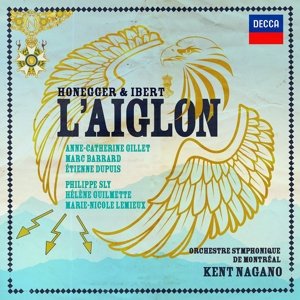
CD REVIEW: Arthur Honegger & Jacques Ibert — L’AIGLON (A.-C. Gillet, M. Barrard, É. Dupuis, P. Sly, P. Charbonneau, I. Bell, T. Duncan, J.-M. Richer, H. Guilmette, M.-N. Lemieux, J. Boulianne, K. McLaren; DECCA 478 9502)

IN REVIEW: Arthur Honegger & Jacques Ibert - L'AIGLON (DECCA 478 9502)ARTHUR HONEGGER (1892 – 1955) and JACQUES IBERT (1890 – 1962): L’AiglonAnne-Catherine Gillet (L’Aiglon, duc de Reichstadt), Marc Barrard (Séraphin Flambeau), Étienne Dupuis (Prince de Metternich), Philippe Sly (Maréchal Marmont, L’autre, Arlequin), Pascal Charbonneau (L’attaché-militaire, Un manteau vénitien, Pierrot), Isaiah Bell (Frédéric de Gentz, Un matassin, Un polichinelle), Tyler Duncan (Chevalier de Prokesch-Osten, Un Gilles), Jean-Michel Richer (Comte de Sedlinsky), Hélène Guilmette (Thérèse de Lorget), Marie-Nicole Lemieux (Marie-Louise), Julie Boulianne (Fanny Elssler), Kimy McLaren (Comtesse Camerata, Une marquise, Isabelle); Chœur de l’Orchestre Symphonie de Montréal; Orchestre Symphonie de Montréal; Kent Nagano, conductor [Recorded ‘live’ during three concert performances in Maison symphonique de Montréal, Québec, Canada, on 17, 19, and 21 March 2015, and in sessions with Hélène Guilmette and Marie-Nicole Lemieux in the same venue during September 2015; DECCA 478 9502; 2 CDs, 92:29; Available from DECCA Classics, Amazon (USA), jpc (Germany), Presto Classical (UK), and major music retailers]

There are many reasons why operas disappear from the repertory. Some scores quickly outlived their usefulness for the occasions for which they were composed. Others were conceived for individual artists whose singular qualities have not been replicated among singers of subsequent generations. Some of the music simply does not merit revival, and some libretti are rubbish. There are also operas afflicted with the inseparable baggage of uncomfortable associations. The neglect of some scores can only be attributed to ignorance, however, and this must be the case with Arthur Honegger’s and Jacques Ibert’s L’Aiglon. With the problems created by the interventions of multiple pairs of hands in operas like Mussorgsky’s Boris Godunov and Puccini’s Turandot looming large in the international repertory, perhaps there is a stigma attached to the appearance of more than one composer’s name at the head of a score. Premièred at the Opéra de Monte-Carlo in 1937 by a cast that included Fanny Heldy and Vanni Marcoux, L’Aiglon is an opera with none of the hallmarks of merited obscurity. Its libretto, based upon a play by Edmond Rostand, respected throughout the world for his Cyrano de Bergerac, is of high literary quality, the characters convincingly drawn and differentiated. The opera’s plot is engaging and fast-paced, its ending restrained but no less touching than the final scenes of La traviata, La bohème, and Werther. Most significantly, Honegger’s and Ibert’s music—extant evidence discloses that Honegger substantially composed Acts Two and Four, Ibert Acts One and Five, and that they worked closely together on Act Three—is consistently superb, the cohesiveness produced by their collaboration nodding to virtually every idiom in French opera from Grétry and Philidor to Debussy and Ravel. Recorded by DECCA with unobtrusive but unmistakable technical wizardry during concert performances that furnished the opera’s long-overdue North American première, L’Aiglon here receives an introduction to the Twenty-First Century wholly worthy of the progeny of one of the most fascinating figures in human history.

Napoléon François Charles Joseph Bonaparte, history’s and Honegger’s and Ibert’s l’Aiglon, was born at the Tuileries in Paris on 20 March 1811, the son of Napoléon and his second empress consort, Marie Louise, the eldest daughter of Holy Roman Emperor Francis II. Napoléon’s sole legitimate heir, the young Prince Imperial was from the time of his birth the titular King of Rome, but his crowns ultimately shielded him from few of life’s difficulties. His tenuous claim to the French imperial throne when his father abdicated, provisionally in 1814 and unconditionally in 1815, was not recognized by Napoléon’s vanquishers: safe in exile in his mother’s native Austria, the tyke may never have known that he was briefly proclaimed emperor after Napoléon’s decisive defeat at Waterloo. Sadly, the younger Napoléon’s life was destined to be little longer than his unheralded tenure as the head of the Empire Français. Sidelined by statesmen understandably wary of seeing another Bonaparte rising to power, Napoléon II lived in a sort of official limbo, his brief career in the Austrian army largely an exercise in keeping him distant from the goings-on at the court of his Hapsburg relatives. Chancellor von Metternich having used the youth as a pawn in his eternal chess match with France, a tribulation that figures prominently in Henri Caïn’s libretto, politics may even have hastened his demise when a request to be allowed to relocate to the healthier climate of Italy was denied. His constitution undermined first by a long bout with pneumonia and then a virulent strain of tuberculosis that plagued Austria in the wake of the cholera pandemic of 1832, l’Aiglon stretched his wings for the last time on 22 July 1832, four months after his twenty-first birthday.

His skill in leading Twentieth-Century French operatic repertory, not least Francis Poulenc’s harrowing Dialogues des Carmélites and Olivier Messiaen’s sprawling Saint François d’Assise, having been revealed in numerous critically-acclaimed performances and recordings, California-born conductor Kent Nagano was an inspired choice for presiding over the Orchestre symphonique de Montréal performances planned to lift L’Aiglon aloft. The orchestra’s lauded mastery of Tchaikovsky repertory during the tenure of former Artistic Director Charles Dutoit was a fantastic preparation for approaching L’Aiglon. Fusing elements of the French and Viennese traditions so beloved by Tchaikovsky, Honegger’s and Ibert’s score mixes portions of Stroh and Courvoisier into an intoxicating musical cocktail. The brief scene for L’Aiglon and Thérèse in Act One is reminiscent of Richard Strauss’s Presentation of the Rose in Act Two of Der Rosenkavalier, and there are echoes of Massenet’s Don Quichotte, the libretto of which was also written by Henri Caïn, in the final scene of Honegger’s and Ibert’s score. The opera’s surrealistic fourth act would not seem out of place in the pages of Balzac’s Colonel Chabert. If these resemblances suggest a disconcerting stylistic mélange, the unimpeachable continuity of the music will be especially astonishing to the listener. Even in Act Three, on which both composers toiled, transitions are seamless. The fluidity of Nagano’s conducting makes them seem even more so. Under his baton, the spirited waltz of the ballet music—a sequence that might easily be assumed to be the work of Johann Strauß II—sounds like bona fide music for dancing, and every dramatic point made by Honegger, Ibert, and Caïn is recreated by Nagano. There are no suggestions of ticking boxes or crossing moments off of a list, however. The whole of the Impressionistic Act Four is paced with the abstract inevitability of a play by Harold Pinter, and Act Five, which has the potential to be maudlin and treacly, is all the more moving for being allowed to progress steadily, eschewing tears and hollow dramatics. The conductor’s baton often seems to soar as if borrowing the eaglet’s wings. Not one passage in the opera’s ninety minutes sounds anything other than ideally-paced.

Following Nagano’s lead, both the orchestra and the Chœur de l’OSM contribute accounts of their parts that none of their Parisian counterparts could surpass. Whether playing passages scored with the gossamer effects of chamber music or those steeped in the bloody din of battle on the hills of Wagram, the OSM musicians play with authentically Gallic elegance and bristling intensity. The ballet receives from them the requisite grace, and the contrasting tumult of Act Four and melancholic subtlety of Act Five are conveyed with complete conviction. The inventiveness of the composers’ instrumentation is apparent throughout the performance owing to orchestral playing that is without shortcomings. As the disembodied voices of the Wagram battlefield, the twenty singers of the chorus, trained by Andrew Megill, deliver the utterances of the veterans of the engagement and those of the hallowed ground itself with menace, mystery, and resounding musicality. Allied with Nagano’s imaginative but accurate conducting, the OSM instrumentalists’ and choristers’ performances give L’Aiglon a brilliant, cloudless sky into which to take flight.

One of the most enjoyable aspects of this recording of L’Aiglon is the uncompromisingly excellent work of a true ensemble cast of native French speakers. Large casts without weaknesses among their ranks are now only very rarely encountered in the world’s opera houses. Honegger’s and Ibert’s music is good enough to make a vivid impression even if not ideally sung, but the artists assembled in Montréal’s acoustically spectacular Maison symphonique prove on disc to be a far better-integrated ensemble than many casts with extensive experience in staged productions. Among the alluringly phonogenic gentlemen, tenor Jean-Michel Richer is a Comte de Sedlinsky whose brief presence in the drama lingers in the memory, the character’s lines poured out in a stream of silvery tone. Fellow tenors Isaiah Bell and Pascal Charbonneau are similarly effective in their respective rôles, including their turns in the Act Three masque as Un polichinelle and Un manteau vénitien and Pierrot. Bell’s dulcet-toned Frédéric de Gentz matches Richer’s Sedlinsky in seizing the listener’s attention. As L’attaché militaire, Charbonneau’s slender, pointed voice chills and calms in equal measures, his timbre perfect for the character who clings to the periphery of the plot with ambiguous intentions. The Chevalier de Prokesch-Osten was among the young Prince’s few true friends, and it is impossible to imagine his operatic incarnation being more deserving of the confidence of an emperor’s son than he is as portrayed here by baritone Tyler Duncan. Both his Prokesch and his Gilles in Act Three are luxuriously voiced, the warmth of both the sound and the demeanor endearing him to the listener as an inspiringly reliable beacon of safety and genuine camaraderie for the increasingly isolated l’Aiglon.

Alongside such a strong cast of male singers, the female contingent of DECCA’s L’Aiglon command admiration for their own finely-judged, capably-voiced portrayals. Mezzo-soprano Julie Boulianne sings Fanny Elssler so attractively as to make the character markedly more appealing to the senses than Caïn’s words permit her to be in the drama. Soprano Kimy McLaren’s Comtesse Camerata, the agent of l’Aiglon’s escape from his Austrian wardens, and impersonations in the masque in Act Three are also sung and acted with youthful charm and tones that seem to effervesce from a freshly-uncorked bottle of champaign. Soprano Hélène Guilmette’s Thérèse de Lorget, the widowed empress’s reader and the young Prince’s de facto love interest, is distinguished by radiant singing, her voice glowing with ardor even when the words that she articulates express the character’s embarrassment in the presence of l’Aiglon. ‘Little Brooklet’ is a wonderfully appropriate epithet for Guilmette’s Thérèse: her singing flows like the crystalline waters of an unspoiled spring.

Though dismissive of her concern for him in one scene, the operatic Napoléon II is kinder to his mother than his historical counterpart is known to have been, accounts of his life documenting his wish that the more famous Joséphine were his mother rather than Marie-Louise. Who would not be inclined to deal affectionately with a mother sung by contralto Marie-Nicole Lemieux? Throughout the opera, Lemieux depicts Marie-Louise as a stern, aptly imperious figure who loves her son and regards him wistfully as the only remaining vestige of a glorious past. Hers are the misfortunes of political disgrace and outliving both spouse and child. Lemieux’s vocalism occasionally sounds flustered, the pitch secure but the tone not as formidably solid as it has often been. Marie-Louise’s music does not provide Lemieux with opportunities for the kind of bold, full-throttled singing at which she excels, but her artistry engenders a consequential performance.

Singing the rôle of Maréchal Marmont, bass-baritone Philippe Sly enriches the performance with every note that he sings. The shame and sadness with which he intones ‘Je ne l’ai pas revu’ when confronted by l’Aiglon about having abandoned Napoléon on the battlefield are deeply poignant. Still more stirring is the sense of honor with which Sly phrases ‘Ah! monseigneur, accusez la fatigue. Que voulez-vous?’ Sly’s burnished timbre lends his portrayal of the Maréchal both humanity and tragic grandeur, but it is the beauty of his singing that sustains his haunted, haunting performance.

The Prince de Metternch and Séraphin Flambeau of baritones Étienne Dupuis and Marc Barrard are the dueling forces that collectively form the fulcrum upon which the opera’s diegesis teeters. Vocally and dramatically, the gentlemen are on equal footing, the importance of their opposing loyalties cogently expressed through their impactful singing. Dupuis and Barrard spar with the sure aim of Olympic fencers in the second and third scenes of Act Two, when Flambeau terrorizes Metternich with the pseudo-shade of Napoléon. Barrard’s vocal acting in Flambeau’s phantasmagorical death scene affords the character’s suicide the honor of a hero’s passing. In the opera’s final scene, Dupuis manages to suggest that Metternich at last sympathizes with l’Aiglon. Perhaps his compassion is born solely of the relief of the legacy of Napoléon finally receding into the past, but the dignity with which Dupuis pronounces ‘Vous lui remettrez son uniforme blanc’ as the curtain falls rings with sincerity. Like Sly, Barrard and Dupuis proffer such expressive performances principally because they sing so handsomely.

Continuing the tradition established by Monteverdi with Nerone in his L’incoronazione di Poppea and advanced by Sesto in Händel’s Giulio Cesare, Mozart’s Cherubino and Massenet’s Chérubin, and Richard Strauss’s Octavian in Der Rosenkavalier and Komponist in Ariadne auf Naxos, Honegger and Ibert made their l’Aiglon a brother of Gounod’s Siébel and Stéphano. If her singing on this pair of discs is indicative of her work in general, l’Aiglon could hope for no better interpreter than Belgian soprano Anne-Catherine Gillet. Hearing her assured command of the wide range of l’Aiglon’s music, it is hardly unexpected that she is also a noted interpreter of Massenet’s Manon. Gliding through the awkward adolescent exchanges of Act One, Gillet’s upper register gleams. Gillet garners pity for the merciless treatment that l’Aiglon receives from Metternich in Act Two. The son that Gillet depicts in Act Four wants desperately to live up to the impossibly imposing stature of his diminutive father. In Act Five, the serenity and simplicity with which Gillet’s Prince takes leave of life, revisiting the grandeur of his christening, elevates the opera’s final scene to the heights of Machiavellian tragedy. Not surprisingly, the soprano’s diction is splendid. Every word that she caresses with her dazzling voice has its place in her captivating portrayal of l’Aiglon. This eaglet’s plumage is a musical wonder of nature.

The lion’s share of artistic works fashioned by collaborative efforts suffer from an unequal distribution of riches. In L’Aiglon, a passage here emphatically says, ‘Honegger,’ and a passage there just as emphatically says, ‘Ibert,’ but every passage in the score renders a message of artistically advantageous cooperation. Indeed, the heart of this recording of L’Aiglon is cooperation: respect among artists for themselves, one another, and the score in their hands yields a performance that enchants and enlightens. A more plaintive memorial to the hapless Eaglet of Napoleonic France and a finer performance of L’Aiglon are unfathomable.

IN REVIEW: Le Chevalier de Prokesch-Osten and Napoléon II in a scene from Edmond Rostand's L'AIGLON [Print by LaCroix, Paris, circa 1910; public domain]Un prince et son ami: Le Chevalier de Prokesch-Osten and Napoléon II in a scene from Edmond Rostand's L'Aiglon [Print by Lacroix, Paris, circa 1910; public domain]

02 March 2016

SINGER SPOTLIGHT: Cosmopolitan Queen of Bel canto — soprano JESSICA PRATT

SINGER SPOTLIGHT: Cosmopolitan Queen of Bel canto - soprano JESSICA PRATT [Photo © 2015 by Benjamin Ealovega]The radiant face of Twenty-First-Century bel canto: Soprano Jessica Pratt [Photo © 2015 by Benjamin Ealovega]

There are voices that are wholly forgettable and voices that one actively endeavors to forget. There are voices that, try as one might, can never be purged from the memory. Very rarely, though, there are voices that one hears and, for all the right reasons, never forgets, voices that etch into the memory the circumstances of the first hearing with the vivid significance of a life event. There was the Metropolitan Opera broadcast of Wagner’s Die Walküre on 6 December 1941, for instance, when, with the world on the brink of cataclysmic war, an untested soprano named Astrid Varnay introduced herself to the airwaves as Sieglinde. There were MET performances when Plácido Domingo and Dame Kiri Te Kanawa unexpectedly made company débuts as substitutes for ailing colleagues. There was that 1959 Covent Garden Lucia di Lammermoor when an Australian soprano who had been on the Royal Opera’s roster for nearly a decade, Dame Joan Sutherland, became a sensation. Much as the perceived paucity of important voices among today’s singers is lamented, the truth is that Melbas and Nordicas, Flagstads and Callases, Slezaks and Pertiles have ever been rare: even in the Eighteenth Century, when singers first gained celebrity-status notoriety in the modern sense, it was reportedly said that there were one God and one Farinelli, deities of equal scarcity. In this remarkable Twenty-First Century, when young singers face pressures for which conservatories can only partially prepare them, the future of opera depends more than ever before upon unforgettable voices—voices, that is, like that of soprano Jessica Pratt. Though hardly a novice, she remains a fresh-voiced young lady on the cusp of stardom, but her dedication to continually honing her craft reveals that she is anything but blinded by her success. A lovely lady of integrity both on and off the stage, she embodies bel canto in art and in life.

Born in England, Pratt relocated to Australia in her teens but now makes her home in Italy. It seems only natural that an artist with an insatiable thirst for knowledge of her chosen profession should reside upon the land from which the first founts of operatic creativity sprung, but Pratt is delightfully clear-sighted about the benefits of her intercontinental upbringing. ‘As a singer growing up in Australia​,​ Joan Sutherland and Nellie Melba were and are great examples whom I find extremely inspiring​,’ she says with obvious affection and respect for her forebears. In opera, there’s nothing like a Dame from Down Under, but this sophisticated soprano’s musical perspective is unusually global. ‘I also adore listening to recordings of Sills, Cuberli, Studer, Devia, Scotto, Olivero, Anderson, Moffo, Caballé, and Callas, among others,’ she confides. ‘I also find Fritz Wunderlich to be a very healthy singer to listen to. I think [that], as time goes on, I have started to realize that the wonderful sounds these singers produce are done with their minds and without forcing.’ An equilibrium of mental acuity and physical exertion is critical to vocal well-being, especially among singers at the starts of their careers, Pratt advocates. ‘As young singers, we always try to make something happen physically: however, the more that you step out of the way and just let your body do what is essentially a natural thing, the better the quality of sound. Less is more.’ This is wisdom with which one of her Australian idols concurred. ‘Nellie Melba writes at the beginning of her treatise on singing, The Melba Method, [that] “it is easy to sing well, and very difficult to sing badly! How many students are really prepared to accept that statement? Few, if any. They smile, and say: ‘It may be easy for you, but not for me.’ And they seem to think that there the matter ends. But if they only knew it, on their understanding and acceptance of that axiom depends half their success. Let me say the same in other words: In order to sing well, it is necessary to sing easily.” That phrase struck me as a young singer, and only after years of study and performance experience am I actually, really understanding it.’ Has this understanding changed her reactions to the work of the predecessors she so admires? ‘Yes, now, with experience, I admire the ease and freedom in Sutherland’s recordings more than anything else,’ she muses.

SINGER SPOTLIGHT: Soprano JESSICA PRATT in the title rôle of Gaetano Donizetti's LUCIA DI LAMMERMOOR at Teatro di San Carlo in Naples, Italy [Photo by Luciano Romano, © by Teatro di San Carlo]Method of her madness: Soprano Jessica Pratt in the title rôle of Gaetano Donizetti’s Lucia di Lammermoor at Teatro di San Carlo, Napoli [Photo by Luciano Romani, © by Teatro di San Carlo]

Though still well shy of forty, Pratt has already sung many of the most challenging rôles in the bel canto repertory, garnering critical acclaim and the appreciation of audiences throughout the world. Whether breathing new life into well-traveled characters like Elvira and Amina in Bellini’s I puritani and La sonnambula, Donizetti’s Lucia di Lammermoor, and Violetta in Verdi’s La traviata or resurrecting long-forgotten or under-served heroines like Donna Isabella in Nicola Vaccaj’s La sposa di Messina [recorded in performance at the XXI ROSSINI IN WILDBAD Festival by NAXOS] and Verdi’s Giovanna d’Arco [recorded in performance at the 2013 Festival della Valle d’Itria and recently released on CD and DVD by Dynamic], her performances are noteworthy for the intelligence in planning her career that her singing divulges. Especially in the first few seasons of a singer’s career, staying on the path that is healthiest for the voice can be nearly as daunting an effort as discerning that path in the first place. ‘In the beginning,’ Pratt recalls of the foremost hurdles of the earliest days of her international career, ‘it was the constant pressure to accept more lyric rôles which would have been entirely inappropriate as I did not yet have the discipline to measure out the voice over the entire performance of an opera and to resist the urge to push when things get dramatic.’ Nonetheless, there are forces at work that are not wholly within even an exceptionally wise singer’s control. ‘Of course, the temptation is strong because it is more common for a theatre to put on La traviata, for example, so there are more offers with a higher cachet, but I prefer to keep to the repertoire I love singing and that I believe is right for my voice for as long as possible.’ She quickly adds, ‘That is not to say I don’t enjoy singing Violetta. [She] is a part of my repertoire, too, but must remain a minor part like the Queen of the Night’—the rôle in which she will make her début at the Metropolitan Opera in the 2016 – 2017 Season—‘and eventually the more lyric Donizetti and Bellini rôles. I think that keeping eighty percent of my engagements in a year to lighter bel canto rôles and then adding the occasional rôle which is slightly more lyric gives me the basis to keep things healthy.’

Even so, there is nothing formulaic about Pratt’s artistry. ‘Purity, vulnerability, honesty, and intimacy come to mind,’ she responds when asked how she might describe her artistry, and her interpretation of the eponymous Babylonian queen in Rossini’s Semiramide—a rôle added to her repertory in 2015 with performances for Opéra Municipal de Marseille and Washington Concert Opera [reviewed here]—is an ideal manifestation of those qualities and the care that she exercises in discerning among the notes of a composer’s music not just a character but also indications of how to portray her. Significantly, Pratt’s performances epitomize the delicate balance between score and self. Her characterizations are redolent not of the ostentatious concept of being a woman like Semiramide in a Stanislavskian sense but of in-depth connections with composers’, audiences’, and her own perspectives. ‘I think it is natural for us to portray parts of ourselves or to see ourselves reflected in the characters we play,’ she suggests. ‘For singers, it is also a type of catharsis: we can work on exploring more vulnerable or more powerful parts of ourselves which might help those parts to grow in real life, too. I certainly feel like I have lived many lives through the characters I have played on stage.’ She sees finding the points at which composers’ and singers’ creative capacities intersect as the key to providing audiences with engaging portrayals. ‘Obviously, we often have to use our imaginations and exaggerate smaller feelings or observe others in similar states to the characters we play as we cannot live all the experiences we portray—I would be locked up in an asylum by now!’ she explains. ‘I enjoy playing Lucia di Lammermoor very much as it is a chance to put absolutely everything out before an audience. It is a portrayal of madness, a depression that fascinates me.’ Viewed through various lenses, this fascination is at the heart of Pratt’s artistic philosophy. She goes on to say, ‘I also felt a strong connection with Violetta in La traviata because the society who judged her​ ​for her lifestyle reminded me of being judged badly in the past as a possible partner because I am an opera singer, traveling the world alone [and] thus not marriageable because of my independence and not being able to be physically present all the time.’

SINGER SPOTLIGHT: Soprano JESSICA PRATT, star of Festivale della Valle d'Itria's 2013 production of Giuseppe Verdi's GIOVANNA D'ARCO, released on CD and DVD by Dynamic [Cover art © by Dynamic]Lady with a mission: Soprano Jessica Pratt, star of Festivale della Valle d’Itria’s 2013 production of Giuseppe Verdi’s Giovanna d’Arco, released on CD and DVD by Dynamic [Cover art © by Dynamic]

Pratt’s candid observation illuminates an aspect of a singer’s career that proves a challenge too insurmountable for some artists. Further outlining her approach to Violetta, she says. ‘I had also experienced in my life some very difficult health situations, and when Verdi portrays the moment that Violetta realizes she has been betrayed by her own body, which will no longer do what she wants, which is simply to get dressed and leave the house, I saw myself in hospital many years ago, when all I wanted in the world was to just stand up. I think that certain situations come with extremely strong emotions, and they can remain blocked inside us. Music is an important part of our social fabric because it helps us to explore these emotions and to unblock them.’ Contemplating the hardships that she has overcome gives Pratt pause to think of the toll that the realities of a singer’s life take on the individual. ‘Harder sacrifices are missing weddings and family milestones and not being present in the day-to-day lives of my nieces and my family in Australia and England,’ she reflects. ‘The worst [sacrifice] is being far away in a time of crisis. A recent example of this is having to go on stage and perform a comedy, Barbiere di Siviglia, in front of 14,000 people at Arena di Verona when I’d just found out [that] my father was diagnosed with lung cancer. I went on stage, played the part, and cried in my dressing room during the breaks. The lady who was doing my makeup very kindly kept fixing my face all evening without saying a word about it. Thankfully, a few days later, I had six days off and could fly to Australia to be with my father during his operation to remove the lung. He is now on the road to recovery. We have a strange kind of pressure on us in the theatre: “the show must go on” is really ingrained in our character, a sense of responsibly towards all the people who have bought tickets and traveled to see a performance.’

What makes such deprivation and isolation worthwhile? How can the pain and guilt of absence be justified? Every singer must answer these questions from her or his own unique point of view, and Pratt’s thoughts again stem from her undeviating attention to the quality of the product that she is ‘selling’ to audiences. ‘The most fulfilling [aspect of an artist’s career] is when someone tells you that watching the opera helped them in some way to overcome or to explore emotions,’ the soprano opines. She endeavors to dispel one of the hoary myths of opera, sharing that ‘the difficulties are of course many. It is not glamorous living out of a suitcase for eleven months of the year.’ Far from being glamorous, the life of a conscientious singer—a singer, that is, with as much concern for her health and happiness off the stage as for her success on the stage—is a continual process of self-evaluation. ‘We have to stay constantly healthy and well-rested, especially in my repertoire, as the vocal line is so exposed that any glitch in the legato or sounding tired is immediately noticeable,’ she imparts. ‘This means, at least in my case, hardly ever going out in the evening, not drinking alcohol or being in noisy places, a whole series of foods to avoid to reduce the possibility of reflux and so on and so forth. These lifestyle changes in all honesty are not so difficult to do and not much of a sacrifice for the moment in the theatre when a cadenza or a phrase [comes] off just right and [everyone in] the whole theatre holds their breath together.’

SINGER SPOTLIGHT: Soprano JESSICA PRATT as Violetta in Victorian Opera's 2014 production of Giuseppe Verdi's LA TRAVIATA in Melbourne, Australia [Photo by Jeff Busby, © by Victorian Opera]Sempre libera: Soprano Jessica Pratt as Violetta in Victorian Opera’s 2014 production of Giuseppe Verdi’s La traviata in Melbourne, Australia [Photo by Jeff Busby, © by Victorian Opera]

With the demands that today’s singers face focusing her thoughts on the progress of her career, Pratt ponders the choices that she has made and, could she begin anew, how she would advise her younger self with the benefit of her experience. ‘I could say take an easier life path, but I would never have listened!’ she laughs. ‘I would advise her to learn as many languages as possible as they are absolutely necessary: it is much easier to cover a memory lapse when you speak the language you are singing in!’ A vital lesson seldom relayed to young singers in lecture halls, Pratt affirms, is that the greatest obstacle to a singer’s success—and, perhaps more momentously, to a singer’s enjoyment of that success—is the singer’s own drive. ‘Don’t let perfectionism get in your way,’ she remarks with special concentration. ‘If you get eighty percent of the things you wanted to do right in a performance, that is good. The next time will be better. It is not a perfect reading of the score that the audience needs. We have to move the audience with our performance. Let go of perfectionism and interpret.’ In the midst of such introspection, the serious young lady’s innate good humor gushes to the surface with a flourish of the practical applications of her sixth sense. ‘Oh, and by the way,’ she jokingly whispers to the Jessica Pratt of years past, ‘the last five Super Bowls were won by...’

Pratt’s début solo recital disc, Serenade, a programme of songs by the defining geniuses of Italian bel canto Rossini, Donizetti, and Bellini, the French masters Gounod, Delibes, Massenet, and Bachelet, and the unjustly-neglected Belgian composer Eva Dell’Acqua, now remembered almost solely for her 1893 song for coloratura soprano ‘Villanelle,’ splendidly sung on the disc by Pratt, was recently released in the Opus Arte label’s Rosenblatt Recitals series. The combination of French and Italian music on Serenade, delivered with musical and linguistic naturalness exemplified by her unaffectedly charming performance of Rossini’s 1822 ‘Addio ai viennesi,’ highlights an invaluable facet of Pratt’s artistry. Unlike many singers of any age, she is sensitive to the extent to which the expressive power of music is markedly undermined by indifferent use of text. ‘Young singers should learn as many languages as they can,’ she explains. ‘They will need them and will have no time to learn them later.’ This, she contends, should be supplemented by literary awareness. ‘As to approaching rôles, read books, as they will develop your imagination, especially with similar characters and in time periods similar to [those] in which operas [are] staged so that you can immerse yourself in that world,’ she advises. Pratt is adamant that textual acuity must be paralleled by vigilant, unending refinement of the technique. ‘Do your technical training and study so that the mechanical part of singing is in your muscle memory when you go on stage,’ she counsels. ‘You cannot express an emotion properly if you are thinking about how to make a sound. Do your technique at home, and then you mentally put it in a box and close it with the key so it will be there when you come back, but you must go on stage and express emotions and trust that your muscle memory and technique will take care of the vocal production. You will have to sing in every position imaginable, and many are not conducive to good singing. Very​ ​few stage directors care about this: you will be wasting your breath asking them for pity, so you might as well start practicing singing lying upside down on the couch now​.’

SINGER SPOTLIGHT: Soprano JESSICA PRATT as Gilda in Teatro de la Maestranza’s 2013 production of Giuseppe Verdi’s RIGOLETTO in Sevilla, Spain [Photo by Jesús Morón, © by Teatro de la Maestranza]Bella figlia: Soprano Jessica Pratt as Gilda in Teatro de la Maestranza’s 2013 production of Giuseppe Verdi’s Rigoletto in Sevilla, Spain [Photo by Jesús Morón, © by Teatro de la Maestranza]

Advice is easily given but far less easily followed. How does this uncommonly shrewd singer apply her insights about the methodology of singing to her own career? Not surprisingly, she starts at the beginning—as Julie Andrews and Maria von Trapp might agree, a very fine place to start. ‘I never listen to the operas until I know them well myself, have written my variations, and [have] decided what I want to do with the phrasing as I am afraid I will be subconsciously influenced by another artist’s performance,’ she discloses. ‘I imagine that when these rôles were written they were all learned without the chance to ever hear them sung by other performers as there were obviously no recordings. Now we have this wonderful wealth of knowledge and ideas at our fingertips, but we also are in danger of losing our individuality. Not only the singers but also the audience perhaps run the risk of getting stuck into stereotyping rôles, expecting to hear the same type of voice and the same variations in a role that originally was varied by each individual performer to suit their particular vocal gifts. Lucia di Lammermoor is a perfect example of this. The audience waits all night to hear the traditional flute cadenza written by Tetrazzini (most call it the Callas cadenza as our recording memory only goes so far), resulting in a situation in which one of the most famous parts of the opera was not written by Donizetti!’ Losing her individuality hardly seems a reason for anxiety for an artist of Pratt’s discernment. Understandably, though, she would cherish the occasion to create a rôle written for her by one of her operatic idols. ‘I would love [for] Donizetti to come back and write an opera on the novel Tess of the d’Urbervilles by Thomas Hardy. [Hardy’s] description of Tess’s descent into madness due to a string of terrible life circumstances and societal pressure is haunting.’

In many ways, hearing Jessica Pratt sing—or hearing her talk about singing, for that matter—offers the Twenty-First-Century listener extraordinary opportunities to relive the Golden Age of bel canto, a time when Giuditta Pasta, Giulia Grisi, and Maria Malibran graced the stages of Europe. From these legendary ladies of the distant past to more recent luminaries, Pratt is commendably reverential of the now-endangered legacy of true bel canto and her place in it. ‘Bel canto is just that: beautiful singing,’ she says. ‘It has very little to do with how high you can sing but of how purely you can sing. Bel canto is about ease and beauty of sound. One has to spin an uninterrupted web of sound the whole evening, expressing emotions through beauty like a painter might paint a terrible scene but with beauty and elegance that take your breath away.’ This analogy is wonderfully appropriate for an artist who summarizes the focus of her creative energy with three compelling words: ‘observe, experience, and portray.’ Words are cheap, but voices like Jessica Pratt’s are priceless.

SINGER SPOTLIGHT: Soprano JESSICA PRATT's début solo recital disc SERENADE on the Opus Arte label [Cover art © by Opus Arte]First lady of song: Soprano Jessica Pratt’s début recital disc, Serenade, on the Opus Arte label [Cover art © by Opus Arte]

To learn more about Jessica Pratt, please visit her website and follow her on Facebook and Twitter. The author’s sincerest thanks are extended to Ms. Pratt for her time and openness and to Tim Weiler at O-PR Communications for his assistance and patience.

29 February 2016

CD REVIEW: Franz Schubert — WINTERREISE (Dimitris Tiliakos, baritone; Vassilis Varvaresos, piano; Navis Classics NC16008)

IN REVIEW: Franz Schubert - WINTERREISE (Navis Classics NC16008)FRANZ SCHUBERT (1797 – 1828): Winterreise, D911Dimitris Tiliakos, baritone; Vassilis Varvaresos, piano [Recorded in Stichting Westvest 90, Schiedam, Netherlands, 21 – 25 July 2015; Navis Classics NC16008; 1 CD, 76:27; Available from Navis Classics, Amazon (USA), fnac (France), jpc (Germany), Presto Classical (UK), and major music retailers]

In the wondrously discombobulating realm of music written for the human voice, there are works that artists with sufficient good sense to safeguard their vocal endowments and respect their places in the distinguished history of song approach—or should approach—with healthy reverence. The soprano who regards Norma’s ‘Casta diva,’ Isolde’s Liebestod, or Brünnhilde’s Immolation as mere intersections of notes and words is unlikely to find lasting success singing any of these epic pieces. The violinist who perceives in the scores of the Beethoven, Brahms, and Bruch concerti only opportunities for technical peacocking is not worthy of the music. For the conscientious Lieder singer, Franz Schubert’s genre-defining Winterreise is a work of similar significance, one that must be studied, absorbed, felt, even loved before it can be satisfactorily sung. In this music, it is not enough to master the notes and correctly pronounce the words. Unsurprisingly, the Schubert discography is littered with merely competent recordings of Winterreise, many of which sound beautiful to the ears but communicate nothing to the heart. For those who cherish the Art of Song, the release of a new recording of Winterreise is cause for equal excitement and trepidation. Recorded with great skill and obvious affection by the label’s manager, Daan van Aalst, with the ideal natural acoustical balance between voice and piano for which all labels recording Lieder repertory should strive, Navis Classics’ Winterreise is a traversal of this epic cycle that is truly a journey, one that takes the listener into ominous, uncomfortable recesses of the psyche with the emotional directness and collaborative musicality missing from so many performances and recordings of Winterreise. Most crucially, the heart that beats tumultuously at the core of this Winterreise is Schubert’s, an attribute that has eluded the endeavors many of the most famous names in the cycle’s storied history on records.

Born on the picturesque island of Rhodes, situated just off the southwest coast of Turkey but one of Greece’s Dodecanese islands, baritone Dimitri Tiliakos brings to his work an artistry steeped in the millennia of history and traditions of his homeland. Following study of the viola, he honed his vocal technique under the tutelage of his illustrious countryman, the still-too-little-appreciated baritone Kostas Paskalis. Upon that foundation, he has built an impressive international career that, to date, has taken him to many of the world’s important opera houses, including New York’s Metropolitan Opera, where he débuted as Schaunard in Puccini’s La bohème in 2010. His resonantly masculine but sympathetic Aeneas opposite Simone Kermes’s Dido on Teodor Currentzis’s fascinating recording of Purcell’s operatic magnum opus will soon be joined by his performance of the title rôle in the conductor’s Sony recording of Mozart’s Don Giovanni, recorded in Perm in December 2015. His partner in this Winterreise, prize-winning pianist Vassilis Varvaresos, is also a native of Greece, born in Thessaloniki, the capital of Greek Macedonia. Having been heard in prestigious venues including New York’s Carnegie Hall, Amsterdam’s Concertgebouw, Paris’s Salle Gaveau, and The White House, where he played at the invitation of President Barack Obama, Varvaresos has garnered a reputation as an exceptional interpreter of a wide repertory that includes his own compositions. It is fanciful to suggest that the baritone’s and pianist’s common nationality engenders heightened artistic accord, but the synergy that this pair of artists bring to their performance of Winterreise is incredible. The songs, first published in 1828, here sound as though they are being extemporized by a single artist before the studio microphones. Tiliakos and Varvaresos phrase in tandem with the synchronicity of dance partners, the baritone’s voice and the pianist’s fingers executing an eloquent pas de deux that bridges the two centuries between Schubert’s composition of the Lieder and today with startling immediacy. This is a reading of Winterreise that does not shrink from extremes of dynamics and tempo and is all the better for it. Winterreise is not a dainty odyssey: why do so many performers fidget with the music as though it were?

From the start of ‘Gute Nacht,’ it is apparent that this will be no ordinary, ‘safe’ Winterreise. Tiliakos’s mezza voce is wonderful, sustained and projected by his exemplary breath control, and his soft singing is often mesmerizing. He touches notes above the stave gently but without resorting to falsetto, and he shares with Hermann Prey and Heinrich Schlusnus the ability to sing piano without crooning or condescending. The modulation to the major for the last stanza of ‘Gute Nacht’ is cathartic as Tiliakos sings it, the tension unostentatiously resolved. Varvaresos executes the trills in the opening bars of ‘Die Wetterfahne’ with uncommon rhythmic crispness, the ornaments for once bring perfectly in time with the melodic line as they should be but seldom are, and Tiliakos displays the strength of his voice, slight hints of unsteadiness at the top of the range showing themselves when the volume increases. However, the baritone does not use Schubert’s most animated passages as an opportunity to overwhelm the music with pseudo-operatic grandstanding. Varvaresos’s playing of the restless accompaniment of ‘Gefrorne Tränen’ complements Tiliakos’s listless, almost embarrassed interpretation of the song, and their sensitive but unsentimental ‘Erstarrung,’ a song that goes for nothing in many performances of Winterreise, is unexpectedly one of the most vivid numbers in their cycle. ‘Der Lindenbaum’ is justifiably among Schubert’s most admired Lieder, and the delicacy of singing and pianism with which it is shaped here is very effective, disclosing the inherent rightness of handling the song with simplicity. The effortlessness with which Tiliakos braves Schubert’s awkward intervals in ‘Wasserflut’ lends the song eerie charm.

The enigmatic atmosphere of ‘Auf dem Flusse’ is conjured by the pianist and deepened by the singer, their work highlighting the haunting power of the song. The rumbling accompaniment of ‘Rückblick’ is played by Varvaresos with pinpoint accuracy and Stravinskian buoyancy. Tiliakos traces the uncertain, somewhat disjointed vocal line with the kind of technical security that enables searching dramatic introspection. Their ‘Irrlicht,’ too, possesses an unnerving charisma that permeates the performance: the song’s essence is both chilling and comforting. With its suspended resolutions of cadences and ritornello-like piano part, ‘Rast’ is a link with the Baroque, its dialogue between voice and instrument reminiscent of music like the Largo ma non tanto movement of Bach’s D-minor Concerto for Two Violins (BWV 1043). Tiliakos and Varvaresos duet with the sacrosanct trust of chamber musicians. Echoes of Haydn resound in ‘Frühlingstraum,’ translated by both singer and pianist into statements in Schubert’s most concentrated Romantic language. In a sense, the first strains of ‘Einsamkeit’ are like a fun-house mirror reflection of ‘Der Lindenbaum,’ but Tiliakos sings it so unaffectedly that the song’s latent spiritual grotesqueries seem less like torments and more like much-needed companions.

‘Die Post’ is an example of the breadth of Schubert’s talent for cinematic use of the piano, the unmistakable sounds of galloping post carriage horses and the post horn in the song’s accompaniment contrasting with the unperturbed stasis of the vocal line. Varvaresos and Tiliakos present the song straightforwardly, completely avoiding some performances’ intimation that it is a piano recital into which a singer wanders. There is a vein of affection in ‘Der greise Kopf’ that many artists do not bother to tap, but Tiliakos and Varvaresos extract the plasma from the piece and transfuse it into their musical veins, portentously imparting the text’s ambivalence about growing old. The inquisitive crow that appears in ‘Die Krähe’ is welcomed as a comrade by Tikiakos’s narrator rather than being dismissed as an intruder, and he and Varvaresos give the song a gentle humor. ‘Letzte Hoffnung’ is not as bleak as its title suggests, and this performance focuses on an unexaggerated articulation of the text, eschewing the melodramatic wailing in which some performers mire the song. As sung here, ‘Im Dorfe’ is an unusually clear-sighted examination of the perceived manifestations of human emotions in their physical surroundings, an exploration furthered in ‘Der stürmische Morgen,’ imaginatively played and sung. Throughout his survey of the Lieder in Winterreise, Tiliakos exhibits propitious confidence in the full range demanded by the music, rising without strain to notes above the stave and descending with similar assurance to the bottom of the compass. His diction is clear without seeming stilted or artificial, and so well-matched is Varvaresos’s phrasing, even when piano and voice pursue divergent paths, that it would be easy to erroneously regard this Winterreise as the product of a single musician.

The unique sensibilities of Tiliakos’s and Varvaresos’s explication of the psychological intricacies of Winterreise are distilled into a laser-like focus in the sequence of the final six songs of the cycle. The subtleties of ‘Täuschung’ are insightfully differentiated from the prevailingly desolate mood of ‘Der Wegweiser,’ and the hymn-like ‘Das Wirtshaus’ is expansively phrased, giving the song’s ethos a proto-Wagnerian depth. The dramatically alert elocution of ‘Mut!’ takes its strength from the performers’ organic musicality, the song’s expressive potency—undermined by many artists’ over-emphatic approaches—intensified by the singular metaphysical sagacity with which Tiliakos and Varvaresos convert the meaning of the text into sound. The stark imagery of ‘Die Nebensonnen’ is brought to disconcerting life by the baritone’s visceral singing: one practically squints at the blinding glare of the fraudulent suns of which he sings. In this performance, the hurdy-gurdy man of ‘Der Leiermann’ is not a terrestrial Charon demanding remuneration for passage to another plane of existence but a Delphic harbinger of a new reality. As elucidated by Tiliakos and Varvaresos, the narrator’s journey does not reach a tragic terminus: here, Winterreise is truly a cycle, an orbit through an ever-changing landscape scarred but not obliterated by loss and disillusionment.

Perhaps the most telling ambiguity in Classical Music in the Twenty-First Century is the contrast between the disheartening lack of civility among artists and the damning politeness of their work upon the world’s stages. When Giulietta Simionato’s Santuzza hurled tidings for a ‘mala pasqua’ in Turiddu’s face, the audience, whether in the theatre or listening at home, felt the blow down to the marrow of their bones. When Maria Callas’s Anna Bolena demanded justification of ‘giudici—ad Anna?’ from the hypocritical Enrico, she for a moment wore not costumes and rhinestone jewels but the martyr’s crown of the unjustly accused. When the Busch Quartet played the music of Beethoven, one listened not for particular notes or phrases but for whispered messages from the composer. Schubert’s Winterreise deserves this same level of commitment from those who perform it—and from those who hear it. The performance by Dimitris Tiliakos and Vassilis Varvaresos allows the listener to genuinely experience Winterreise. If the sonnets of Shakespeare, the canvases of El Greco, and the novels of Zora Neale Hurston could be condensed into seventy minutes of song, this Winterreise might be the result, but this Winterreise is a compelling work of art all on its own, a vision of humanity shared by three artists—Franz Schubert, Dimitris Tiliakos, and Vassilis Varvaresos—courageous enough to look beyond the façades of pretty fusions of music and text.

27 February 2016

CD REVIEW: Gaetano Donizetti — LE DUC D’ALBE (L. Naouri, A. Meade, M. Spyres, G. Buratto, D. Stout, T. Llŷr Griffiths, R. Tritschler, D. Kimberg; Opera Rara ORC54)

IN REVIEW: Gaetano Donizetti - LE DUC D'ALBE (Opera Rara ORC54)GAETANO DONIZETTI (1797 – 1848): Le duc d’Albe—Laurent Naouri (Le duc d’Albe), Angela Meade (Hélène d’Egmont), Michael Spyres (Henri de Bruges), Gianluca Buratto (Daniel Brauer), David Stout (Sandoval), Trystan Llŷr Griffiths (Carlos), Robin Tritschler (Balbuena), Dawid Kimberg (Un tavernier); Opera Rara Chorus; Hallé; Sir Mark Elder, conductor [Recorded at Hallé St Peter’s, Ancoats, Manchester, England, in June 2015; Opera Rara ORC54; 2 CDs, 93:22; Available from Opera Rara, Amazon (USA – CD | mp3), jpc (Germany), Presto Classical (UK), and major music retailers]

One of the most confounding dilemmas in opera is the question of what to do with scores that were left incomplete by their composers or exist in multiple forms. There are instances in which the decisions are easy, of course: though her earlier guise is not without obvious assets, Beethoven’s Fidelio is almost universally preferred over her younger self, Leonore, and the version of Massenet’s Werther adapted to accommodate a baritone protagonist for the benefit of Mattia Battistini is very rarely heard in comparison with the performance diary of the canonical version with a tenor protagonist. Händel’s Radamisto, Gluck’s Orfeo ed Euridice/Orphée et Eurydice, Offenbach’s Les contes d’Hoffmann, and Verdi’s La forza del destino and Don Carlos all present riddles that are not easily solved. In the nearly 230 years since the opera’s première, conductors, opera house managers, and impresarios have debated whether to perform the Prague or Vienna version of Mozart’s Don Giovanni. Should both of Don Ottavio’s arias be included, or must fidelity to the letter of one of the versions be preserved; and what of Donna Elvira’s ‘Mi tradì quell’alma ingrata’? Is Wagner’s Der fliegende Holländer to be staged in a single act or in three acts, set in Scotland or Norway? Should a performance of Puccini’s Turandot end at the point at which the composer’s death halted his work on the score, employ the sanctioned completion by Franco Alfano, or devise another option? There are as many possible solutions as there are people to ponder the questions, but the very notion of a single right answer is as fanciful as the ‘chimere’ and ‘castelli in aria’ of which Rodolfo sings in La bohème.

In a sense, the death of Gaetano Donizetti in 1848 was a merciful release, the last three years of the composer’s life having subjected him to the agonies of disease, deterioration, and institutionalization. Particularly in his final year, bouts of lucidity and work alternated with periods during which it was reported that he had virtually no sensory engagement with his surroundings. Perhaps he retreated in those distant moments into the theatre within him, where new works continued to take shape. The deaths of his parents, his wife, and all three of his children by the autumn of 1837 undoubtedly made his fifth decade a lonely time when the characters to whom he gave life in his scores were his closest companions. Though such projects were rarely without plentiful headaches, the prospect of writing a new score for the Paris Opéra must have at least given Donizetti a welcome outlet into which his energy could be channeled. When the composer abandoned Naples after the censors denied his Poliuto a première on the stage of the Teatro di San Carlo and relocated to Paris in October 1838, he was hardly a stranger in the French capital, where his Anna Bolena, Lucia di Lammermoor, and other scores had attained popularity in the repertories of several theatres, most notably the Théâtre-Italien, performances under the auspices of which—a momentous example being the 1835 première of Donizetti’s Marino Faliero, commissioned by the company and first performed not long after the première of Bellini’s similarly-conceived I puritani—bounced during Donizetti’s residencies in the city among four venues including the famed Salle Favart. After Salvadore Cammarano’s Poliuto underwent redressing by Eugène Scribe as Les martyrs and the resulting opera received its first production at the Opéra in April 1840, Donizetti turned his attention back to fulfilling the second of his two commissions from the Opéra, a setting of a libretto by Scribe and Charles Duveyrier: Le duc d’Albe.

By the time that Les martyrs reached the stage, the score of Le duc d’Albe, begun in 1839, was half-completed, vocal lines for the incomplete portions, mostly Acts Three and Four, already substantially sketched. The real impetus for the regrettable ultimate abandonment of Le duc d’Albe will now likely never be known. The oft-repeated story, worthy of Gaston Leroux’s Le fantôme de l’Opéra, of the Opéra’s manager’s dismissal of Le duc d’Albe because its heroine, written with tessitura similar to that of the title rôle in Anna Bolena, was not congenial for the company’s—and his—leading lady, mezzo-soprano Rosine Stoltz, may be wholly or partially apocryphal, but, if not on Stoltz’s behalf surely to her benefit, Hélène in Le duc d’Albe was cast aside in favor of Léonor in La favorite, a reworking of Donizetti’s 1839 score L’ange de Nisida, recently announced as a future Opera Rara recording project. Rather than employing the completion of the score fashioned by Donizetti’s pupil Matteo Salvi and first performed using an Italian translation [Scribe’s libretto did not languish in neglect, eventually being recalled to duty for Verdi’s Les vêpres siciliennes] in Rome in 1882 or exploring other avenues like the jarringly divergent completion by Giorgio Battistelli staged by Vlaamse Opera in 2012, this Opera Rara release presents Roger Parker’s critical edition of only the music completed by Donizetti, augmented by a handful of newly-composed passages, the work of Martin Fitzpatrick, necessary for the continuity of the existing material. True to the label’s mission of ensuring that ‘operas once threatened with extinction [are] now brought vividly back to life,’ this recording enables Twenty-First-Century listeners to hear Le duc d’Albe as it was bequeathed to posterity by its composer in a performance that would have caused the Opéra to reconsider its rejection, Rosine Stoltz and her admirers be damned.

Their work having been featured on previous Opera Rara recordings, the excellent playing of the Hallé musicians and the vigorous but stylish conducting of Sir Mark Elder are not surprising, but they here surpass their own high standards. The orchestra’s crackling account of the opera’s atmospheric Prélude launches a performance in which every Hallé member uses his or her instrument not as an impersonal conduit for sound but as a participant in the drama. As in their acclaimed performances and recordings of Wagner’s Die Walküre and Götterdämmerung, the Hallé players excel in the construction of a sonic profile consistent in its brilliance but adaptable in scope to the needs of the score. Donizetti’s skill as an orchestrator became ever more refined as his career progressed, and his writing for strings in Le duc d’Albe has a Mozartean elegance that dovetails very effectively with his bold, Verdian music for brasses and woodwinds. Elder’s ear for individual instrumental timbres and the ways in which Donizetti manages and manipulates them is invaluable in this score, and his trust in his Hallé colleagues’ impeccable musical integrity frees him to focus on presiding over a performance that balances brawn and bel canto. Central to the preservation of that balance is the singing of the Opera Rara Chorus. At the start of Act One, the choristers’ exclamations of ‘Espagne! Espagne! Espagne!’ immediately elevate the temperature of the performance to a feverish level, and the force with which they declaim ‘Honneur à lui! Ce guerrier notre idole’ later in the act is breaktaking. In Act Two, their caroling of ‘Liqueur traîtresse’ introduces wry humor into the otherwise deadly serious circumstances. Then, their ominous ‘Les derniers feux meurent dans l’ombre’ establishes the dangerous tension of the act’s final minutes. The sincere religiosity of their intoning of ‘Liberté! ... Liberté chérie!’ makes Donizetti’s depiction of the Flemings’ quest for freedom from their Hapsburg overlords a relative of the struggles against oppression in Verdi’s Nabucco, I Lombardi alla prima crociata, Attila, and Macbeth. Had Le duc d’Albe been completed, it might well have proved as galvanizing a work of musical politics as Verdi’s Risorgimento operas and Auber’s La muette de Portici. Nevertheless, the most appreciable accomplishment of Elder’s conducting is that nothing about this performance of Le duc d’Albe sounds incomplete.

Another expectation of Opera Rara recordings is casting of supporting rôles with artists of markedly higher quality than many opera companies and record labels have sufficient resources or vision to engage. In this regard, too, this Le duc d’Albe is a particular triumph for Opera Rara. Heard in Act One, South African baritone Dawid Kimberg as the Tavernier and Welsh tenor Trystan Llŷr Griffiths as Carlos sing attractively and securely. One of today’s most communicative Lieder singers, Irish tenor Robin Tritschler voices Balbuena’s intoxicated haranguing of Hélène in Act One, ‘Pourquoi dans cette foule heureuse et satisfaite,’ with appropriate swagger, his light but plush voice filling his character’s lines with greater beauty than their coarseness merits. Appearing in both acts, the captain of the Spanish garrison, Sandoval, is portrayed with fittingly martial fortitude by bronze-timbred baritone David Stout, a former head chorister at Westminster Abbey. There is smarmy self-satisfaction in his delivery of ‘Par Saint-Jacques, messieurs, on ne boit qu’à Bruxelles,’ and he chants ‘Voyez donc cette belle’ repulsively—perfectly in character, that is. His mettlesome study of Sandoval continues to gain stature in Act Two. Donizetti deserves no less than Kimberg, Griffiths, Tritschler, and Stout contribute to this Le duc d’Albe, but how many performances or recordings of any repertory enjoy the participation of artists of their calibre?

The aptly-named Daniel Brauer is brewed into a potent figure by Italian bass Gianluca Buratto. An uncompromising Flemish patriot, Daniel occasionally seems like a refugee from Meyerbeer’s Less Huguenots, premièred in Paris in 1836. [Incidentally, Scribe also collaborated on the libretto for Les Huguenots.] Buratto detonates ‘Quelle horreur m’environne’ in Act One with dark implications, but he interacts with Hélène with affection and restraint. In the fast-paced second act, the bass takes care to highlight the emotional chasm that opens between ‘Ici l’on travaille et l’on chante!’ and ‘Mais j’entends battre la retraite.’ Buratto’s voice and demeanor are perhaps slightly too refined for the heroic but pragmatic Daniel, but the singer’s performance validates the realization that being a man of action and a man of thought are not mutually-exclusive concepts. Most importantly, he sings Daniel’s music capably and handsomely.

The rôle of the enigmatic Duc d’Albe, the Spanish viceroy of Flanders, likely suffers more than any of the other principal characters from the truncated form in which the opera survives, the beginning of Act Three having been planned as a solo scene for the Duc, but French baritone Laurent Naouri takes full advantage of every opportunity given to him and succeeds in creating a remarkably three-dimensional figure whose presence in the drama is considerably greater than the sum of its relatively few musical parts. In Act One, Naouri voices ‘Race faible et poltronne’ powerfully, the character’s ambivalence obvious from the start. The singer’s native French diction is a definite advantage, but the worst French among the cast is very good. The baritone phrases ‘J’aime son audace’ with toughness that does not impede the suggestion of warmth towards his rediscovered son. Absent from Act Two, the Duc’s shadow is perceived nevertheless, largely owing to Naouri’s incendiary portrayal. Along with some splendid high notes, Naouri produces sporadic patches of strenuous, unsteady singing. His reading of the troubled Duc embodies dramatic and musical authority, however, and, solely on vocal terms, he is a legitimate successor to Louis Quilico and Silvano Carroli in the character’s draconian music.

The notion that Missouri-born tenor Michael Spyres could sing more excitingly than in his assumption of the rôle of Polyeucte in Opera Rara’s 2014 concert performance and studio recording of Donizetti’s Les martyrs might seem ridiculous to listeners who have not heard this recording of Le duc d’Albe. As the colloquialism promises, though, hearing is believing, and there are sensational things to be heard in Spyres’s singing of Donizetti’s music for Henri de Bruges. In Henri’s exchanges with Hélène, Daniel, and the Duc in Act One, Spyres adopts a lover’s, a fellow patriot’s, and a defiant freedom fighter’s inflections, all while singing magnificently. The tenacity of Spyres’s articulation of ‘Punis mon audace!’—reminiscent of the title character’s ‘Giudici...ad Anna!’ in the Act One finale of Anna Bolena—is thrilling, and his virile ‘Non, non, point de grâce’ transforms the final scene of Act One of Le duc d’Albe from a standard-issue operatic clash into a life-or-death campaign against despotism. His excursions into the vocal stratosphere in the finales of both acts are as invigorating as they are secure. Duetting with his beloved and pursuing his determination to terminate the incumbency of the tyrant who is actually his father, Spyres provides the stimulus that propels Act Two to its electrifying conclusion. In the duet with Hélène, he vocalizes ‘Ah! Oui, longtemps en silence’ with fearlessness and sophistication. These qualities define Spyres’s singing in every scene in which he appears in Le duc d’Albe. The celebrated tenor Gilbert Duprez created the rôles of Polyeucte in Les martyrs and Fernand in La favorite, and it is feasible that it was for Duprez that Donizetti intended the rôle of Henri in Le duc d’Albe. If Duprez was capable of singing Henri’s music half as well as Spyres sings it on this recording, Parisians having been deprived of hearing his interpretation of the part was one of the foremost musical misfortunes of the Nineteenth Century.

Spyres’s Henri warrants a first-rate leading lady, and soprano Angela Meade, hailing from Centralia, Washington, and here making her Opera Rara début, fits the bill spectacularly. With a repertoire including lauded outings in rôles as diverse as the Contessa in Mozart’s Le nozze di Figaro, Bellini’s Beatrice di Tenda and Norma, Donizetti’s Anna Bolena and Lucrezia Borgia, Verdi’s Elvira in Ernani, Leonora in Il trovatore, and Alice Ford in Falstaff, and Fidelia in Puccini’s Edgar, Meade is one of today’s most intrepid singers. Vocal dauntlessness is best justified by technical confidence, and Meade’s singing on this recording exudes mastery of red-blooded bel canto. From her first appearance in Act One, she personifies an Hélène whose resilience is nearly as impressive as her vocal resources. Donizetti’s opera essentially enacts upon the stage the events represented in Beethoven’s familiar Egmont Overture, the opera’s plot beginning on the day after Hélène’s father, the Count of Egmont, was executed under orders from the Duke of Alba. With her impassioned singing of ‘Au sein des mers et battu par l’orage,’ Meade confirms that her Hélène is a daughter in whom the spirit of her father lives. The causticity of ‘A quoi bon des prières vaines’ is mirrored in the icy glint that the soprano’s singing takes on, but the lady’s comportment softens with Meade’s lusciously-phrased ‘Ah! Que du ciel descende.’ Then, the aristocratic bearing with which she voices ‘Moi-même je frissonne’ discloses Hélène’s innate nobility of heart. The ease with which Meade rises to the challenges of Act Two is staggering, her utterance of ‘Henri! Noble jeune homme! Ah, j’ai lu dans son âme’ amazing with its blend of technical aptitude and histrionic panache. Equally gripping is her expressive ‘Ton ombre murmure, o mon père!’ In the duet with Henri, she sculpts the line in ‘Oui, longtemps en silence’ with the unerring hand of a Rodin, capturing in sound the souls of both the text and the woman she portrays. Meade’s jaunts above the stave are fantastic, not least the extraordinary top E♭ in unison with Spyres in Act Two, but it is the solidity of the sound throughout the wide compass of her music that is so gratifying. With her performance in Le duc d’Albe, Meade affirms that in her Opera Rara’s discerning decision makers have found a prima donna who earns a place alongside Nelly Miricioiu, Majella Cullagh, and Annick Massis.

Opera Rara’s commitment to recording ignored treasures of Nineteenth-Century opera—or, as in the case of the label’s planned studio recording of Rossini’s Semiramide, recording these treasures as they ought to be but are so rarely performed—sometimes leads into musical territory that Alexander Pope might have described as ground ‘where angels fear to tread,’ but no fools rushing in are Opera Rara and the artists who take part in the label’s projects! The Opera Rara catalogue is a lavish collection of performances that allow scores to exhibit their efficacy as their composers intended, but even among many gems this Le duc d’Albe sparkles very brightly.

24 February 2016

CD REVIEW: Georg Friedrich Händel — ACIS AND GALATEA and SAREI TROPPO FELICE (A. Sheehan, T. Wakim, D. Williams, J. McStoots, Z. Wilder, A. Forsythe; cpo 777 877-2)

IN REVIEW: Georg Friedrich Händel - ACIS AND GALATEA (cpo 777 877-2)GEORG FRIEDRICH HÄNDEL (1685 – 1759): Acis and Galatea, HWV 49a [original chamber version of 1718] and Sarei troppo felice, HWV 157Aaron Sheehan (Acis), Teresa Wakim (Galatea), Douglas Williams (Polyphemus), Jason McStoots (Damon), Zachary Wilder (Coridon); Amanda Forsythe (soprano – HWV 157); Vocal and Chamber Ensembles of Boston Early Music Festival; Paul O’Dette and Stephen Stubbs, leaders [Recorded in the Sendesaal, Bremen, Germany, 27 June – 1 July 2013; cpo 777 877-2; 2 CDs, 107:18; Available from ClassicsOnlineHD (Download | Streaming), jpc (Germany), Amazon (USA), fnac (France), Presto Classical (UK), and major music retailers]

Whether the medium at hand is literary, musical, political, or visual, the Zeitgeist of an age is of necessity manifested in the creative energy of its artists. There are of course Existentialist ties among artists, their work, and their communities, but the bonds that unite a work of art with its physical, social, and temporal environments are often as unglamorous as financing and fortuitous intersections of space and supplies. From the relatively broad perspective facilitated by the Twenty-First Century’s unprecedented access to information, it seems extraordinary that a society that, if accounts by writers of the ilk of Lytton Strachey are to be trusted, so dismayed Queen Victoria’s consort, Prince Albert of Saxe-Coburg and Gotha, with its paucities of discipline, imagination, and integrity should a century before Victoria’s ascension in 1837 have inspired Georg Friedrich Händel to create for its entertainment some of the finest music produced in the first half of the Eighteenth Century. It has sometimes been suggested by observers for whom art begins and ends with money changing hands that Händel was essentially an opportunist: with a new, friendly dynasty upon the throne, Britain was a singer in search of a song, and Händel marketed himself as just the man to write it. He faced obstacles and suffered losses in the capital along the Thames that would have sent opportunists scurrying back to the Continent, however, and in the last fifteen years of his life he gave Britain several of his greatest scores, gifts that musical Britons did very little to deserve. It cannot have solely been opportunism that compelled the stern composer to permanently trade Halle for Mayfair, but there is no question that Händel and the English musical establishment enjoyed a mutually-beneficial relationship that continues to pay lavish returns.

Before permanently throwing his lot in with that of the English in 1712, Händel followed the tide of his burgeoning interest in opera, ignited in Hamburg, to the land of the genre’s birth. Continuing the serendipitous pattern of recording studio-made souvenirs of lauded Boston Early Music Festival performances, this cpo release unites Händel’s early Italian cantata ‘Sarei troppo felice’ (HWV 157) with the 1718 Cannons edition of the pastoral masque Acis and Galatea. Composed in September 1707 during the young Händel’s fruitful time in Rome and contemporaneously with Rodrigo, his first opera wholly in Italian, ‘Sarei troppo felice’ uses a text wholly or partially by Cardinal Benedetto Pamphilj. Unfortunately, the full manuscript of the cantata is not known to survive, but despite its early date—Händel was twenty-two years old when it was completed—the score often reveals the composer’s fledgling ingenuity at its most expressive. Sung for cpo by soprano Amanda Forsythe and accompanied in part by gambist Laura Jeppesen, ‘Sarei troppo felice’ proves to be an intriguing companion for Acis and Galatea. One of today’s most impressive singers in any repertory, Forsythe here makes much of little, heightening the emotional significance of each repetition of the opening line, ‘Sarei troppo felice.’ She phrases the Largo ‘Se al pensier dar mai potrò’ with great feeling, her use of text enabling the listener to sense the words’ meaning without comprehending a single syllable of Italian. The disquietude that floods her voice when she sings ’Clori, schernita Clori’ seems to flow from the most intimate recesses of her soul, and the emotive power of her traversals of ’Giusto Ciel se non ho sorte’ and ’Ah! che un cieco ho per guida’ is, on a scale appropriate to Händel’s music, no less than that borne by the utterances of an insightful Fiordiligi or Gilda. That Forsythe is an important singer is a fact acknowledged by virtually every listener fortunate enough to have heard her, and her singing of ‘Sarei troppo felice’ here confirms that she is an artist with the rare capacities to discern in any music a journey of the heart and to guide the listener in discerning—and exploring—it, too.

It was during his residency at Cannons, the Middlesex seat of the eventual Duke of Chandos [prior to 1719, when his Marquessate and Dukedom were created by the Crown, His Grace was but a lowly Baron, Viscount, and Earl], that Händel composed Acis and Galatea, the twelve Chandos Anthems, and the earliest of his pioneering English oratorios, Esther. Using as his libretto an adaptation of John Dryden’s translations of Ovid on which John Gay, John Hughes, and other writers, perhaps even Alexander Pope, likely collaborated, Acis and Galatea in its Purcellian masque form was completed in 1718. The circumstances of its first performance are unknown, but it is logically conjectured that a masque in which the hero is granted riparian immortality was conceived for al fresco performance, Cannons boasting of greatly-admired waterworks in its gardens. BEMF’s 2009 production sought to restore to Händel’s 1718 pastoral masque the authentic provenance of its birth, and this recording offers felicitous proof of the Festival’s success. Dismissive critical assessments of the scale of the performance—and the singers’ individual performances—on these discs, some authored by generally respected advocates for Baroque repertory, are mystifying. It is important that the 1718 Acis and Galatea not be confused with its brethren in the Händel catalogue, the 1708 Neapolitan serenata Aci, Galatea e Polifemo, the three-act 1732 score premièred by Anna Maria Strada del Pò, Senesino, and Antonio Montagnana, and the 1739 two-act English adaptation. Measured against the proper standard, that of the known and probable contexts of the first performance of the Cannons version, the performance spurred by the bar-raising work of the BEMF Vocal and Chamber Ensembles exemplifies the best fusion of scholarship and timeless musicality.

The tuneful Sinfonia introduces Acis and Galatea with aptly Arcadian grace, and the playing of BEMF’s team of peerless Händel stylists—violinist and leader Robert Mealy, violinist Cynthia Roberts, cellist Phoebe Carrai, Rob Nairn on double bass, Gonzalo X. Ruiz playing solo oboe and recorder, oboist and recorder soloist Kathryn Montoya, bassoonist Dominic Teresi, harpsichordist Avi Stein, and musical directors Paul O’Dette on archlute and Stephen Stubbs on Baroque guitar and theorbo—sets the stage for a performance in which Händel’s music sounds newly-minted. Each of the musicians is an undoubted virtuoso, but the most remarkable aspect of their playing is the skill with which they furnish precisely the magnitude of sound that each number requires. As at Cannons in 1718, the vocal soloists also serve as the choristers, and the integration of their voices in the opening chorus, ‘O the Pleasure of the Plains,’ is superb. They seem an altogether different ensemble in the anguished pronouncements of ‘Wretched Lovers! Fate has past this sad decree, no joy shall last’ and ‘Mourn, all ye Muses, weep, all ye Swains.’ Comforting the despondent Galatea and then entreating her, ‘Galatea, dry thy Tears,’ their sound is again transformed, now glowing with melodious optimism. Under O’Dette’s and Stubbs’s direction, the decorous drama plays out plaintively, every embellishment enacted by singers and instrumentalists displaying absolute refinement.

Blame for the principal and, fundamentally, only flaw in the performance of Acis and Galatea on cpo’s discs must be laid at Händel’s feet. It is unpardonable that the shepherd Coridon has so little to do when he is given life by the hypnotic tones of tenor Zachary Wilder. His performance of Coridon’s air ‘Would you gain the tender Creature’ is exquisite, his timbre suiting the music as though Händel composed the piece with it in mind. The Polyphemus who could ignore this Coridon’s earnest effort at calming his ire must be audiologically as well as visually limited. In the history of recorded opera, there are moments that can never be replicated or forgotten: Pagliughi’s ‘Regnava nel silenzio,’ Flagstad’s Liebestod, Callas’s ‘Vissi d’arte, vissi d’amore,’ Mödl’s Todesverkündigung, Björling’s ‘Donna non vidi mai.’ To these must be added Wilder’s ‘Would you gain the tender Creature.’ A performance such as this makes the dearth of memorable Isoldes and Toscas far easier to bear.

Equally effective is tenor Jason McStoots’s sweetly-vocalized portrayal of Acis’s confidant and fellow shepherd Damon. The sincerity that shapes his singing of the recitative ‘Stay, shepherd, stay!’ is mirrored in the confidence of his vocalism, and his performance of the air ‘Shepherd, what are thou pursuing?’ exudes concern for the course upon which Acis has set himself. Still more affecting is McStoots’s voicing of the air ‘Consider, fond Shepherd.’ His technique equal to every difficulty of his part, McStoot depicts an urbane but gratifyingly frank Damon. Like Wilder’s, his voice sounds tailor-made for the music.

Bass-baritone Douglas Williams creates within the boundaries of Händel’s music a multi-dimensional Polyphemus who manages to be strangely sympathetic even when crushing shepherds under boulders. His strapping tones, stronger at the top than at the bottom of his character’s range, give the one-eyed giant an atypical depth, this Polyphemus unapologetically wearing the scars of a continually-scorned lover. Williams surges through the accompanied recitative ‘I rage, I melt, I burn’ with the unstoppable force of an avalanche, but his is the voice of a creature consumed by love, not that of a schoolyard bully. Not unlike Jean-Philippe Rameau’s merciless mocking of the title character’s would-be lovemaking in his Platée, there is an unmistakable vein of humor in the famous air ‘O ruddier than the Cherry!’ Williams’s Polyphemus sounds as though he truly knows no other way of wooing than ham-fisted blustering, but he blusters most musically, jigging through the divisions rather than shouting them into submission as many of his fellow cyclopses have done. In the recitative with Galatea, the object of his unsubtle desire, he phrases ‘Whither, Fairest, art thou running’ with a concerted effort at artless charm, but his frustration erupts anew in his air ‘Cease to Beauty to be suing.’ In the fateful trio with Galatea and Acis, Williams’s voice throbs with fury that does not disguise accents of sorrow: no mindless brute, he knows on some level, like Santuzza in Mascagni’s Cavalleria rusticana when she reveals Turiddu’s affair with Lola to Alfio, that his actions have neutralized his rival but also deprived him of any possibility of winning his beloved’s affection. Williams makes Polyphemus a wounded beast whose shortcomings are all too human but whose voice is as dangerous a weapon as the stone with which he seals his fate.

By contrast, soprano Teresa Wakim’s Galatea is the personification of delicate femininity. The gleaming tone with which she illuminates the words in the accompanied recitative ‘Ye verdant Plains and woody Mountains’ is followed by an outpouring of concentrated bel canto in the air ‘Hush, ye pretty warbling Quire!’ Both the recitative ‘Oh, did’st thou know the Pains of absent Love’ and the air ‘As when the Dove’ are sung with rapt probity, and the moonstruck fervor of her delivery of Galatea’s words in the duet ‘Happy We!’ is both touching and tasteful. The soprano articulates the recitative ‘Cease, o Cease, thou gentle youth’ poignantly. Her terror in the trio with Acis and Polyphemus is as gripping as her grief in ‘Must I my Acis still bemoan’ and ‘’Tis done’ is heartbreaking. Wakim ends the masque with a rapturous performance of the air ‘Heart, the Seat of soft Delight,’ her voice soaring with renewed ardor. How could any Acis and Polyphemus not lose their hearts to this Galatea?

There is a sort of clairvoyance at the core of tenor Aaron Sheehan’s portrayal of Acis that ushers the listener into the character’s very private, endearingly uncomplicated world from the first golden notes of the singer’s performance of the air ‘Where shall I seek the charming Fair?’ Clairvoyance is not the correct term, really, for Sheehan’s conveyance of Acis’s introverted but all-consuming passion transcends sensory perception. Sheehan’s lean, agile voice moves gorgeously through the airs ‘Lo, here my Love, turn, Galatea, hither turn thy Eyes’ and ‘Love in her Eyes sits playing,’ his handling of fiorature as natural as his eloquent diction. He joins Wakim in the duet ‘Happy We!’ with beaming devotion. The titanium core of Sheehan’s voice lends his singing of the recitative ‘His hideous Love provokes my rage’ and air ‘Love sounds th’Alarm and Fear is a-flying!’ smoldering masculinity, and he fights fearlessly in the trio ‘The Flocks shall leave the Mountains’ for the love that has changed Acis’s life. Death is as innate a part of opera as of life, but few operatic deaths are as profoundly stirring as Sheehan makes Acis’s demise in the accompanied recitative ‘Help, Galatea, help, ye Parent Gods!’ The singer’s quiet, almost serene realization of the extinguishing of Acis’s life brings to mind the bittersweet death of Mr. Barkis in David Copperfield, in which Dickens wrote that, ‘it being low water,’ the noble-hearted, seafaring fellow ‘went out with the tide.’ His plangent vocalism having engendered a captivating character, Sheehan is an Acis whose destiny reaches the loftiest heights of tragedy.

Anyone approaching this recording of Acis and Galatea expecting Siegmund, Sieglinde, and Hunding speaking the language of Giulio Cesare and Rodelinda is destined for self-imposed disappointment. After his immigration to London, when his life became fodder for the diary-keeping gossips of English society, Händel may well have lacked the virtues of carefully-honed diplomacy and tactfulness, but his music suggests that his thorny manner defended a sensitive spirit. The cantata ‘Sarei troppo felice’ and the 1718 Cannons incarnation of Acis and Galatea are not the works of a curmudgeon, no matter how fiercely their creator guarded his most personal emotions. There is no hiding the tenderheartedness of the man who composed music that inspires performances like this ‘Sarei troppo felice’ and Acis and Galatea.